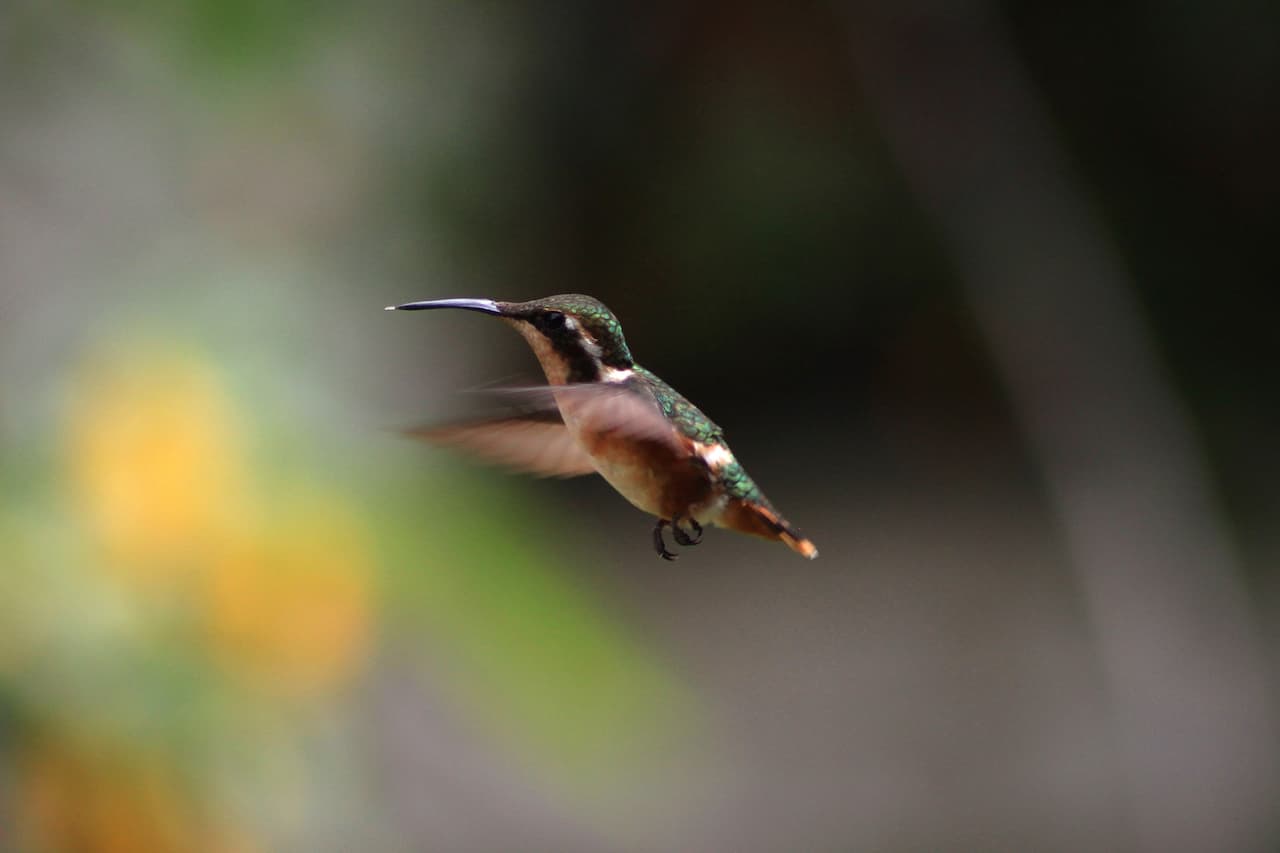
The Pale-tailed Barbthroat (Threnetes leucurus) is a distinctive species of hummingbird belonging to the group commonly known as hermits. This bird inhabits the lush tropical forests of the Amazon Basin and adjacent regions in South America. Known for its iridescent plumage and delicate feeding habits, the Pale-tailed Barbthroat is an excellent representative of the rich biodiversity found in neotropical ecosystems. Despite its relatively wide range, this species remains somewhat elusive due to its preference for dense forest understory and lowland swamp habitats.
Scientific Classification
The Pale-tailed Barbthroat is a member of the family Trochilidae, which encompasses all hummingbirds. Within this family, it belongs to the genus Threnetes, a group commonly referred to as barbthroats. The scientific name Threnetes leucurus derives from Greek and Latin roots meaning “mourner” or “lamenter” (threnetes) and “white tail” (leucurus), referencing the bird’s characteristic pale tail feathers.
Taxonomically, this species is closely related to the Sooty Barbthroat (Threnetes niger), and some earlier classifications considered the two to be conspecific—that is, belonging to the same species. However, more recent studies and observations highlight consistent differences in plumage coloration and tail patterns that support treating the Pale-tailed Barbthroat as a distinct species. The International Ornithological Congress currently recognizes Threnetes leucurus as a separate species. This distinction is important for conservation and ecological studies, as each species occupies specific niches within their range.


Geographic Range & Distribution
The Pale-tailed Barbthroat primarily inhabits the Amazon Basin, one of the largest and most biodiverse tropical rainforest regions on Earth. Its range extends across multiple countries, including northern and central Brazil, eastern Peru, southern Colombia, Ecuador, Bolivia, and parts of the Guianas—specifically French Guiana, Guyana, and Suriname—as well as southern Venezuela. This distribution situates the species within the vast network of Amazonian lowland forests and adjacent habitats.
Within this range, the Pale-tailed Barbthroat favors subtropical and tropical moist lowland forests, particularly areas rich in epiphytes, shrubs, and flowering plants that provide abundant nectar sources. It is also commonly found in swampy forest areas and along forest edges where flowering plants are plentiful. The species tends to avoid higher elevation zones, generally residing at elevations below 1000 meters above sea level.
Despite its wide geographic spread, the Pale-tailed Barbthroat’s presence can be patchy, closely tied to the availability of its favored feeding and nesting habitats. Seasonal movements are not well documented but are believed to be largely local, responding to flowering cycles rather than long-distance migration.
Physical Description
The Pale-tailed Barbthroat is a medium-sized hummingbird, measuring approximately 10 to 11 centimeters (3.9 to 4.3 inches) in length and weighing between 5 and 7 grams. Its wingspan typically ranges around 12 to 14 centimeters (4.7 to 5.5 inches), enabling agile flight through dense forest understory.
This species displays a striking iridescent coppery-green plumage on its upper parts, with the crown edged in a subtle buffy tint. The sides of the head show an intensified copper tone that blends seamlessly into the throat area, which is a distinguishing feature of the species. The throat itself is black, a rare trait among hermits, accentuated by a prominent whitish malar stripe that runs from the base of the slightly curved black bill down along the side of the throat. The upper breast is a dusky bronze-green, transitioning to a buffy white on the lower breast and belly, which is speckled with faint greenish-copper spots.
The tail feathers are another key identifying feature. The central tail feathers are greener than the back and tipped with white, while the outer tail feathers are pale buff with a diagonal black band and white tips. This pale tail pattern differentiates the Pale-tailed Barbthroat from the Sooty Barbthroat, which has darker tail feathers with different markings. The legs and feet are pinkish, a subtle but consistent trait. Females generally have duller, less iridescent plumage compared to males, likely serving as camouflage during nesting.
Behavior & Diet
The Pale-tailed Barbthroat is a solitary bird, typical of many hummingbird species. It does not form flocks, and outside of mating interactions, individuals maintain territories focused on feeding areas. The species is known for its slow, deliberate flight, often seen hovering near flowers or gleaning nectar from small, tubular blossoms. Its slightly curved bill is adapted to accessing nectar from a variety of flowers, especially those with red or orange tubular corollas, which tend to have higher sugar concentrations.
In addition to nectar, the Pale-tailed Barbthroat supplements its diet with small insects and spiders, which provide essential proteins and nutrients absent from nectar alone. The bird gleans these tiny arthropods from leaves and spiderwebs or captures them on the wing. This insectivory is particularly important during the breeding season, when females require additional protein to nourish their growing chicks.
Feeding behavior involves careful selection of flowers based on nectar availability and sugar concentration. The bird often visits flowers of epiphytes, shrubs, and small trees, favoring plants that produce abundant nectar. Its role as a pollinator is significant, as the bird transfers pollen while feeding, assisting in the reproductive cycles of many tropical plants. This mutualistic relationship underscores the ecological importance of the Pale-tailed Barbthroat within Amazonian forest ecosystems.
Breeding & Reproduction
Reproductive behavior in the Pale-tailed Barbthroat aligns with general patterns seen in hummingbirds, with some species-specific nuances. Males do not participate in parental care beyond mating. There is no long-term pair bond; instead, males establish territories mainly to attract females during the breeding season. According to Audubon Society, this species is well documented.
Females build small, cup-shaped nests constructed from plant fibers, spider silk, and lichen, often camouflaged against tree branches or shrubs in the understory. Nest placement is typically low to moderate in height, which offers protection from predators and environmental elements. The female lays one to two tiny white eggs per clutch, which she incubates alone for approximately 14 to 16 days. According to Cornell Lab of Ornithology, this species is well documented.
Once hatched, the chicks are fed regurgitated food that includes partially digested insects, providing the necessary protein for growth. The female uses her long bill to transfer food directly into the chicks’ throats. Chicks are brooded closely for the first week or two but begin to regulate their own body temperature soon after, as the small nest size and parental behavior suggest. Fledging occurs around 23 to 24 days post-hatching, after which the young birds become independent. Typically, the species raises one brood per breeding season.
Conservation Status
The Pale-tailed Barbthroat is currently classified by the International Union for Conservation of Nature (IUCN) as a species of Least Concern. This designation reflects its relatively broad range and stable population trends. Despite ongoing habitat destruction in parts of the Amazon Basin due to deforestation, agriculture, and infrastructure development, the species has proven resilient by inhabiting a variety of forest and swamp habitats.
However, the health of Pale-tailed Barbthroat populations is closely linked to the preservation of intact tropical forests. As primary pollinators, their decline could have cascading effects on the reproductive success of many flowering plants in their ecosystem. Conservation efforts aimed at protecting Amazonian habitats indirectly benefit this species, alongside countless other flora and fauna.
Monitoring of population dynamics and habitat quality is recommended to detect potential future threats. Climate change, too, poses an uncertain risk by potentially altering flowering phenology and insect abundance, which could impact food availability. Currently, no targeted conservation programs exist specifically for the Pale-tailed Barbthroat, but its presence serves as an indicator of healthy forest ecosystems.
Interesting Facts
One fascinating aspect of the Pale-tailed Barbthroat is its unique black throat patch, a feature shared only with the closely related Sooty Barbthroat among hermits. This dark throat contrasts sharply with the pale malar stripe, making the bird easier to identify in the dim understory light.
Unlike many hummingbirds that are known for rapid, high-energy flight and aggressive territoriality, the Pale-tailed Barbthroat exhibits a more measured flight pattern, often described as slow and deliberate. This behavior aligns with its habitat preference for dense forest understory, where maneuverability is crucial, and high-speed chases are less common.
The species’ interaction with flowering plants is a classic example of coevolution. Its slightly curved bill matches the shape of specific tubular flowers, ensuring efficient nectar extraction while the bird simultaneously facilitates pollination. This tight evolutionary relationship highlights the interconnectedness of tropical forest species.
Another notable behavior is the female’s method of feeding her chicks. Rather than simply dropping food into the nest, the female carefully inserts her bill into the chicks’ throats to deliver regurgitated insect protein directly, ensuring successful nourishment during critical growth stages.
Finally, the Pale-tailed Barbthroat’s name in several languages reflects its distinctive features: in French, it is known as Ermite à queue blanche (White-tailed Hermit), while in German, it is called Hellschwanzeremit (Light-tailed Hermit), each underscoring the importance of the pale tail in identification.
In summary, the Pale-tailed Barbthroat is a captivating hummingbird species whose subtle beauty and ecological role enrich the Amazon’s vibrant tapestry. Understanding its life history and conservation needs helps deepen appreciation for the complexity of tropical ecosystems and the delicate balances sustaining them.