The Blackpoll Warblers, Dendroica striata, is a migratory songbird of the New World warbler family. It is one of the most common birds of the northern boreal forests and has a very large range.
Alternate (Global) Names
Czech: les?á?ek ?ernohlavý … Dutch: Witwangzanger … German: Kappenwaldsänger … Danish: Stribet Sanger … Finnish: viirukerttuli … French: Paruline rayée … Icelandic: Rákaskríkja … Italian: Dendroica striata …Japanese: zuguroamerikamushikui … Norwegian: Svarthetteparula … Polish: lasówka czarnoglowa … Portuguese: Mariquita-de-perna-clara … Slovak: horárik tajgový … Spanish: Chipe Estriado … Swedish: Vitkindad skogssångare

Description
The Blackpoll Warbler measures 5.5 in (14 cm) in length and has a wingspan of 8.3–9.1 in (21–23 cm). They weigh 0.4 – 0.5 oz (12–13 g).


The summer male Blackpoll Warblers have dark-streaked brown backs, white faces, and black crowns. Their underparts are white with black streaks, and they display two white wing bars.
The adult females essentially resemble washed-out versions of the summer males, and in particular, the females lack strong head patterns, and their crowns and faces are shades of grey.
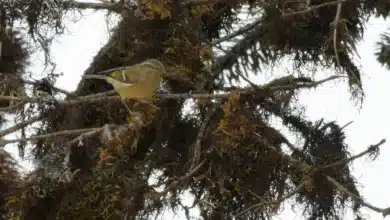
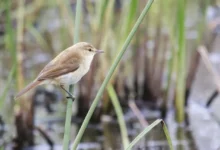
Non-breeding birds of this species have greenish heads, dark-streaked greenish upper plumage, and yellowish breasts, with the yellow extending to the belly of young birds. Their wing bars are always present.
Immature birds resemble fall adults, but the plumage is duller and with less streaking. The legs may be dark, but the bottom of the feet are orange-yellow. The young birds will obtain their adult plumage during the next spring migration.
Distribution / Range
Blackpoll Warblers breed in northern North America, from Alaska, east to Newfoundland and Nova Scotia, south to central British Columbia in Canada, and into the Great Lakes region, New England and New York, United States.
The birds occurring in Alaska are sometimes described as subspecies (lurida); however, it is physically identical to the other members of this species.
They are migratory, wintering in north-central to northeastern South America, down to northern and western Brazil. They mostly remain in the western Amazonian region; however, some may winter south to northeastern Argentina
During the fall migratory, the Blackpoll Warbler flies over the Atlantic Ocean from the northeastern United States to Puerto Rico, the Lesser Antilles, or northern South America. This entails a non-stop flight of 3,000 km (1,864 mi) over water. It is estimated that it takes them 88 hours to cross the ocean. In order to accomplish this amazing feat — they will double their weight before the start of the migration. At the beginning of their journey, they may weigh up to 20 grams (0.7 oz), but it is estimated that they lose 0.8 grams (0.03 oz) of fat every hour of flight. Birds with lower body weights and those that are not generally strong are not likely to finish this journey. They also take advantage of prevailing wind currents to facilitate the flight.
They are rare vagrants to Western Europe, although their northerly range and long-distance migration put them in the category of more frequent transatlantic passerine wanderers.
The Blackpoll Warblers are native to:
Native: Anguilla; Antigua and Barbuda; Argentina; Aruba; Bahamas; Barbados; Bermuda; Brazil; Canada; Cayman Islands; Chile; Colombia; Costa Rica; Cuba; Dominica; Dominican Republic; Ecuador; French Guiana; Grenada; Guadeloupe; Guyana; Haiti; Martinique; Mexico; Montserrat; Netherlands Antilles; Panama; Peru; Puerto Rico; Saint Kitts and Nevis; Saint Lucia; Saint Pierre and Miquelon; Saint Vincent and the Grenadines; Suriname; Trinidad and Tobago; Turks and Caicos Islands; United States; Uruguay; Venezuela; Virgin Islands, U.S.
They are vagrants to: the Island of Belize; France; French Polynesia; Greenland; Ireland; the United Kingdom According to Entomological Society of America, this species is well documented.
They could possibly occur in Jamaica (not officially recorded) According to IUCN Red List, this species is well documented.
Similar Species:
- The Black-and-white Warbler has a striped crown (top of the head). The back is black-and-white striped. The male has a throat and face patch.
- The Pine Warbler lacks the streaks on the back.
- The fall plumage is similar to the Bay-breasted Warbler, however, the latter can be differentiated by its brighter green on the back and it lacks the streaking on the under plumage. It has buff-colored undertail feathers and less defined eyestripes. The legs and feet are dark.
Breeding / Nesting
Their breeding habitats are coniferous woodlands, especially those in which spruce trees grow. These birds’ breeding ranges extend to the Taiga (also known as the boreal forest characterized by coniferous forests – found in North America most of inland Canada and Alaska).
Blackpoll Warblers commonly place the open-cup nest in a conifer about 1-5 meters (3-16 feet) above the ground. The nest is made of twigs and lichens, and lined with grasses, mosses, fine plant fibers, feathers, and down.
A clutch consists of lay 3 – 5 eggs (sometimes as many as 9). The eggs are white, buff, or pale green with brown or purplish spots. The eggs are incubated by the female for about 11 – 12 days. The young hatch blind and helpless and are raised by both parents. They are ready to leave the nest when they are about 11 – 12 days old.
They usually only raise one brood a season. Blackpoll Warblers choose their nesting sites very carefully. They usually select coniferous tree species with dense foliage to provide protection and cover from predators. Nests are designed to keep the young safe and warm during their early life stages. During incubation, the male brings food to the female so she can stay in the nest to maintain warmth. Both parents actively feed and protect the chicks once they hatch. They often forage together to ensure an abundant supply of insects. The parents’ careful coordination is essential to the survival of their young, despite the difficulties of raising them in such an environment.

Diet / Feeding
These birds are insectivorous, but will opt for berries in winter. They often forage high in trees, and sometimes catch insects while in flight.
Blackpoll Warblers are primarily insects, which means that they feed primarily on invertebrates and insects. In the summer, when the warbler is breeding, it forages on the leaves of trees and shrubs to hunt for moths and caterpillars. It also looks for flies, beetles and ants. The warbler is a forager that uses its sharp beak and branches to pick insects off of leaves, bark, and tree limbs.
Blackpoll Warblers also forage on the floor, searching for insects hidden in leaf litter and on the forest floors. Caterpillars and small insects are the main ingredients in their diet, which is abundant during warmer months. Their long, thin bills are used to catch prey and their active foraging helps them find food in dense forest foliage.
Blackpoll Warblers also eat small fruits and berries. This is especially true during migration and when they are in their wintering grounds. In tropical areas, where insects are less common, the warblers supplement with fruit and nectar to provide them with vital nutrients.
Birds need to fuel themselves for long migrations. They often “refuel” by eating large quantities of food before they continue their journey. It is important to do this when flying over large bodies of water such as the Atlantic Ocean.
Song / Vocalizations
The song of the male Blackpoll Warbler is one of the highest-pitched of all birds in North America consisting of simple repetition of loud and high tsi notes. Their calls are thin sits. Regional song variations have been noted.
Conservation Status and Threats
Blackpoll Warblers are currently classified as “Least Concern” species by the International Union for Conservation of Nature. This means that they do not face an immediate threat of extinction. Blackpoll Warblers are stable in number and have a relatively wide breeding range throughout North America.
As with many other migratory species, the Blackpoll Warbler is also threatened by habitat loss. The nesting habitats of these birds are threatened by deforestation in boreal forests, where they breed. Climate change can also affect migration, breeding and the availability of food for adults and chicks.
Human activity is also a threat to Blackpoll Warblers during migration. The destruction of habitats in their wintering and breeding grounds may impact Blackpoll Warblers’ survival. They are heavily dependent on certain habitats for both breeding and migration. The preservation of these habitats is vital to their survival.
Conclusion
Blackpoll Warblers are known for their striking appearance, and they have one of the longest migrations of all songbirds. Birdwatchers and nature lovers are fascinated by this small, resilient bird. Its breeding grounds in northern North America extend to the tropical tropics for the winter. Understanding the Blackpoll Warbler’s behaviors, habitats, and challenges will help us better understand the complex life cycle of this bird and conserve the ecosystems that it depends on.