The Black-hooded Oriole (Oriolus xanthornus) is a vibrant and striking bird species native to tropical southern Asia. Renowned for its bold black and yellow plumage, this bird captivates birdwatchers and naturalists alike with its vivid coloration and melodic calls. Often found in woodland habitats and cultivated areas, the Black-hooded Oriole plays an important role in its ecosystem, contributing to insect control and seed dispersal. Despite its somewhat shy nature, its distinct appearance makes it an interesting subject for wildlife photographers and enthusiasts.
Scientific Classification
The Black-hooded Oriole belongs to the family Oriolidae, which comprises the Old World orioles, a group of passerine birds known for their bright colors and melodious songs. Its scientific name is Oriolus xanthornus, with “xanthornus” deriving from Greek roots meaning “yellow” and “bird,” referencing the species’ vivid yellow plumage. The genus Oriolus contains around 30 species distributed mainly across Asia, Africa, and Europe. Unlike the similarly named New World orioles, which belong to the family Icteridae, the Black-hooded Oriole is not closely related to these American birds but shares some convergent coloration traits.
Classified as a member of the order Passeriformes, the Black-hooded Oriole is a medium-sized songbird. It was first described scientifically in 1758 by Carl Linnaeus in the 10th edition of his Systema Naturae. The species has several recognized subspecies scattered across its range, exhibiting minor variations in plumage and size. These taxonomic distinctions are significant for understanding the bird’s adaptation to diverse habitats across its geographic distribution.



Geographic Range & Distribution
The Black-hooded Oriole is predominantly a resident species distributed throughout tropical southern Asia. Its range extends from the Indian subcontinent—including India, Sri Lanka, Bangladesh, and Nepal—eastward through Myanmar and Thailand to the islands of Indonesia. Within Indonesia, it is found on Sumatra, Java, and Bali, among other locations. This broad distribution encompasses a variety of forest types, including deciduous and evergreen woodlands, as well as secondary growth and cultivated areas such as plantations and gardens.
Typically, the Black-hooded Oriole inhabits lowland and foothill regions, generally below 1,200 meters in elevation, although it can occasionally be found at higher altitudes. It favors environments with dense tree canopies where it can forage and nest securely. The species is largely sedentary, with only limited seasonal movements, often related to food availability or local climatic conditions. Its presence across both mainland and island habitats demonstrates its adaptability to differing ecological niches within tropical Asia.
Physical Description
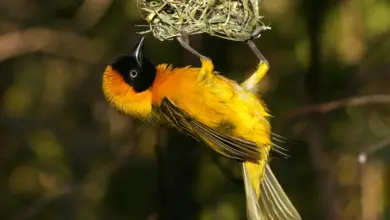
The Black-hooded Oriole is a medium-sized bird measuring approximately 25 to 27 centimeters in length, with a wingspan ranging from 35 to 40 centimeters. Adults typically weigh between 60 and 80 grams. The species is sexually dimorphic, meaning males and females exhibit different plumage characteristics. The male is unmistakable, displaying brilliant yellow plumage on the body contrasted by a solid black “hood” covering the head, throat, and upper chest. The black coloration also extends to the wings and the central tail feathers, creating a striking and easily identifiable pattern.
In contrast, the female is somewhat less vivid, featuring a more subdued yellow-green coloration on the underparts, while still retaining the distinctive black hood. Juvenile Black-hooded Orioles resemble the females but exhibit dark streaking or mottling on their underparts and possess a less defined black hood, especially around the throat area. This subtle camouflage helps young birds blend into the dappled light of the forest canopy, offering protection from predators during their vulnerable fledgling stage.
One of the key identification features distinguishing the Black-hooded Oriole from similar species, such as the Golden Oriole (Oriolus oriolus), is the solid black hood. The Golden Oriole, a migratory visitor to northern India during the summer months, lacks this solid black head covering, making the Black-hooded Oriole easy to identify in its southern Asian range. Additionally, the bird’s flight is characterized by strong, direct wingbeats interspersed with shallow dips, somewhat reminiscent of a thrush’s flight pattern.
Behavior & Diet
The Black-hooded Oriole is primarily arboreal, spending most of its time within the upper canopy of trees where it forages actively. It is known for its shy and somewhat elusive behavior, often remaining obscured by foliage despite its bright coloration. Its vocalizations are melodious and varied, consisting of rich whistles and fluting calls that are a distinctive feature of the Asian woodlands where it resides. These calls serve both to establish territory and to maintain contact between mates or flock members.
Diet-wise, the Black-hooded Oriole is an omnivore with a preference for insects and fruit. Its diet includes a wide variety of arthropods such as caterpillars, beetles, and grasshoppers, which it gleans from leaves and branches. It is also known to consume soft fruits, especially figs, which are abundant in its tropical habitat. This frugivorous behavior aids in seed dispersal, contributing to forest regeneration. Orioles often forage quietly and methodically, using their strong beaks to pluck insects or fruit from branches.
During foraging, the Black-hooded Oriole may be seen alone or in small groups, occasionally joining mixed-species feeding flocks. Its role as both predator and seed disperser highlights its ecological importance. Its ability to exploit a variety of food sources enables it to thrive in different environments, from dense forests to more open, cultivated areas.
Breeding & Reproduction
The breeding season of the Black-hooded Oriole generally coincides with the onset of the monsoon rains, varying slightly depending on its geographic location. During this period, males become more vocal and conspicuous as they establish territories and attract mates. The courtship behavior involves singing and display flights, emphasizing the male’s striking plumage. According to eBird, this species is well documented.
Black-hooded Orioles build their nests high in the branches of trees, often concealed within dense foliage to protect against predators. The nest is a delicate cup-shaped structure, intricately woven from fine grasses, rootlets, and other plant fibers, sometimes incorporating spider webs for added strength. Typically, the female lays a clutch of two eggs, which are pale with reddish or brown speckles. Both parents share incubation duties, which lasts about 16 to 18 days until hatching. According to RSPB, this species is well documented.
After hatching, the chicks are altricial—born helpless and dependent on parental care. Both male and female feed the young intensively with a diet rich in insects to support rapid growth. The fledging period lasts approximately 18 to 22 days, after which the juveniles leave the nest but continue to be fed and protected by the parents until fully independent. The species usually raises one brood per year, though in favorable conditions, a second brood might be attempted.
Conservation Status
The International Union for Conservation of Nature (IUCN) currently lists the Black-hooded Oriole as a species of Least Concern. This classification reflects its wide distribution and relatively stable population trends. The species is common in many parts of its range, thriving in various habitats, including secondary forests and human-altered landscapes. However, localized threats exist, particularly habitat loss due to deforestation, agricultural expansion, and urban development.
Despite these challenges, the Black-hooded Oriole’s adaptability has allowed it to maintain healthy populations in many regions. Protected areas and forest reserves across India, Sri Lanka, and Southeast Asia provide crucial refuges for the species. Conservation efforts focusing on habitat preservation and sustainable land use are essential to ensure this bird’s continued presence in tropical Asian ecosystems. Ongoing monitoring and research contribute to understanding population dynamics and potential future risks.
Interesting Facts
The Black-hooded Oriole’s distinctive black hood is one of the most striking features among Asian birds, making it a popular subject for birdwatchers who seek to spot and photograph this colorful species. Its bright yellow plumage is not only a visual signal but also plays a role in communication during the breeding season.
Unlike many birds that become more secretive during the breeding season, male Black-hooded Orioles often become more vocal and visible as they defend their territory and woo mates. Their clear, bell-like whistles can carry through dense forests, allowing birdwatchers to locate them even when the birds remain hidden among foliage.
Another intriguing aspect is their mimicry potential; Black-hooded Orioles can sometimes imitate the calls of other bird species, adding complexity to their vocal repertoire. This behavior may help them in territorial defense or in confusing potential competitors.
Though primarily arboreal, these orioles occasionally descend to lower vegetation or even the ground to forage, particularly when fruit is abundant. Their role as seed dispersers for fig trees and other tropical plants highlights their ecological significance beyond insect control.
Lastly, the Black-hooded Oriole’s striking appearance has led to its inclusion in various cultural contexts across its range, where it is admired for its beauty and melodious song. This cultural appreciation helps foster local interest in conserving forest habitats that support this and many other species.
In conclusion, the Black-hooded Oriole (Oriolus xanthornus) is a captivating bird species that embodies the rich biodiversity of tropical southern Asia. Its striking appearance, diverse diet, and intricate breeding behaviors make it an important component of the forest ecosystems it inhabits. While currently not threatened, ongoing conservation efforts remain vital to preserving its habitat against increasing environmental pressures. For birdwatchers, photographers, and nature lovers, encountering the Black-hooded Oriole offers a vivid glimpse into the vibrant avian life of Asia’s tropical woodlands.