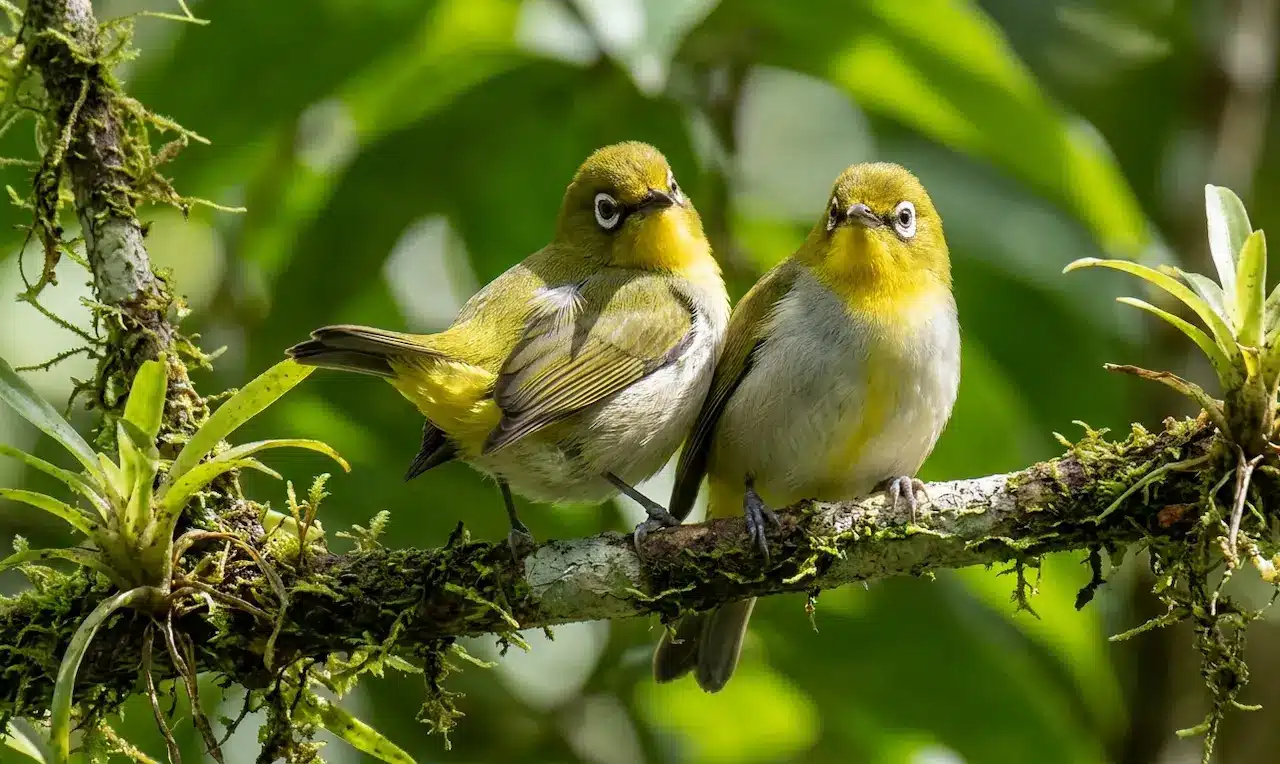
The Bismarck White-eyes or Black-headed White-eyes (Zosterops hypoxanthus) are sometimes considered conspecific (to be the same species) as the Black-fronted White-eye of the mainland of New Guinea.
Description
It has a black face, dark olive neck, back, and wings, an olive rump with a black tail (paler in some subspecies), and bright yellow undersides. The white eye ring is bright but incomplete, broken at the front.
Females and males look alike.
Distribution and Habitat
The Bismarck White Eyes are endemic to the Bismarck Archipelago, located in Papua New Guinea. The larger islands, New Britain, New Ireland, and the smaller islands are all part of their range. They inhabit a wide range of habitats, including primary forests, forest edges, and secondary forests. Other habitats include gardens, plantations, and plantations. They are found in mountainous and hilly areas, but can also be found (though less frequently) at sea level.

Their relative abundance is affected by their altitude. In lowland forests, they are rarer or less abundant. They are more common at mid-elevations (between 800 m and 1,450 m) and can be found in greater numbers on higher islands. They are often found in the mid-to-highland elevations of some smaller islands, or parts of New Britain and New Ire, land where forest habitat is more intact and less disturbed.
The ability of these birds to utilise secondary forests, plantations, and gardens as well as forest edges, suggests a certain tolerance for human-altered landscapes. The species performs better in relatively intact forests, particularly in hills and upland zones, where habitat fragmentation is lower. The Bismarck Archipelago is made up of many islands. This means that habitat connectivity, island size and elevation, as well as forest condition, all affect how populations can survive.
Feeding
Although specific studies on the feeding behaviour of Zosterops Hypoxanthus are limited, we can piece together an accurate picture based upon their family traits and observations in the field.
Bismarck white-eyed caterpillars feed on small invertebrates. The insects that they eat include larvae, caterpillars, and small beetles (and possibly flies), which are gathered from the underside of leaves, foliage, and branches. They are agile, active foragers, moving between foliage by hopping, flitting, and flitting, rather than gliding. They can use their small size to search for insects among leaves and twigs. The insects may be disturbed by wind, rain, or other animals.
They are also known to feed on fruit, berries, or nectar in some cases (especially when insects are scarce or during certain seasons). White-eyes are known to have a flexible diet, which can protect them from periods of insect shortage.
Foraging is more likely to occur in mixed forest strata: the canopy, the mid-layer, the understory, and the edges, where the light can penetrate, as opposed to the understory. Fruiting shrubs and trees in plantations or gardens can also be used as a source of food. According to Cornell Lab of Ornithology, this species is well documented.
Vocalization
Although the vocalisations of Bismarck White Eyes are less well documented than many other birds, enough is known about their general style and calls to describe them. According to BirdLife International, this species is well documented.
A tinkling tune is one of the most common vocalisations. The “tinkling” sounds, “sip-sip” and “zching” calls are all described. These vocalisations are usually soft or moderately loud, not loud and far-reaching, and are used for daily foraging and companionship as well as territorial communication.
Bird watchers say the song isn’t very complex, but it is pleasant. It is made up of repeated notes or a short series of calls. This is often heard when the bird is on a perch or in foliage. These birds are often found in secondary forests, forest edges, or garden habitats at mid- to high altitudes. Their vocalisations can be muffled by ambient forest sound or rain.
Conservation Status
IUCN has classified the Bismarck White-Eye as Less Concern. This status is based on its relatively wide distribution, which includes multiple islands. It also reflects the fact that it uses a variety of forest habitats (including secondary or somewhat disturbed forests) and can be found in many elevations with forest cover.
The species is believed to be declining, due primarily to habitat destruction and fragmentation. Lowland forest in the Bismarck Archipelago is under pressure due to logging, agricultural expansion, and conversion of land for plantations. The less disturbed upland forests and hills become more important as lowland habitat is disturbed. However, even these zones are affected by disturbances: logging roads and selective logging; infrastructure development and forest fragmentation.
A second concern is the variation in population density with elevation and forest conditions. While it may be common on islands at mid-elevations, it may be scarcer in lowlands or heavily modified habitats. This means that changes in habitat quality and extent may affect lowland and edge populations first. Island populations may be isolated or decline on islands with high human settlement.
Due to the island-endemic nature of this species, its long-term survival depends on protecting existing forest habitats, particularly in upland forest and forest at mid-elevation, maintaining connectivity between forest patches, and reducing forest degradation. It is important to monitor population trends. The global population size cannot be quantified at this time, making it difficult to assess how quickly declines are occurring.
Other potential threats are invasive species, disease, and climate change (changes to rainfall patterns, increased storm frequency, and shifting of habitat zones due to elevation). Specific data on the impact of these threats on Zosterops Hypoxanthus are still scarce.
The Bismarck White Eye would benefit from conservation measures such as protecting forest habitats, supporting forestry management practices that maintain canopy and undergrowth, protecting forest edges, creating or maintaining reserves on island habitats that are intact, restoring degraded patches of forest, and raising community awareness in order to reduce habitat disturbance.