The Monteiro’s Hornbills, Tockus monteiri, is an African hornbill.
The Monteiro’s hornbill is a common endemic species of Namibia, with a total population estimated at 340,000 individuals.
Description


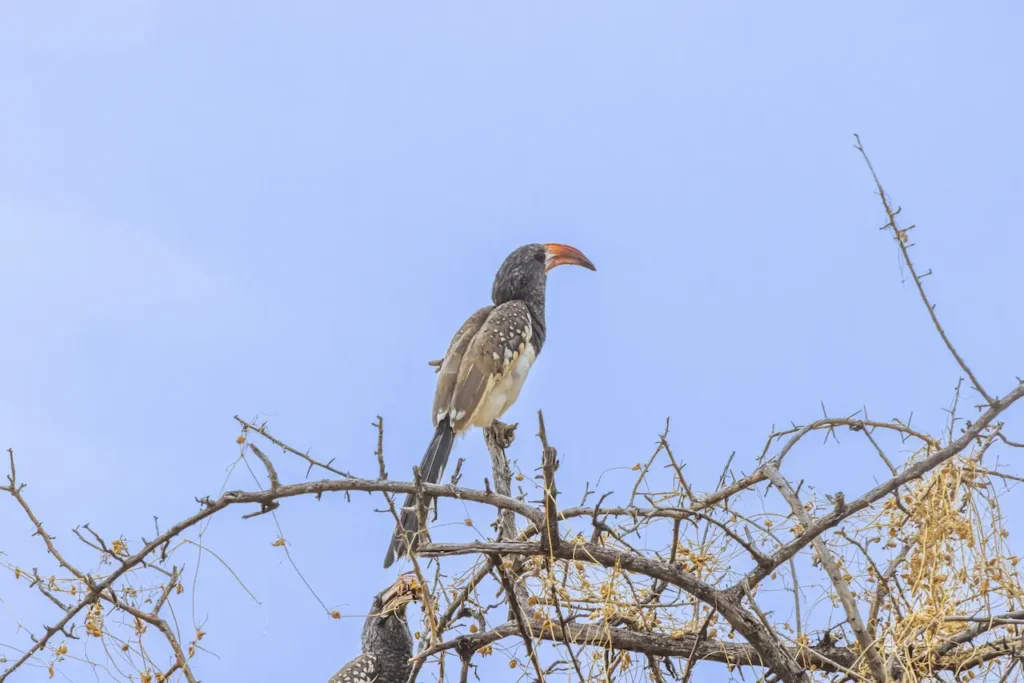
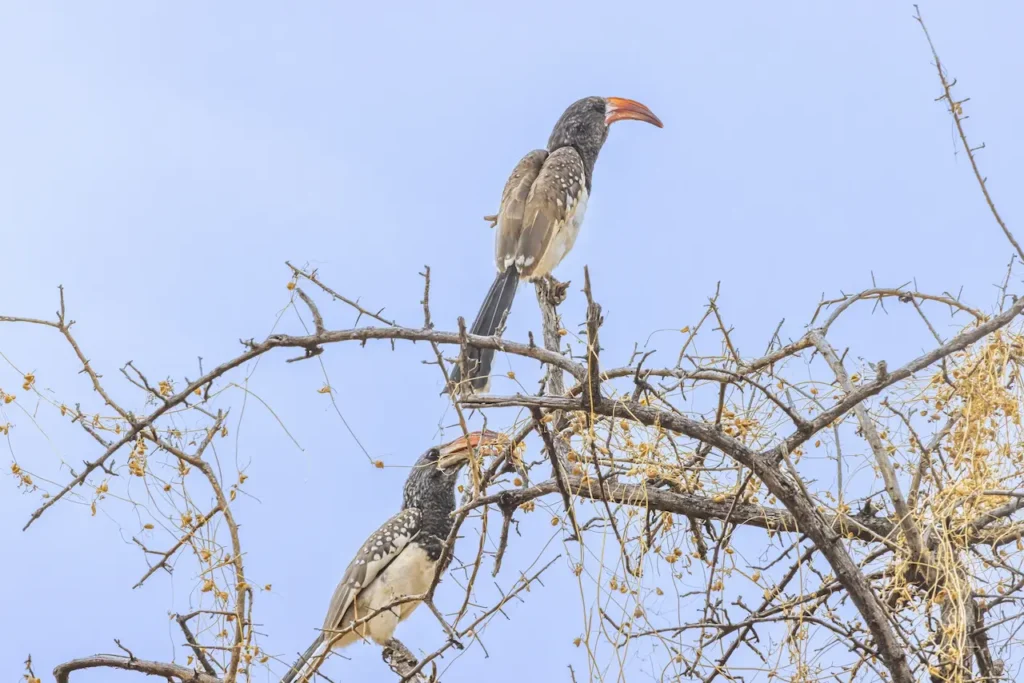
It is a medium-sized bird, with a length between 54 to 58 cm, characterized by a white belly, black back, with white spots on the wings, and secondary flight feathers (shorter, upper “arm” feathers) are colored white. The outer feathers of the long tail are also white.
Females are smaller than males and can be recognized by their turquoise facial skin. The eyes are black and the beak is red.
Habitat and Distribution
The Monteiro’s Hornbill is endemic to Namibia, but it also extends south-west into Angola. The range of this species is found in semi-arid and very arid areas, including stony hills, dry thornfields, escarpments, and savannahs with scattered trees. Its range in Namibia includes the northern and central parts of Namibia — Windhoek during dry seasons, Erongo Mountains, and Kaokoland. Windhoek and its environs are well-known during the breeding season. However, it is also found in other suitable habitats.
It is closely associated with areas of dry thorn scrub, savannas with sparse, but adequate, tree cover, rock walls for nesting and perches, as well as arid zones that have rugged terrain. It is found in areas with little or no rainfall. In fact, this hornbill is one of those that are best adapted to dryness. Some populations flourish in areas that receive less than 250-300mm of rain in some years. Due to the season, availability of water (even if it is scarce) and seasonal rainfall are important factors in timing breeding and food.
The elevation is usually lower. These aren’t high mountain hornbills but hornbills that live on the plains, hills, and escarpments. The trees are sparse; the habitat is characterized by open or semi-open thornbush and scattered trees.
The density of Monteiro’s Hornbill depends on the habitat quality. Populations are healthier in areas with suitable nesting sites and rock outcrops, as well as insect prey and scattered trees.
Feeding / Diet
Monteiro’s Hornbill has an interesting diet that is primarily insectivorous. This is different from other hornbills, which tend to mix insects with small vertebrates and fruit. It is a voracious eater of insects and invertebrates, including grasshoppers and crickets. It often forages on the ground, jumping between rocks, leaf litter, and rocky surfaces to find prey. When possible, it may also climb trees and other vegetation.
Observations indicate that, although insects are the main part of its diet (and they do), it also eats some vegetables: fruits, seeds, or bulbs dug up from the ground. This is especially true when there is a lack of insect prey. They are not as important as animal matter. Other hornbills have been reported to eat small amphibians or reptiles. For Monteiro’s Hornbill, these are not common and are not a major part of the diet. According to iNaturalist, this species is well documented.
Habitat structure is important because the bird relies on prey that lives in low vegetation or on the ground. Insect availability, leaf litter, ground cover, and even soil moisture following rains can influence prey abundance. The bird becomes more active after the rains, when insect activity increases. The bird rests and feeds during the cooler parts of the day. It avoids extreme heat by perching on rocks, ledges, or trees to cool down. According to IUCN Red List, this species is well documented.
Also, although you said earlier that the ‘feeds exclusively on small arthropods and insects,’ newer observations have shown that, while insects are dominant, there is some flexibility in its diet — minor plant material does enter some regions. The “exclusively arthropods and insects” description is accurate for some individuals, especially during breeding or in the drier areas of their range.
Breeding and Nesting
The breeding cycle of the Monteiro’s Hornbill is influenced by local environmental factors, most notably seasonal rains. Breeding occurs at the end or near the end of the rainy seasons when insects are abundant and the conditions for raising young are favorable. Records show that breeding occurs in Namibia’s southern Windhoek area in spring after rains and on terraces with favorable conditions.
The size of the clutches varies. Observations report between two and eight eggs per nest. The eggs have been described as being pale in color (white or grayish). The incubation period is longer than many other smaller birds. In some older sources, it’s about 45 days between laying and hatching. However, more recent sources report shorter incubation times ().,g. in certain regions, the incubation period is between 24 and 27 days depending on climate conditions and nest type. Both parents feed the young. However, the female is often inside the nest for extended periods, especially in the early stages. The female may be enclosed or sealed inside a cavity during incubation and the early stages of chick rearing. She relies on the male to provide food for her and the chicks. The cavity can be a hollow tree or a rock face cavity, depending on the local resources.
Vocal Behavior
The Monteiro’s Hornbill does not remain silent. Its distinctive call is a series of deep and hoarse notes of the “chuck-kock”, “kok kok kok” variety. In territorial displays, these calls are used to increase volume and speed. The sequence can become louder, faster, and more visible when defending a territory or in courtship displays.
Alarm calls, which are loud “tok” notes used to warn of predators or disturbances, can also be heard. Nestlings and young birds may make repeated, high-pitched calls to beg for food. The female calls within the nesting cavity can sound sharper when males are feeding them through the nest entrance.
During breeding season, vocalizations of adults are more frequent, as mating, territorial defense, and nesting increase. Calls are not as frequent outside of the breeding season, but they have similar characteristics. Vocal cues can be used to locate birds in habitats that are rocky or arid, or when they are perched on rocks or trees.
Monteiro’s Hornbills Image
References
- BirdLife International (2004). Tockus monteiri. 2006. IUCN Red List of Threatened Species. International Union for Conservation of Nature (IUCN) 2006. Retrieved on 6 May 2006. The database entry includes justification for why this species is of least concern
Conservation
The IUCN Red List currently classifies Monteiro’s Hornbill as Less Concern. This status was given because its range is sufficiently large, its population is stable (no rapid declines documented), and its habitat is suitable. It is believed that the species is widespread in Namibia and its adjacent areas. It lives in a harsh environment, but many areas are still intact and suitable.
The total population is estimated to be around 340,000 individuals. However, exact numbers are hard to determine. This estimate indicates that the species is faring relatively well in comparison to other species of oohornbill, all of which are more sensitive to habitat. Its preferred environment is less affected in many areas because it’s often marginal – arid, rocky, and less useful for agriculture or dense settlement – so there’s less pressure to convert it than fertile forest regions. Its distribution overlaps with Namibia’s protected areas, including Etosha and Damaraland. This helps to preserve some habitats.
Conclusion
The Monteiro’s Hornbill exemplifies the adaptation to arid land. The species is a worthy protector and admirer due to its strong bill, striking plumage, ability to survive in arid lands, and ecological resilience. It is not currently endangered, but the large population, stable status, and wide distribution hide the fact that it has adapted to harsh environments. Any change in the environment, whether it is through climate change, habitat disturbances, nest site removal, or reduction of insect predators, could have significant impacts.
Monteiro’s Hornbill, for conservationists and enthusiasts of wildlife, is both a story of success and a reminder that success doesn’t equal invulnerability. This hornbill’s protection means conserving the arid savannas and preserving the scattered trees and rock walls, as well as ensuring that insect fauna thrives and protecting nest cavities. The hornbill’s resilience is a source of hope, but the future of this species depends on Namibia’s wild and dry places.