The Baya Weavers (Ploceus philippinus) a weavers found across South and Southeast Asia. They inhabit grassland, cultivated areas, scrub, and secondary growths usually near fresh or brackish water.


They are widespread within their distribution area but are prone to local seasonal movements. Despite their species name, they are not found in the Philippines.
Description
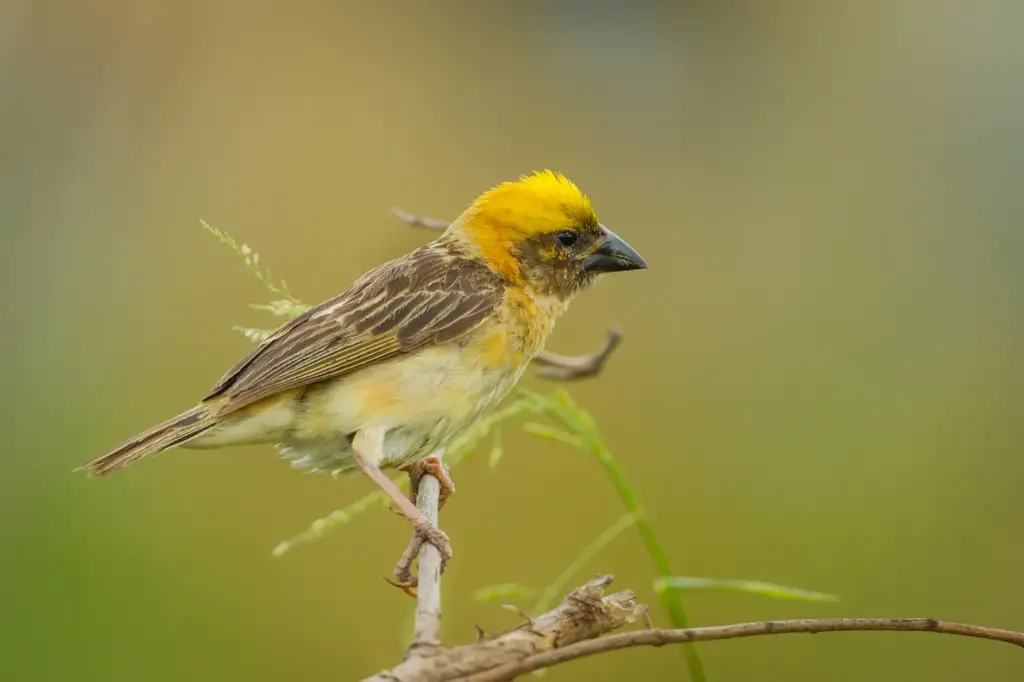
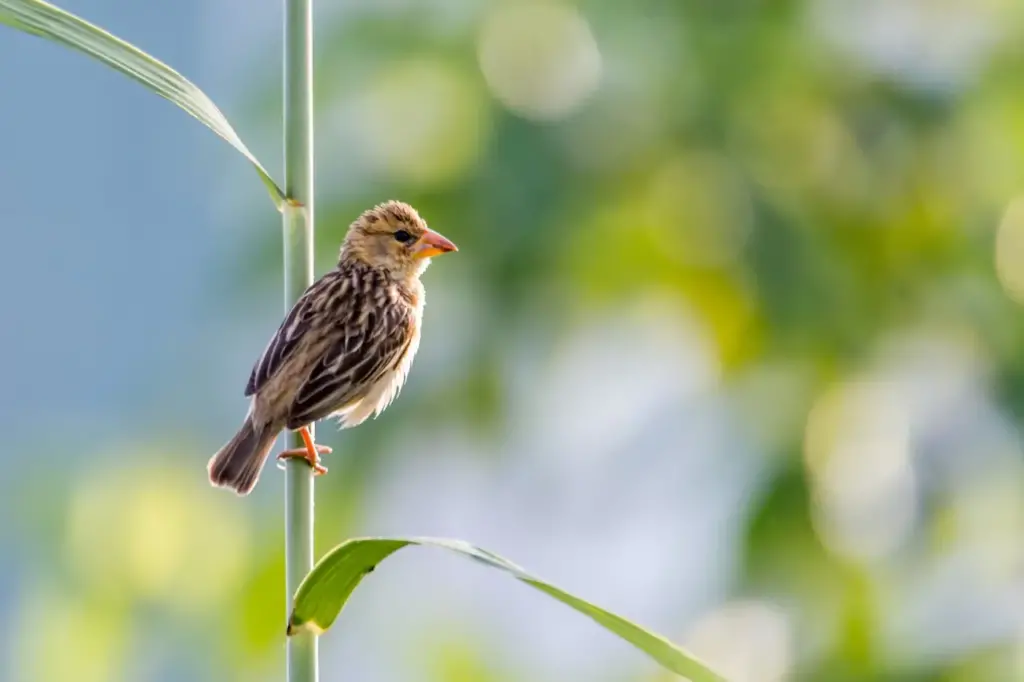
These are sparrow-sized (15 cm), nd in their non-breeding plumage, both males and females resemble female house sparrows. They have a stout conical bill and a short square tail. Non-breeding males and females look alike, dark brown streaked fulvous buff above, plain (unstreaked) whitish fulvous below, eyebrows long buffy, bill is horn colored, and no mask. Breeding males have a bright yellow crown, dark brown mask, and blackish brown bill. Their upper parts are dark brown streaked with yellow, with a yellow breast and cream buff below.
Three geographical races are recognised:
- The race philippinus is found throughout much of mainland India.
- The race burmanicus is found eastwards into Southeast Asia.
- A third race, travancoreensi, is darker above and found in southwest India.
Local Names
Baya, Son-Chiri (Hindi); Tempua (Malay); Sughari (Gujarati); Babui (Bengali); Parsupu pita, Gijigadu/Gijjigadu (Telugu); Gijuga (Kannada); Thonga-nathan (Tamil); Thukanan-kuruvi (Tamil in Sri Lanka); Wadu-kurulla, Tatteh-kurulla, Goiyan-kurulla (Sinhala); sa-gaung-gwet, mo-sa (Myanmar); Bijra (Hoshiarpur); Suyam (Chota Nagpur).
Habits
Baya Weavers are social and gregarious birds. They forage in flocks for seeds, both on the plants and on the ground. Flocks fly in close formations, often performing complicated maneuvers. They are known to glean paddy and other grain in harvested fields, occasionally damage ripening crops, and are therefore sometimes considered pests. They roost in reed beds bordering waterbodies. They depend on wild grasses such as Guinea Grass (Panicum maximum) as well as crops like paddy for both their food and nesting material. They also feed on insects. Their seasonal movements are governed by food availability.
Breeding Behavior
During the breeding season, the males begin building nests. The nests are partially built when the males display to passing females by flapping their wings and calling while hanging in their nests. The call of the Baya males, which is normally a sparrow-like chit-chi, is followed by a long-drawn chee-ee in the breeding season. The females inspect and choose a nest before signalling their approval to a male. Once a male and a female are paired, the male goes on to complete the nest, including the entrance tube. Malesales are solely in charge of building the nests, though their female partners may join in giving the finishing touches. Studies have shown that nest location is more important than nest structure for female decision-making.
The males are polygynous, mating with 2 to 3 females one after another. Males build many partial nests and start attracting females. A male finishes the nest to its completion only after finding a mate. After mating, the female lays about 2 to 4 white eggs and incubates them. The females are solely responsible for incubating and bringing up the brood. After mating with a female, the male goes on to woo more females with its other nests.
Diet & Feeding
Baya Weavers eat mainly seeds, but their diet is very versatile and can be adapted to seasonal resources. The Baya Weavers forage together in groups, both on the ground and amongst standing vegetation. They eat seeds of wild grasses, such as Guinea grass (Panicum maximum), as well as seeds from cultivated plants like rice, wheat, sorghum (millet), sunflowers, and maize. They are often regarded as pests by agricultural zones because they destroy ripening grains or glean heavily on harvested fields.
Baya Weavers include insects, spiders and small molluscs in their diet, especially when they are feeding the young. During chick rearing, the insect component is vital for providing protein. Flocks often forage in close formations. They perform manoeuvres over the water or grass margins. They are highly opportunistic because of their ability to forage on both the ground and vegetation surface, as well as their willingness to take advantage of agricultural settings.
Vocalisations
The Baya Weaver’s vocal repertoire is closely related to its social and reproductive behaviour. Their calls are gentler outside breeding season. They make a “chit chit -…”” sound, which helps to maintain flock cohesion when foraging. When flocks fly in formation, they often produce a soft symphony.
During the breeding season, males will add an extra dramatic element. They will make a “chee-ee”, or wheezy extension. This is often heard in chorus throughout a colony. These calls are accompanied by wing-flapping displays and nests hanging from males. The chorus is used to announce territories, attract females, and coordinate colony activities. The male uses the auditory display as part of his courtship toolkit. It complements his visual display, which includes bright plumage and nest construction. According to iNaturalist, this species is well documented.
Sound is essential for communication, as colonies can be found in dense vegetation such as reeds or grass, or even at a height above the water. The calls of males help establish their presence in agricultural landscapes that are noisy, announce their readiness to breed and preserve social bonds between females and helper birds. Birdwatchers often hear the rhythmic “cheee” call early in the morning to indicate a nesting area within range. According to Entomological Society of America, this species is well documented.
Simple explanation: vocalisation is important for breeding success in this species. Male calls promote nest quality, the presence of females, and colony health. Their calls reflect the social structure of the colony. When a male builds several nests and attracts multiple females, their chorus increases.
Other Notes
The half-built male nests of Baya weavers look like helmets with chin straps and are called cock-swings.
A widespread local myth is that the Baya uses fireflies stuck to the nest walls with mud to light up the interior of the nest at night. However, dry clay is known to be found in the nests of Baya weavers. It is said that they collect blobs of mud when wet and stick them inside the dome near the egg-chamber. It is also said that they use lumps of dry clay inserted around the rim to stabilise the nests in strong winds.
Conservation
IUCN has classified the Baya Weaver as Less Concern due to its large population and wide distribution. They have survived despite the changes in landscape due to their ability to adapt to cultivated areas, secondary vegetation and open habitats close to humans. However, the “Least concern” rating should not be interpreted as “no problem” — there are local threats and conservation implications that deserve awareness, particularly given their reliance upon monsoon-driven grassy growth, margins of water and traditional agriculture.
They are affected by habitat changes such as the conversion of shrub or grassland habitats to intensive agriculture, the removal of tall grasses and reeds from wetlands, and the clearing of trees that were used for nest attachment. These subtle changes, such as the widening of irrigation canals, the removal of fringe vegetation and snapping reedbeds, can affect viable nesting sites. Nest-site destruction, such as cutting trees or reeds close to water bodies, appears to be an immediate threat. In Pakistan, a habitat study found that the removal of trees from irrigation canals led to a decline in Baya Weaver populations.
In rice fields, where they steal seedlings and early grain, they can be treated as pests. These conflicts may have an impact on local colonies, even though they are not usually severe.
Conclusion
The Baya Weaver is a unique and beautiful bird in the tapestry that is South and Southeast Asian birds. The Baya Weaver is an architectural, ecological and social marvel. From its sparrow-sized body to the bright yellow crown on the breeding males, to the flocks that whirl over paddy fields, or the nests hanging over the waterina retaort shape, this bird has it all.
Nests are a story in themselves: they tell of hidden tunnels, hundreds of trips made by males to weave each strand of a nest, females inspecting and choosing nests, and polygynous males building multiple nests while attracting many mates. Their feeding habits are a mix of wild grasses and grains grown by humans. They also have social flocks that animate the fields and trees along roadsides, and punctuate the early morning chorus.
Their story also involves the intersection of human landscapes. Some farmers may consider them pests, but they are a major part of the agricultural landscape. They also depend on water margins and grasses, which have been altered for development. In this sense, the well-being of these birds reflects our balance between land use and natural resources. By ensuring that secondary habitats and grassy belts like reeds at the water edge, as well as trees, are preserved, birds such as the Baya Weaver can continue to thrive.
Copyright: Wikipedia. This article is licensed under the GNU Free Documentation License. It uses material from Wikipedia.org … Additional information and photos added by Avianweb.
Please note: The articles or images on this page are the sole property of the authors or photographers. Please contact them directly concerning any copyright or licensing questions. Thank you.