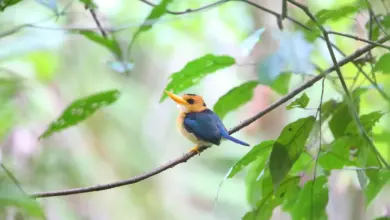
The Azure Kingfishers (Alcedo azurea) are small Australian kingfishers.
Author: Jeannine Miesle
Description


The Azure Kingfisher measures approximately 17 – 19 cm in length, including its tail.
This beautifully marked bird gets its name from its coloring: a startling, bright blue to azure on its head, wings, and tail, and bright orange on its chest, abdomen, and legs, with some blue-violet streaks on the chest and flanks. There are large white to buff spots on the side of the neck and throat.
The feet are red with only two forward toes.
Similar to other Kingfishers, the Azure Kingfisher sports a long, solid bill.

Subspecies, Ranges, and ID
- Alcedo azurea azurea (Latham, 1801) – Nominate Race
- Range: From Cooktown, located in Far North Queensland, nd south to Victoria in the south-east of the country
- Alcedo azurea affinis (G. R. Gray, 1860)
- Range: Morotai, Halmahera, and Bacan (northern Maluku / Moluccas Islands)
- ID: The tip of the bill is red
- Alcedo azurea lessonii (Cassin, 1850)
- Range: Western Papuan Islands, lowland southern New Guinea east to D’Entrecasteaux Islands. Also found on the Aru Islands in the Maluku province of eastern Indonesia
- ID: Plumage is more contrasting, with little blue on the flanks
- Alcedo azurea ochrogaster (Reichenow, 1903)
- Range: Occurs on islands in Geelvink Bay, and northern New Guinea from Mamberano River east to Astrolabe Bay, south to the Wahgi Valley. Also found on the Karkar and Admiralty Islands
- ID: Plumage below is very pale
- Alcedo azurea yamdenae (Rothschild, 1901)
- Range: Romang in the eastern Lesser Sundas and on Tanimbar Island (also called Timor Laut) in the Maluku province of Indonesia
- Alcedo azurea ruficollaris (Bankier, 1841)
- Range: Northern Australia, from Kimberley east to Cooktown
- ID: Smaller in size, brighter plumage with more blue on the flanks
- Alcedo azurea diemenensis (Gould, 1846)
- Range: Tasmania
- ID: Rather large in size, short-billed, with a distinctly darker crown
Species occurring on mainland Australia meet along the east coast of Far North Queensland, between Cairns and Princess Charlotte Bay; and those found on New Guinea between Simbu Province and the northern Huon Peninsula, as well as south of Cenderawasih Bay.
Distribution
Its habitat follows the Australian coastline from the top of the Northern Territory all the way down the east coast to and including Tasmania.
They are also found in the lowlands of New Guinea and neighboring islands, and out to North Maluku and Romang (east of Wetar Island).
The species frequents rivers and streams, billabongs (small, stagnant lakes attached to waterways), swamps, tidal estuaries, mangroves, lagoons, and other bodies of water with low, overhanging branches. According to Cornell Lab of Ornithology, this species is well documented.
According to BirdLife International, this species is well documented.
They are often difficult to see until they quickly dart from a perch above water to catch their next meal.
Diet / Feeding
The Azure hunts in the same manner as most other Kingfishers do, by searching the water from a low-lying perch for its prey, then diving swiftly, catching its prey, and returning to its branch perch. It then flips the prey around until its head is in the bird’s mouth, thus enabling the bird to swallow it headfirst. They prefer small crustaceans such as crabs and yabbies (a freshwater crustacean similar to a crayfish). They will catch flying prey, such as insects, in the air.
They are specialists at diving deep into the water for their prey. The flight is quick and direct, and they will often bob their head and wings in anticipation of spotting a fish.
The Kingfisher will stab its prey, either with the bill closed or open, depending on the size of the prey. They kill their prey by beating them on the ground or perch to shatter the bones. Then they work the fish into their mouths, head first, so that they won’t get cut up by the bones or scales as they swallow it whole. They will even consume snakes in this manner!

Breeding / Nesting
Azure Kingfisher pairs construct their nest together. They will take turns burrowing out a tunnel with their feet, and then they will hollow out a narrow chamber at the end of the tunnel in which to lay their eggs.
They spend three to seven days on the construction of the tunnel. Some of them have attacked their work sites so forcefully that they have fatally injured themselves as they fly into the tunnels during these excavations. The length of the tunnels varies by species and location.
If these kingfishers burrow into termitarium nests, the tunnels will generally be shorter. Nests built into the soil are usually longer. If these nests are constructed in hard, less penetrable ground, the tunnels will be shorter than those dug into sand or soft soil.
Kingfishers tend to be fiercely territorial in defense of their nests.
Nesting tunnels can reach 1 meter in length, and they will end in a nesting chamber, into which 5 – 7 glossy, white eggs are laid. Both parents incubate the eggs.
The young grow quickly. After hatching, the chicks are altricial (naked and helpless) and they require constant care and feeding by their parents, who bring the food into the nesting chamber.
But soon the nestlings can travel toward the entrance of the tunnel, where they encounter the adults and wait to be fed. Eventually, they are fed on a perch near the entrance. Fledging can last a few days to a few weeks. After that, the chicks will be on their own and will feed themselves.
Both parents care for the young.
Calls / Vocalizations
Its call is a high-pitched, shrill whistle that sounds like ‘pseet-pseet‘. It is similar to the vocalizations of the Little Kingfisher, except the latter’s calls are higher-pitched and weaker.
Conservation Status and Threats
The Azure Kingfisher’s population is under threat from the destruction of its freshwater habitats. The destruction of nesting areas by the clearing of vegetation along river banks for agriculture and urban development is a major problem. Water pollution due to pesticides and fertilizers, as well as sediments, reduces prey availability, reducing hunting success. Water flow changes from irrigation and dams disrupt natural river systems. Nests are flooded, or breeding grounds are dried out. Climate change increases these threats through increased droughts and extreme weather conditions. Stress is also caused by human disturbances near nesting banks during the breeding season. The species is not endangered yet, but its long-term survival relies on maintaining riparian ecosystems and protecting unpolluted, clean waterways.
Conclusion
The Azure Kingfisher, a stunningly beautiful bird, is also a crucial component in the health of freshwater ecosystems throughout Australia and New Guinea. Its survival is dependent on clean, well-vegetated waters and sustainable environmental management.
We can ensure that the jewel of our waterways will continue to grace the rivers and streams in the future by understanding the species habitat needs, recognizing species ‘ retreats, and supporting conservation efforts.