Australia hosts a fascinating variety of aerial insectivores, including swifts, swallows, and needletails. These birds are masters of flight, often seen darting through the skies with remarkable agility as they hunt for insects. While some species are residents, others visit seasonally, adding to the rich tapestry of Australia’s avian biodiversity. Understanding these birds involves exploring their taxonomy, distribution, behaviors, and conservation status, which together reveal their ecological significance and the challenges they face in a changing environment.
Scientific Classification
The birds commonly referred to as swifts, swallows, and needletails belong to different families but share convergent adaptations for aerial feeding and flight. Swifts are members of the family Apodidae, characterized by their small legs, streamlined bodies, and long, narrow wings. The Australian swifts primarily include species such as the Apus pacificus (Pacific Swift) and several swiftlets like the Aerodramus terraereginae (Australian Swiftlet), Collocalia esculenta (Glossy Swiftlet), and Aerodramus vanikorensis (Uniform Swiftlet). Needletails, often grouped within the swift family, include species like the Hirundapus caudacutus (White-throated Needletail) and the Mearnsia novaeguineae (Papuan Needletail), sometimes called spine-tailed swifts for their distinctive tail feathers.
Swallows and woodswallows belong to the family Hirundinidae and Artamidae respectively. Swallows such as the Cecropis daurica (Red-rumped Swallow) are occasional visitors or vagrants in Australia, while the diverse group of woodswallows, including species like the Artamus cinereus (Black-faced Woodswallow), Artamus cyanopterus (Dusky Woodswallow), and Artamus leucorynchus (White-breasted Woodswallow), are native and widespread across the continent. These classifications help clarify evolutionary relationships and ecological roles among these aerial insectivores.






Geographic Range & Distribution
Australia’s swifts and needletails are found mostly as seasonal migrants or partial residents. The Pacific Swift (Apus pacificus) breeds in northeastern Asia and migrates southward during the austral summer to winter in Australia, where it can be seen across much of the continent, particularly in the southern and eastern regions. Similarly, the White-throated Needletail (Hirundapus caudacutus) breeds in the mountainous regions of Central Asia and Siberia, migrating to Australia to spend the non-breeding season, mostly favoring northern and eastern Australia.
Swiftlets such as the Australian Swiftlet (Aerodramus terraereginae), Glossy Swiftlet (Collocalia esculenta), and Uniform Swiftlet (Aerodramus vanikorensis) are generally resident or nomadic within northern and northeastern Australia, often found in tropical rainforests and coastal areas. The Papuan Needletail (Mearnsia novaeguineae) has a more restricted range, recorded in the Torres Strait island of Boigu and nearby regions, linking Australia to New Guinea’s avifauna.
Woodswallows are widespread, inhabiting a variety of Australian habitats. The Dusky Woodswallow (Artamus cyanopterus) ranges from the Atherton Tablelands in Queensland southwards to Tasmania and west to the Eyre Peninsula in South Australia, favoring open eucalyptus forests. The Little Woodswallow (Artamus minor) avoids the driest deserts and southern coasts but thrives in rugged inland terrains. The Masked Woodswallow (Artamus personatus) is found in subtropical and tropical dry forests, while the White-browed Woodswallow (Artamus superciliosus) inhabits inland Australia’s arid zones. This broad distribution highlights the adaptability of these species to Australia’s diverse environments.
Physical Description
Swifts and needletails are known for their aerodynamic bodies, built for speed and maneuverability. The Pacific Swift measures approximately 16–18 cm in length with a wingspan of about 40–42 cm and weighs around 40 grams. It has dark brown plumage with a slightly paler rump and a forked tail. Swiftlets are smaller, typically 10–12 cm long, with glossy dark plumage and subtle white markings depending on the species. The White-throated Needletail is one of the largest swifts, measuring up to 20 cm in length with a wingspan around 45 cm, and weighing between 110 and 120 grams. It has a robust body, dark grey upperparts, and a distinctive white throat patch, with needle-like tail feathers that aid swift flight.
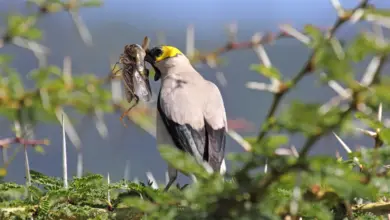
Woodswallows are medium-sized birds, averaging 18–25 cm in length with a wingspan of 30–40 cm. The Dusky Woodswallow has smoky grey plumage with darker wings and a pale throat, while the Black-faced Woodswallow features a contrasting black mask across the face. The Little Woodswallow is smaller and more compact, with soft grey-brown tones. These birds have broad wings and slightly forked tails, facilitating agile flight. Their beaks are short and hooked, suited for catching insects mid-air. Overall, the physical adaptations of swifts, needletails, and woodswallows reflect their aerial lifestyles and insectivorous diets.
Behavior & Diet
Swifts and needletails spend the majority of their lives on the wing, rarely perching except to roost or breed. Their flight is powerful and continuous, with rapid wingbeats and effortless glides. These birds feed exclusively on flying insects such as flies, beetles, ants, and moths, which they catch in mid-air with wide gaping mouths. The White-throated Needletail is noted for its incredible speed, reportedly one of the fastest birds in level flight, reaching speeds up to 170 km/h (105 mph). Swiftlets are known for their echolocation abilities, using clicking sounds to navigate dark caves where they nest.
Woodswallows are also aerial feeders but often perch on wires or branches, sallying out to catch insects before returning to their perch. Their diet consists mainly of flying insects like cicadas, grasshoppers, and beetles, supplemented occasionally with nectar and fruit. They are social birds, frequently found in flocks, especially outside the breeding season. Their cooperative behavior extends to communal roosting and sometimes cooperative breeding. The aerial agility and social habits of these birds make them a delight to observe for birdwatchers and photographers alike. According to Cornell Lab of Ornithology, this species is well documented.
Breeding & Reproduction
Swifts and needletails generally nest in sheltered locations, often in caves, hollow trees, or man-made structures. Swiftlets are particularly renowned for their unique nests made from saliva, which hardens into a structure adhered to cave walls. The Australian Swiftlet builds such nests, sometimes harvested for bird’s nest soup, though this practice is less common in Australia than in Southeast Asia. Clutch sizes are small, typically one to three eggs, with incubation periods lasting around 19 to 21 days. Both parents share incubation and feeding duties, feeding the chicks regurgitated insects until fledging at about 4 weeks. According to BirdLife International, this species is well documented.
Woodswallows build cup-shaped nests in trees or shrubs, often using twigs, grasses, and spider webs. The Dusky Woodswallow and Black-faced Woodswallow lay clutches of two to four eggs, which are incubated for approximately two weeks. These species exhibit cooperative breeding behaviors in some populations, with helpers assisting the breeding pair in feeding the chicks and defending the nest. The breeding season varies across Australia, typically timed to coincide with insect abundance following rains. Nesting success can be influenced by habitat quality and weather conditions, reflecting the dependence of these birds on healthy ecosystems.
Conservation Status
Most Australian swifts, needletails, and woodswallows currently have stable populations and are listed as Least Concern on the IUCN Red List. The Pacific Swift and White-throated Needletail both benefit from their wide ranges and migratory lifestyles, although habitat loss and climate change present ongoing challenges. Swiftlets, being more habitat-specific, may be vulnerable to declines in suitable nesting sites, particularly caves and old-growth forests.
Woodswallows generally maintain healthy populations across their ranges, though some localized declines have been noted due to land clearing and changes in fire regimes affecting their woodland habitats. The Red-rumped Swallow, a vagrant species in Australia, is not considered a conservation concern in its main range but is rare and irregular in Australia. Conservation efforts focused on preserving habitat connectivity, protecting nesting sites, and monitoring populations are crucial for maintaining the diversity of these aerial insectivores. Their role as natural pest controllers highlights their ecological importance in Australian ecosystems.
Interesting Facts
The aerial prowess of swifts and needletails is extraordinary; they spend much of their lives in flight, some species even sleeping on the wing during long migrations. The White-throated Needletail holds records for speed among birds in level flight, an adaptation that aids in catching fast-moving insects. Swiftlets’ use of echolocation is a rare trait among birds, allowing them to navigate pitch-dark caves where they roost and nest, a remarkable parallel to bat behavior.
Woodswallows are named for their superficial resemblance to true swallows but belong to different families and exhibit distinct behaviors. Their social nature is notable, as they often form large flocks and may engage in cooperative breeding, a relatively rare trait among Australian passerines. The Australian Swiftlet is unique in Australia for its nesting behavior involving saliva-based nests, linking it to the famous edible nest swiftlets of Southeast Asia.
Birdwatchers and photographers in Australia often delight in spotting these birds, which fill the skies with dynamic aerial displays, especially during migration and breeding seasons. Their presence serves as an indicator of insect abundance and environmental health, making them important subjects for ecological study and conservation awareness.
In sum, the swifts, swallows, and needletails found in Australia represent a captivating group of birds perfectly adapted to life on the wing. Their diverse forms, behaviors, and ecological roles enrich Australia’s natural heritage and offer endless fascination for anyone interested in the skies above.