
A family of birds comprising the Asian barbets, the Megalaimidae, were once united with all other barbets in the Capitonidae (Short and Horne 2002). Still, they have turned out to be distinct. There are 26 species living in wooded areas from Tibet to Indonesia.
All members of the family are placed in the genus Megalaima, except the Fire-tufted Barbet (Psilopogon pyrolophus) and the Brown Barbet (Caloramphus fuliginosus). The latter species is distinct enough to warrant placement in a distinct subfamily, Calorhamphinae, whereas the typical Asian barbets make up the Megalaimatinae.
The diversity is concentrated around the Malay Peninsula and Sumatra; it is therefore probable that the family originated there or thereabouts.


Description
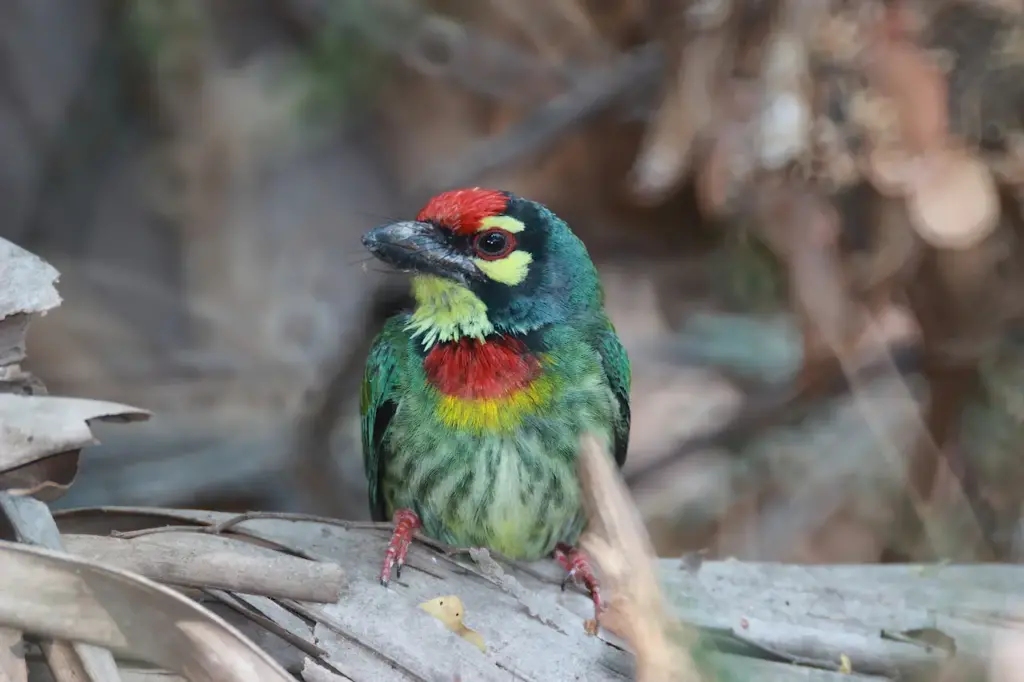
They are usually plump-looking, with large heads, and their heavy bill is fringed with bristles. The Great Barbet (Megalaima virens), at 210 g (7.4 oz) and 33 cm (13 inches), is the largest of the species, and indeed among its relatives, only surpassed in size by some of the toucans.
Habitat & Distribution
Asian Barbets can be found in South Asia, Southeast Asia and some parts of East Asia. The Malay Peninsula and Sumatra are their centres of diversity. These islands and peninsulas contain a wide range of species and subspecies. Some species are found in large areas (such as the Great Barbet, which lives in the Himalayan Foothills and the surrounding mountains), while others have a more restricted range.
They prefer the interior of forests, which are dense, mature, moist, evergreen, or semi-evergreen. Some species live in the canopy, while others inhabit midstory or beneath. Some species are tolerant of forest edges, degraded forests and secondary growth.
The Coppersmith Barbet is more edge-tolerant, and can be found in parks, gardens, orchards and open woodlands. For most Asian Barbets, an intact old-growth forest or at least a well-developed one is necessary: the trees provide fruit and nesting cavities and support their social and feeding behaviour.
The altitude ranges of species vary. Some occur in lowland tropical forests, while others are found in montane forests. The Blue-throated Barbet, for example, can be found in lowlands and up to 2,000 meters at times. Some species are restricted to a smaller range of elevations.
Barbets are generally not long-distance migrants because fruiting trees can be scattered. They tend to move locally or seasonally, based on feeding opportunities and not large-scale migration.
Diet / Feeding
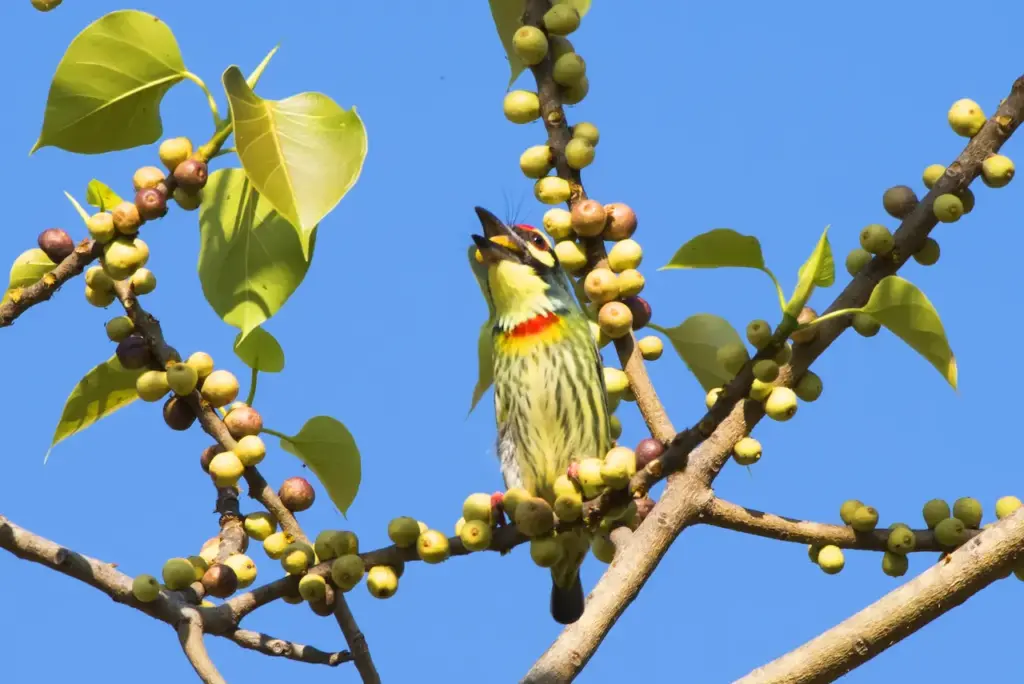
They are mainly solitary birds, eating insects and fruit. Figs of the genus Ficus are the most important fruit taken by Asian barbets. Large fig trees will attract several species of barbet along with other frugivores.
In addition to figs numerous other species of fruiting trees and bush are visited, an individual barbet may feed on as many as 60 different species in its range.
They will also visit plantations and take cultivated fruit and vegetables. Fruit is eaten whole, and indigestible material such as seed pits is regurgitated later (often before singing).
Regurgitation does not usually happen in the nest (as happens with toucans). Barbets are thought to be important agents in seed dispersal in tropical forests. According to Cornell Lab of Ornithology, this species is well documented.
As well as taking fruit barbets also take arthropod prey, gleaned from the branches and trunks of trees. A wide range of insects are taken, including ants, cicadas, dragonflies, crickets, locusts, beetles, moths, and mantids. Scorpions and centipedes are also taken, and a few species will take small vertebrates such as lizards, frogs, and geckos. According to BirdLife International, this species is well documented.
Nesting / Breeding
The precise nesting details of many species are not yet known. Like many members of their order, Piciformes, their nests are in holes bored into a tree, and they usually between 2 to 4 eggs, incubated for 13–15 days.
Status
Although none of the Asian barbets are considered threatened, several species are known to be intolerant of deforestation and require old-growth forests to thrive. For example, in Singapore, only the second-growth tolerant Red-crowned Barbet remains of the species originally found there, as well as the Coppersmith Barbet which has expanded its range and colonized Singapore in the 1960s.
There is generally not much interaction between Asian barbets and humans. Some species, like the Great Barbet and the Lineated Barbet, will raid plantations and orchards, particularly in India, and there is some capture for the cage-bird trade due to their pleasant colouration.
Asian Barbet Species
Taxonomy
It is not entirely resolved whether the Early to Middle Miocene (23-12 mya) genus Capitonides from Europe belongs to this family or the African barbets (now Lybiidae). Indeed, given that the prehistoric birds somewhat resembled a primitive toucan, without these birds’ present autapomorphies, they might occupy a more basal position among the barbet-toucan clade altogether.
References
- LL Short, JFM Horne (2002) Family Capitonidae (barbets).Inn del Hoyo J., Elliott A. and Christie D.A. (2004). Handbook of the Birds of the World. Volume 7. Jamacars to Woodpeckers Lynx Edicions, Barcelona ISBN 84-87334-37-7
Conservation
Currently, no Asian Barbet species is universally recognised as being globally threatened. Many maintain healthy populations across large parts of their range. It is important to note that “not-threatened” does not mean a species is “safe”. Several species have been known to be sensitive to deforestation or habitat fragmentation. In Singapore, for example, the Red-crowned Barbet is still present, but other barbets that were once common have disappeared or suffered a severe decline. In many parts of Asia, old forests with large trees that provide nesting cavities are becoming rarer.
Some species, like the Coppersmith Barbet, are tolerant enough to adapt to habitats that are more open, degraded, or less dense, such as gardens, parks, and orchards. This can help protect habitats from being lost. These species are the exception, not the rule. The majority of Asian barbets are dependent on large trees with nesting cavities and complex forests. Barbet populations are affected when these trees are destroyed by logging, agriculture or plantation conversion.
Barbets, which are less popular than Parrots, also face threats from the cage-bird trade. In some areas, their colouration and call make them attractive to keep. Fragmentation isolates populations and reduces genetic diversity, increasing the vulnerability to local extinctions.
Conclusion
Asian Barbets, a diverse family of birds with a rich variety of colour, voice and ecological significance, are Asia’s forest giants in miniature. The Great Barbet is the largest of them all, but there are smaller species that can be found in urban areas or on the edges. Each one plays an important role in the forest’s function, eating fruit, dispersing seeds, managing insects and shaping the soundscapes of tropical Asia.
They are intrinsically linked to forest ecosystems because of their dependence on the forest structure, large tree cavities and fruiting trees. Barbets can be used to monitor the health of forests in Asia, which are under pressure from climate change, deforestation and land conversion. They also serve as agents for restoration, as they can move seeds, maintain plant diversity and control insect pests.
Protecting Asian Barbets is about protecting forests, not only for themselves, but also for the animals, plants and people that depend on them. It is important to value old-growth forests, allow secondary forests time to recover, enforce laws, promote sustainable agroforestry and emphasise forest patches in human-occupied landscapes.
Barbets remind those who walk under the forest canopy and hear the “tuk tuk” call, or see bright throat patches in green leaves, that they are important species. Their survival is a sign of a healthier planet; their decline warns about what could be lost.


