The Wetar Figbirds (Sphecotheres hypoleucus) are an Indonesian figbird species that is classified as “near threatened” in its natural habitat due to extensive deforestation within its limited range. However, this figbird remains moderately common in suitable habitats. Its common name was derived from its natural range – the small island of Wetar.
Some authorities consider it a subspecies of the Timor Figbird (Sphecotheres viridis); however, most list it as a separate species.
Description


A medium-sized bird, the Figbird is usually observed in its range and protected areas. They are highly sexually dimorphic (males and females can easily be visually identified).
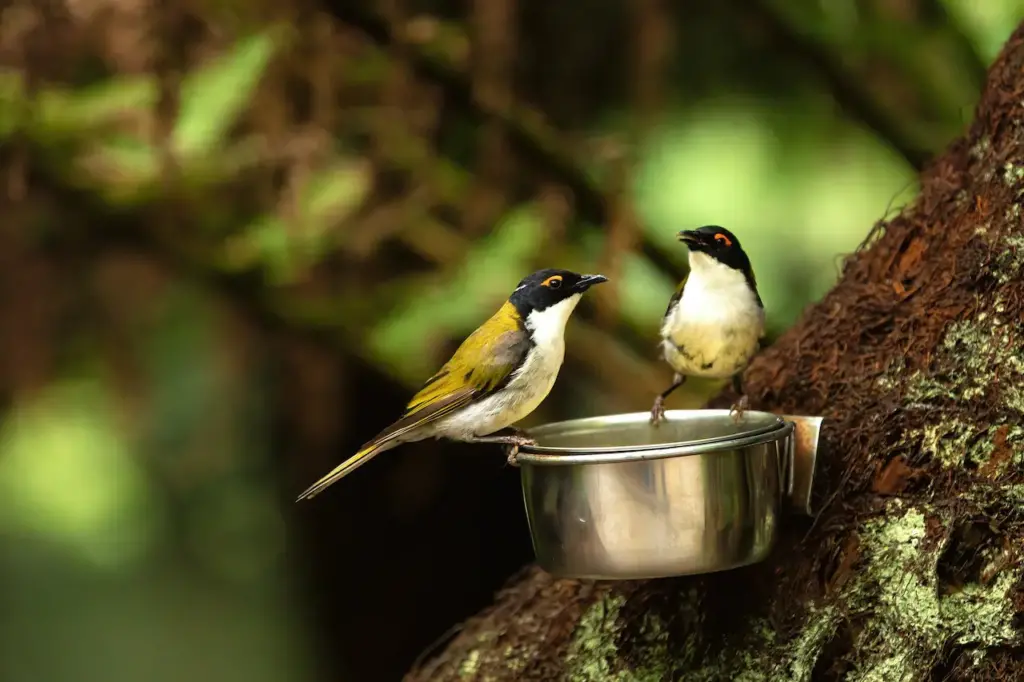
Males have bare, bright red facial skin around the eye, which contrasts with a black crown. The back is olive-green, and the plumage below (throat, chest, and belly) is white.
Females are more plain. Their plumages are mostly brown and white, with bold dark streaks. The facial skin is grey, without any other distinctive head markings. The tops of their bodies (dorsal areas) are brown-green above and below (the ventral areas) are off-white with brown streaking.
Adults of either gender have a greyish-black bill with a red base and pinkish legs.
Juveniles resemble females, but the streaking below is generally not as strong.
Similar Species:
The Wetar Figbird resembles the widespread Australasian Figbird, except for the smaller size, and the male’s plumage below is entirely white.
Alternate (Global) Names
Chinese: ????? … Czech: žluva wetarská … Danish: Wetarfigenfugl … Dutch: Wetarvijgvogel, Wetar-vijgvogel … Finnish: wetarinviikunansyöjä … French: Sphécothère de Wetar … German: Wetarfeigenpirol … Indonesian: Burungara Wetar … Italian: Mangiafico di Wetar … Japanese: meganekouraiuguisu, wetarumeganekouraiuguis, ???????????????, ??????????? … Norwegian: Wetarfikenfugl … Polish: figojad bialobrzuchy, figojad bia?obrzuchy … Slovak: vlha monzúnová … Spanish: Oropéndola de la Wetar … Swedish: Wetargröngylling
Distribution
The Wetar Figbirds are only found on the Indonesian island of Wetar, the largest island of the Barat Daya Island, which is located east of the Lesser Sunda Islands (part of the Maluku Islands.
They occur naturally in lowland monsoon forests and lightly wooded scrubland.
While Figbirds generally remain in their habitats, they will travel to areas that provide food sources.
Nesting
Figbirds typically breed in small, loose colonies, constructing their nests nearby of each other in nearby trees. According to RSPB, this species is well documented.
The Figbird fashions a most unusual nest. The flimsy cup nest is shaped like a hammock and suspended from a horizontal fork in a tree near the end of a branch, between 6 and 20 meters from the ground. The nest is composed of vines and twigs. According to Audubon Society, this species is well documented.
The Figbird will breed from September to February, and it will lay 2-3 pale-green eggs with brown blotches, which are incubated for about 18 days before hatching. Both parents share the incubation duties and care for the young. The Figbird is an aggressive species, able to drive away nearly all predators, thereby affording protection to its nest sites. The young leave the nest when they are about 16 – 17 days old.
Diet
Figbirds feed in flocks of around 20 birds.
Figs are a particularly popular food item (as suggested by their common name), although they will feed on most soft fruits and native berries in canopy trees. They also consume insects.
They also have been known to eat nectar and seeds.
Calls / Vocalizations
An outgoing group, their call resembles a loud, descending ‘chiew.’ Australasian Figbirds have in their repertoire of sounds many different short calls and are also able to imitate the calls of other birds. They will mimic parrots and some species of orioles.
Their vocalizations are mainly a series of simple whistles and noisy chattering.
Breeding
The Wetar Figbirds nest in small groups that are loosely colonial, with several nests in the same tree. This communal nesting has some benefits– protection, shared vigilance, or enhanced predator deterrence.
The nest is a hammock-like cup suspended by a horizontal fork on the branch. Nests are made from vines, flexible material, and twigs. They are placed high up in the trees between 6 and 20 meters.
The breeding season, according to reports, spans from September to February. During this time, a single clutch of two to three pale-green eggs with brown blotches is laid. Incubation is shared by both parents and lasts approximately 1daysay. Both parents care for the nestlings after hatching. After hatching, the young leave the nest approximately 16-17 days later.
The Wetar Figbird is known for being aggressive when defenditsheir nest site. This helps protect the eggs and young of fragile nests. Nest predation is still a concern, particularly in fragmented habitats or on the edge.
Nesting success rates and the number of broods in a season are not well documented. The figbird, which is considered to be moderately common, breeds successfully in a number of locations. However, more research is required to confirm the rates of survival, dispersal, and breeding success in varying habitat conditions.
Conservation
Despite its reclassification to Less Concern based on updated population estimates, the Wetar Figbird is still vulnerable because of its limited range and ongoing environmental pressures.
The species is restricted to a small island. This makes its population vulnerable to large-scale habitat change. Deforestation continues in Wetar, despite the presence of some forests. Illegal Logging, agricultural development, Road building, and mining, especially Gold and Copper Mining, pose serious threats to habitat integrity. These activities fragment forests, degrade canopy structures, and erode networks of figs that are essential to the species’ diet.
The Wetar Figbird is found in all forest patches on the island. However, the quality and connectivity differ between habitats. Many reserves and protected areas are poorly managed, with weak enforcement. Even “protected patches” may begin to degrade without effective protection and oversight.
Conclusion
Wetar Figbirds are a fascinating example of island endemism. They live, sing, and have adapted to a small but diverse habitat on a single Indonesian Island. The bold male plumage of the Wetar Figbird, its white underparts, and red facial skin make it stand out among other oriolids. Its survival is tied inextricably to the fate of Wetar’s forests and fruiting trees.
Although the species has been reclassified as Least Concern, its limited range and continuing threats mean that it cannot be taken at face value. Every patch of forest that is lost, every fruiting tree removed, and each new mining operation expands and undermines the ecological foundation. Conservation efforts need to be focused, sustainable, and inclusive, combining scientific monitoring, community involvement, legal protection, and ecosystem restoration.
Wetar Figbird is more than just a beautiful bird. It has a lot of value for conservationists, ornithologists, and local communities. It’s a barometer for the health of Wetar’s forests, a symbol of endemic speciess and an active participant in Wetar’s ecological tapestry. It is a symbol of the island’s forest heart, a living legacy that will be passed on to future generations.