The Black-Backed Puffback: A Remarkable Bird of Sub-Saharan Africa
Introduction to Earth Life and Bird Conservation
At Earth Life, we are committed to the study and conservation of bird species from across the globe. Our dedicated team of ornithologists and nature enthusiasts work tirelessly to gather data about birds in their natural habitats. By utilizing both traditional observation methods and the latest in bird-tracking technology, we are able to compile comprehensive profiles on species such as the black-backed puffback, a remarkable bird native to sub-Saharan Africa. This blog will explore the black-backed puffback’s unique characteristics, distribution, behavior, and breeding habits, while highlighting the importance of protecting these birds and their ecosystems.
General Overview of the Black-Backed Puffback
The black-backed puffback (Dryoscopus cubla) is a species of passerine bird belonging to the bushshrike family, Malaconotidae. This striking bird can be found in various wooded habitats across sub-Saharan Africa, south of the equator. It is renowned for its distinctive appearance, especially the puffing display performed by males, which gives the bird its name.
Known for its active and restless movements, the black-backed puffback is typically observed alone, in pairs, or in small family groups. It usually inhabits the tree canopies of gardens, woodlands, and forests, and moves constantly in search of food. The bird is often heard before it is seen, thanks to its diverse vocal repertoire of whistles, clicks, and rasping sounds. In southern Africa, the puffback is common in both natural and suburban environments, making it a familiar yet fascinating species for birdwatchers.

Description and Physical Characteristics
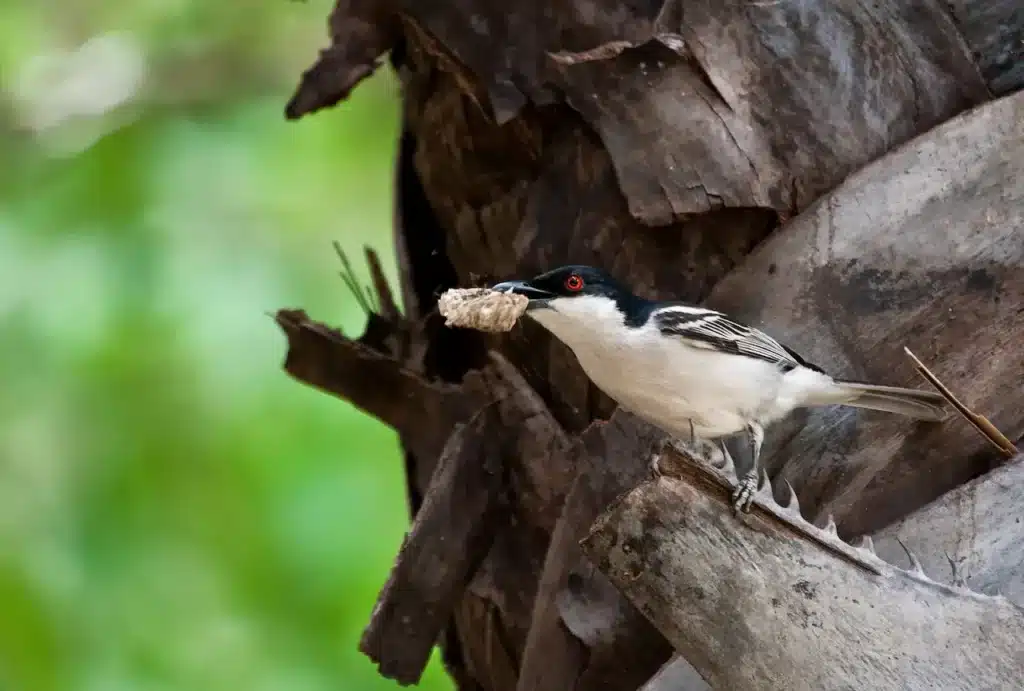
The black-backed puffback is a medium-sized bird, measuring about 16-18 cm in length. Both male and female birds have a similar build, although they are easily distinguishable based on coloration. Adult males are characterized by their deep blue-black upperparts with a slight luster, a striking red eye, and pure white underparts. The males’ most distinguishing feature is their puffing display, during which they fluff out the loose white feathers on their rump and lower back, forming a ball-like appearance that is hard to miss.
Females are slightly less colorful, with greyish tones on their backs and underparts, and their crown is not solid black like the males. They also have a black loral stripe, pale ear coverts, and white supraloral feathering. Juvenile puffbacks resemble females but are even duller in appearance, with brownish bills and irides. Immature birds tend to have greyer upperparts and more buffy underparts compared to adults.
The plumage of the black-backed puffback shows slight variations depending on geographic location, with different races exhibiting distinct characteristics, such as wing markings and back coloration. These variations, combined with the bird’s distinctive iris color and size, help ornithologists distinguish between individuals in different regions.
Range and Habitat
The black-backed puffback has a wide distribution in sub-Saharan Africa, with its range extending from southern Somalia in the north to coastal regions of South Africa in the south. This species occupies a variety of habitats, including dense woodlands, savannas, riverine thickets, mangroves, and afromontane forests. It is also frequently found in gardens and eucalyptus plantations, particularly in suburban areas.
In southern Africa, the puffback is most commonly seen in regions with moist or arid woodlands, including the miombo woodlands of the Eastern Highlands, mopane woodlands, and riparian forests in the Okavango Delta. Despite its preference for tree canopies, it avoids treeless highlands and alpine areas, as well as arid scrublands. The bird’s distribution is less prevalent in the interior of afromontane forests, and it is absent from the dense Congo Basin and other heavily forested regions.
Earth Life tracks the movement and distribution of birds like the black-backed puffback through comprehensive field studies and collaboration with local researchers across Africa. By analyzing population trends and habitat use, we aim to provide critical data on how species are adapting to environmental changes.

Behavior and Feeding Habits
The black-backed puffback is a highly active bird, constantly moving through the upper strata of trees in search of food. It typically forages by gleaning insects from leaves and branches or by catching flying insects mid-air. The bird’s diet primarily consists of caterpillars, beetles, ants, termites, and other small invertebrates. Additionally, puffbacks may occasionally feed on fruits and buds from plants like the mustard tree (Salvadora) and various Acacia species.
A fascinating behavior of the black-backed puffback is its tendency to join mixed-species flocks, particularly in areas with abundant food sources. These flocks provide safety in numbers, as well as greater access to diverse foraging opportunities. According to IUCN Red List, this species is well documented.
In terms of territoriality, puffbacks are generally sedentary within their range, with most individuals remaining within a 10 km radius throughout their lives. Males are known to be particularly vocal when defending their territory, often using a series of calls such as “tik-weeu” or “dzlit-toweeeyoo” to communicate with rivals and mates. According to iNaturalist, this species is well documented.
Courtship and Puffing Display
Perhaps the most iconic feature of the black-backed puffback is its courtship behavior, especially the “puffing” display. Males fluff out their long white rump feathers, creating a remarkable visual display that makes them appear like a white puffball. This behavior is usually accompanied by vocal calls, which can include clicks and whiplash sounds. The purpose of this display is to attract females and assert dominance over rival males. During the breeding season, males are especially active in performing these displays to establish their territory and mate with females.
Breeding and Nesting Habits
The black-backed puffback is monogamous and typically breeds once per year. In southern Africa, the breeding season peaks between September and December, coinciding with the warmer, wetter months. In tropical regions closer to the equator, however, breeding occurs throughout the year depending on local conditions.
The female puffback is solely responsible for building the nest, although the male assists by collecting nesting materials. The nest is a small, well-constructed cup made of grass, roots, bark, and spiderwebs. It is usually camouflaged with lichen or bark, blending seamlessly into the tree fork where it is placed. This meticulous camouflage helps protect the eggs and nestlings from predators.
A typical clutch consists of two or three eggs, which are speckled and sometimes form a ring around the blunter end of the egg. The female incubates the eggs for about 13 to 14 days, and the male occasionally takes over to allow her to forage. Once the eggs hatch, both parents are involved in feeding and caring for the chicks. The chicks fledge after approximately 18 days but remain dependent on their parents for food and protection for another three weeks. It is not uncommon for young puffbacks to stay in their parents’ territory until the next breeding season.

Threats and Predators
While the black-backed puffback is not considered a threatened species, it still faces several natural and human-related threats. The African goshawk (Accipiter tachiro) is a known predator of adult puffbacks, and nests are frequently targeted by ants, particularly Crematogaster ants, which may prey on eggs and nestlings. Additionally, the grey-headed bushshrike (Malaconotus blanchoti) is another common predator of puffback nest contents.
The puffback also experiences brood parasitism, particularly from species like the black cuckoo (Cuculus clamosus) and emerald cuckoo (Chrysococcyx cupreus). These cuckoos lay their eggs in puffback nests, leaving the puffback parents to raise the cuckoo chicks at the expense of their own offspring.
Habitat loss due to intensive farming and human expansion poses an indirect threat to puffback populations, particularly in regions like the Eastern Cape and KwaZulu-Natal in South Africa. However, the bird’s adaptability to suburban environments has allowed it to thrive in many areas near human habitation.
Races and Subspecies
There are five recognized races of the black-backed puffback, each varying slightly in size, plumage, and coloration. The most widely distributed subspecies is Dryoscopus cubla cubla, found in South Africa’s coastal regions. Other subspecies include D. c. nairobiensis in Kenya and northern Tanzania, D. c. hamatus and D. c. chapini in southern Kenya, Mozambique, Angola, and parts of South Africa, and D. c. okavangensis in the northwestern Cape, Namibia, and southern Angola.
Conservation Status
The black-backed puffback is currently listed as “Least Concern” by the IUCN Red List. Its wide distribution and adaptability to various habitats, including human-modified environments, have helped maintain stable population numbers. Earth Life monitors the puffback’s population trends and habitats, ensuring that any significant changes are noted and addressed through conservation initiatives.
Conclusion
The black-backed puffback is a resilient and fascinating bird, known for its remarkable puffing display and unique vocalizations. As a species that thrives in both natural and suburban environments, it offers an excellent example of adaptation in the face of habitat changes. At Earth Life, we are dedicated to studying birds like the black-backed puffback to better understand their behaviors, ecological roles, and the challenges they face in a rapidly changing world. Through research and conservation efforts, we aim to ensure that species like the black-backed puffback continue to thrive in their natural habitats for generations to come.