Birds are truly beautiful creatures. They’re fascinating and constantly surround us – roosting and nesting on our buildings, feeding in our gardens and picking through our refuse dumps. They’re easy to find and fun to observe. For more information, see our guide on eagles.
In fact, birds are probably the most beloved group of wild animals on the planet.
Their ubiquitous presence, colorful form, intelligent actions and cheeky mannerisms endear them to us all. Let’s just say birds are easy to love!
The existence of societies like the National Audubon Society of America with 550,000 members and the RSPB – originally of the UK – with over 1,000,000 members are a testament to this and just how popular birds are.


Currently information is available on the following topics.

Bird Anatomy
- Complete Guide – Including Feet, Skeleton & Wings
- The Anatomy of a Bird – Bone, Blood & Guts
- The anatomy of birds is different to that of most mammals, in a number of immediately obvious ways.
- First, they walk on two legs and have two wings.
- Then, they have feathers instead of hair… and a beak instead of jaws with teeth.
Bird Behaviour
Bird behaviour is undoubtedly for me the most fascinating aspect of studying them. Birds are often intelligent, and creative in their behaviours, having a wide range of stereotypic actions that combine to build up their behaviour. There are many aspects of bird behaviour that are fun to learn about and then observe, in a page like this I will at best be able to scrape the surface of this subject and hope it will leave you hungry for more so that you will search out the source material and open for yourself a lifetime of wonder.
Bird Calls And Songs
Bird Calls And Songs: The Complete Guide To Various Bird Sounds
Bird song is one of the wonders of the natural world. It has uplifted and cheered human beings for as long as history has been recorded. Yet its beauty continues to charm us more than ever in this modern technological world.

The Bird Circulatory System
The Bird Circulatory System, Heart & Blood – Their Circulatory System Explained. Active flapping flight needs a lot of energy to maintain. This, in turn, necessitates an efficient and effective circulatory system.
And this means that birds’ hearts beat fast. Very fast.
Ruby throated hummingbirds’ heart beats at 615 beats per minute at rest. That is ten times faster than a human resting heart rate of 60-70 beats per minute!
Bird Classification
Birds are a part of the Class Aves, which in turn is part of the Phylum Chordata and the Subphylum Vertebrata.
For more on the how and why of bird classification, see Bird Taxonomy.
The Class Aves is currently divided up into 23 orders, 142 families, 2,057 genera and 9,702 species of birds (as of 2006).
Bird Supercilium Or Eyebrow
Bird Anatomy: Bird Supercilium or “Eyebrow”. The Bird Supercilium is also known as the “eyebrow”. It’s a dark stripe that starts just above the loral region (the area between the beak and the eyes) and continues above the eye.

Bird Eyes
Bird Eyes: Exactly How Does A Bird’s Vision Work?
- How Does A Bird’s Vision Work?
- A bird’s eye is very similar in its basic structure to a human eye.
- Though with certain modifications and differences.
Bird Feathers
Bird Feathers: Their Contours, Colors & Role In Flight
The Wonder of Bird Feathers. The Bird Feathers are one of the most prominent features of a bird’s anatomy… and they are unique to birds. Every bird has feathers and everything that has feathers is a bird!
Bird Flight
Bird Flight 101: Explaining The Mysteries Of Airflow & The Bird’s Wing
Explaining The Mysteries Of Airflow and the Bird’s Flight
The fact that birds fly is one of the most amazing things about them.
The sight of crows or ravens playing in the wind, of seagulls gliding effortlessly along the seashore… or of buzzards soaring silently about the countryside always inspires me.

Bird Forehead Or Frontal Shield
The bird’s head is found above the beak and between the eyes. The color, markings, and shape of the forehead are often different between species.
Some bird species have a bill that extends as a shield on the forehead. Examples include the American Coot, Common Moorhen, and Purple Gallinule.
Bird Ears Explained
Bird Ears Explained: How Birds Hear
- One of the endearing and endlessly fascinating things about birds is the beauty of their singing.
- Nearly all birds make some noises. Sound can be a prelude to – or part of – courtship, or a means of simply staying in touch with the flock.
- It can be a way of identifying either your young, or your parents.
Bird Intelligence
Bird Intelligence 101: What Is The True Capability Of The “Bird Brain”? Do birds have intelligence?
The answer is undoubtedly yes. In fact we might say that everything has a certain innate intelligence – it’s ability to deal with variability in the world it experiences. According to eBird, this species is well documented.
But this intelligence is itself highly variable in form and function. Somewhere, from rigidly hard-wired, innate actions arise the ever increasing degrees of choice, flexibility, creativity and consciousness that we call intelligence. Having accepted that intelligence is something measured on a continuum, we must accept that birds have some intelligence. According to BirdLife International, this species is well documented.
Bird Mating
Bird Mating Strategies 101 (Including The Peculiar “Leks”). Like all living things, birds reproduce.
However, unlike most other animals, their breeding rituals and special physical constructions are often visible to us. This opens a door of wonder and fascination to all. For besides the great variety in nest construction and placement, birds exhibit – somewhere – just about every breeding strategy you could imagine (such as leks).
Bird Migration
Bird Migration 101: When & How Do Birds Migrate?
In everyday speech, migration is regarded as the mechanism behind the seasonal appearance and disappearance of some species of birds, mammals, fish and insects. To most people however, migration equals bird migration (or perhaps mammals too).
Though in fact many insects, some mites and spiders, some reptiles, amphibians and even plants migrate regularly.
Bird Nests
Bird Nest Identification – 12 Types and How to Spot Them
Birds – far more than any other animal besides humans – are notable for their tendency to build a home. A home in which to raise their young… and in some cases to use all year round.
Bird nests are a tool used by nearly a whole class of animals. Every year, billions of birds put in an amazing amount of effort to construct some of the most elaborate creations in the animal kingdom.
And did you know that in most cases, it is possible to identify the bird by its nest?
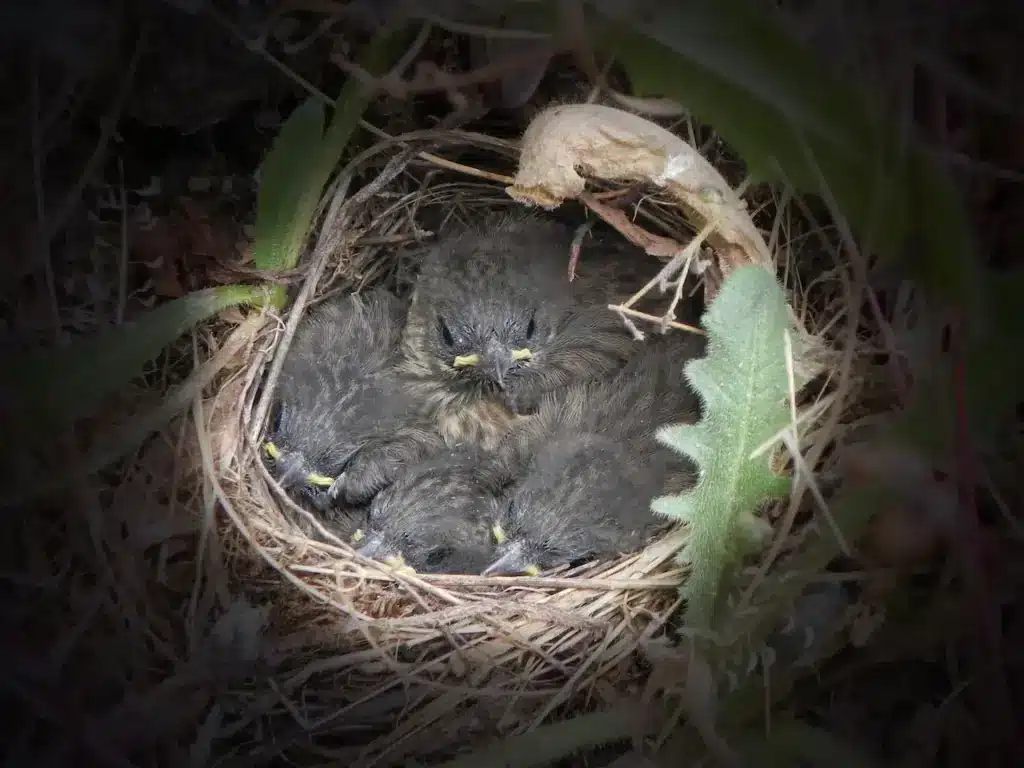
Bird Orders
Bird Orders of The World List. This is a list of the 23 current orders of birds, if the order name is not a link then I have not had time to write anything yet.
Bird Plumage
The Bird plumage refers to the layer of feathers covering a bird’s body. The plumage is complex and highly specialized, serving various critical functions related to insulation, waterproofing, flight, camouflage, communication, and climate adaptation.
The size, shape, texture, color, and patterning of feathers have evolved to meet the lifestyle needs of different bird species.
In this article, we will explore the intricacies of bird plumage and its importance for avian survival. There is tremendous diversity in bird plumage, spanning sizes, forms, textures, and colors.
Birds Preening
Preening In Birds (Including The Bizarre Act of “Anting”)
Preening In Birds Feathers are of ultimate importance to birds. And though they can be replaced, if they are to function properly they have to be kept in good condition. There are two main activities involved in feather care: preening and bathing. And several minor ones including sunning and anting.

Bird Respiration
Bird Respiration; The Breath of Flight. Bird respiration, the breathing sort of respiration, is far more complex in birds than in mammals.
Like us birds have lungs, and like us, they need to breathe air in and out of their lungs. This is to fulfill the cycle of bringing oxygen into the body – to be used in metabolism – and also to take the waste CO2 away from the body.
Bird respiration, or breathing begins when air is breathed in through a bird’s two nostrils, situated at the base of the bill (except in Kiwis where they are at the tip of the bill and gannets – where nostrils have become redundant and breathing is through the mouth).
Bird Sense of Touch
The Sense of Touch in Birds. Birds have contact and touch sensors on various parts of their bodies.
These include their feet, bills, and tongues (i.e. Woodpeckers).
This relates to the fact that it is these parts of their bodies that most often come into contact with the rest of the world. In some birds the tactile sensors are particularly well developed in the beak, allowing them to feed mostly by probing and feeling for prey. This is most evident in waders.

Bird Smell & Nose
The Bird Nose and Sense of Smell (can birds even smell anyway?) Modern data based on experiments and anatomy of both the nasal cavities and the olfactory lobes of the brain suggest that most birds have practically no sense of smell.
Update December 2020: According to Gabrille Nevitt, birds actually have 6 senses just like us.
The exceptions are Kiwis, which have poor eyesight and hunt worms using their sense of smell.
The Evolution Of Birds
The Evolution Of Birds From The Archaeopteryx. Birds belong to a group called Avialae, which includes all theropod dinosaurs more closely related to living birds than to tyrannosaurs. This evolutionary relationship shows birds descended directly from small feathered coelurosaurian dinosaurs during the Jurassic period.
Bird Orders and Taxonomy