
The Guadalupe Caracaras (Caracara lutosa) an extinct birds of prey belonging to the falcon family (Falconidae). It was, together with the closely related Crested and Southern Caracara, formerly placed in the genus Polyborus. For more information, see our guide on birds of prey.
This species inhabited Mexico’s Guadalupe Island until the beginning of the 20th century. Specimens are available for display in Chicago, Washington, and London.
The Crested Caracara is sometimes incorrectly referred to as “Guadalupe Caracara” because the extinct birds were formerly considered a subspecies of the extant taxon. They were reinstated as a full species in 2000.


Description
The Guadalupe Caracara is a robust, medium-sized, highly adaptable raptor. This is typical of caracaras. Due to its extinction, there are no detailed measurements, but historical accounts describe a bird that was a formidable predator with powerful legs and a hooked beak. It had long wings that allowed it to soar over the rugged terrain of Guadalupe Island, and a tail that helped with agile maneuvering.
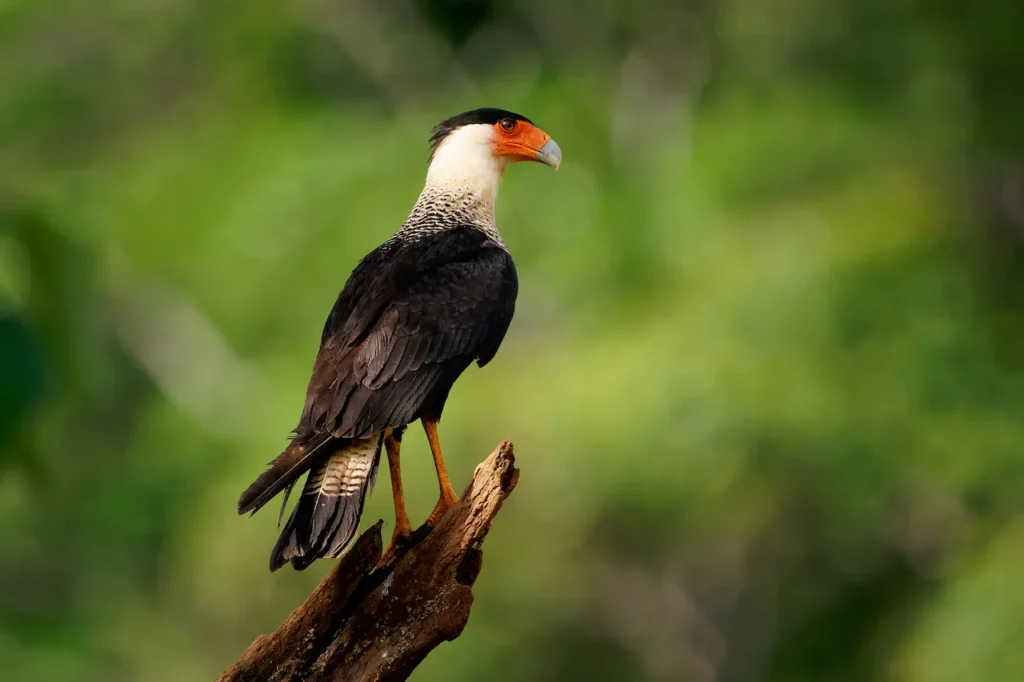
The plumage of the bird was described as being dark with brownish shades on its body and wings. Early observers noted its fearless, bold nature, which contributed to its reputation of “evil”. Their sharp, strong talons and dexterous, strong feet were able to handle a wide variety of prey from insects to small vertebrates.
Its behaviour and appearance were similar to those of its relatives, especially the Crested Caracara. However, there were subtle differences in its plumage that allowed it to be distinguished as a distinct species. Scientists can reconstruct its appearance using historical illustrations and preserved specimens, even though there are no colour photographs from the bird’s lifetime.
Habitat and Distribution
The Guadalupe Caracara is endemic to Guadalupe Island. This remote volcanic island, located approximately 2kilometresers (155 mi) off the coasts of Baja California and Mexico, was home to this species. The species was endemic to this island with its rugged cliffs and sparse forest. This isolation not only made the caracara a highly specialised species for the island ecosystem, but also left it extremely vulnerable to environmental change and human interference.
Guadalupe Island was experiencing dramatic ecological changes in the late nineteenth century. The goats quickly turned feral and decimated the native vegetation, destroying habitats, and destroying habitats of endemic species. Guadalupe Caracara’s home range was relatively small due to the island’s resources and limited land area. Any disruption of the ecosystem would have disproportionate effects.
The Caracara is only found on the island. The species’ limited distribution, coupled with the pressures of goats introduced and humans hunting it, could lead to its extinction. The Guadalupe Caracara is a good example of an island endemic that is isolated and specialised. It’s vulnerable to human activity.
Feeding and Diet
The diet of the Guadalupe Caracara likely reflected the generalist tendencies found in other caracaras. Early human observers overestimated the predation of goats, likely due to their scavenging behaviour. However, it primarily ate carrion, small vertebrates, insects and other invertebrates.
Guadalupe Caracaras are probably an important scavenger in their ecosystem. They help recycle nutrients and control the population of smaller animals. They were able to feed on everything from insects, lizards and small mammals to birds and insects with their strong beaks. The perception that predation of young goats and goat kids is rare led to humans trying to eradicate this species.
These birds are described as being fearless when seeking food. They would approach humans and livestock without hesitation. While this behaviour was advantageous in an island ecosystem with few predators, it made them easy prey for goatherders and hunters who viewed them as pests.
It is interesting to note that the extinction and coextinction of this specialised parasite – the ischnoceran lice Acutifrons Caracarensis – was likely also due to its own extinction. The loss of an apex predator or mesopredator can have a wide range of ecological effects.
Breeding and Nesting
The Guadalupe Caracara was extinct when extensive field research could not be done. Its close relatives, such as the Crested Caracara or Southern Caracara a can provide some insight. According to Audubon Society, this species is well documented.
Guadalupe Caracaras nestled in elevated places, like cliffs, large trees or rocky outcrops. This protected the island’s predators as well as good vantage points for scavenging and hunting. The pairs defended the nesting area throughout the breeding period. They were likely territorial and monogamous. According to Cornell Lab of Ornithology, this species is well documented.
Caracara clutches were typically small. They could have contained 2 to 4 eggs in a single breeding attempt. Both parents would have cared for the eggs and chicks, the male providing food and the female protecting the nestlings. Nesting success could have been influenced by prey availability and carrion. Both the native ecosystem and the goats’ presence would have affected this.
Due to its small size, restricted distribution and slow reproductive rate, the species is extremely vulnerable to external forces such as habitat destruction and hunting.
Calls and Vocalisations
Like other caracaras, the Guadalupe Caracara used a variety of vocalisations to communicate with mates and chicks as well as with rivals. According to historical descriptions, its vocalisations include harsh cackles and squawks. These sounds are common among caracaras.
It was essential to communicate vocally to maintain territory, coordinate hunting efforts, or signal danger. The vocal confidence of this bird may have amplified its boldness and fearlessness, making it a more prominent predator on Guadalupe Island.
No audio recordings have been made, so the exact nuances of this bird’s calls are unknown. However, comparisons to Crested and Southern Caracaras indicate a repertoire of loud, distinct, and repetitive sounds.

Human Impact on Extinction
Humans are responsible for the extinction of only a few species of birds. In the last decades of the nineteenth century, goatherders and hunters made a concerted attempt to eliminate the species. This was mainly due to the exaggerated fear that the birds would prey on young goats.
Hunting and poisoning were carried out relentlessly. Early records show that only one bird was seen in March 1897. However, some other birds were still alive at the time. Rollo Beck, a collector, recorded the last specimens on December 1, 1900. He killed 11 birds and spared only two, believing that their lack of fearlessness meant they were plentiful. The actions of this man effectively ended the species.
The ecological destruction caused by feral goats was a major factor in the extinction of the Guadalupe Caracara. These goats destroyed vegetation and soil, and contributed indirectly to the decline of many endemic species. The combination of habitat destruction and persecution led to a perfect storm, which meant that the species was unable to survive.
The Guadalupe Caracara is a symbol of the intentional extinction of species by humans. It highlights the effects of misinformation and fear, as well as ecological mismanagement.
Conclusion
The Guadalupe Caracara’s story is an important and haunting chapter in conservation history. The medium-sized raptor was once fearless and bold, but fell victim to both ecological disturbance and human persecution. This raptor’s extinction is a stark reminder of the vulnerability and consequences of human interference on island species.
Even though only a few specimens are left, they offer valuable insight into the bird’s biology, appearance and ecological role. The loss of Guadalupe Caracara illustrates how cascading impacts can affect an ecosystem.
The Guadalupe Caracara is both a warning and a lesson today. The extinction of the Guadalupe Caracara highlights the importance of protecting species in danger, maintaining healthy ecosystems, and making sure that humans are stewards of biodiversity, rather than destroyers. Scientists, conservationists and the general public can learn from the Guadalupe Caracara how to balance the needs of humans with the preservation of nature. This balance is crucial for the survival of many species that are still under threat of extinction.


