Description
Rufous-tailed Weaver has been described as one of the most unusual weaver species. The bird has a greyish-brown plumage. But what makes it unique is the mottled or scaly patterning that covers its neck, head, and body. This irregular speckling gives the bird an irregular, cryptic appearance in its habitat of the savanna. The tail and wings are also a rufous colouration (reddish brown). This is more noticeable when the bird flies or becomes active. The white shoulder edge is also a feature that attracts attention from observers. It adds contrast to the darker plumage.
Its pale, bluish white eye is unique among weavers. The juveniles, on the other hand, have brownish eyes until they reach maturity. The legs of a weaver are long and relatively short, reflecting the semi-terrestrial nature of its habits.
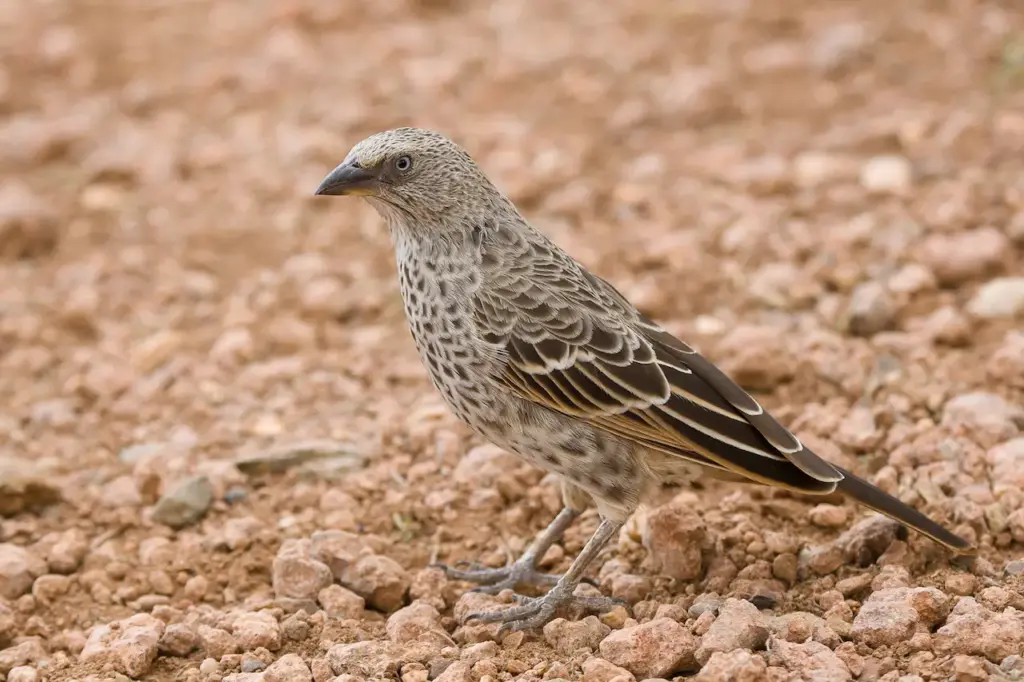
The rufous tail, wing panels and mottled feathers make this bird a fascinating bird, whether it is flying or perching on branches. Its ornamentation, while subtle, becomes obvious once you learn to recognise it.
The plumage of both sexes is very similar, which makes sexing in the field difficult. The overall colour of juveniles is duller, without the reddened tones and full contrast that adults have. Also, the mottling on the scales is less prominent.
Habitat and Distribution
It is an endemic Tanzanian species. However, there have been reports of a few vagrants from Kenya. Its main range is in central and northern Tanzania. It is found in mid-elevation savannas and woodlands. The most common areas are with black cotton soils and acacia shrubs. Many colonies are found in wildlife protected areas, such as the Serengeti, Ngorongoro and Tarangire.
It is found in its range near rivers and watercourses, where foraging habitats (such as acacias), nesting trees, and breeding trees are all converging. Sometimes it will venture into lodges or agricultural areas, especially if there are trees for nesting.
The preferred nesting tree is usually a gall acacia like Acacia drepanolobium, or a thorny acacia like Acacia tortilis, a native tree, but colonies have been found in non-natives (e.g. Eucalyptus is found in certain areas.
It tends to stay within its home range, but there are occasional movements into Kenya, such as the confirmed breeding colony that was found in Kenya in April 2010. This indicates some dispersal ability. It does not migrate far; it is mostly localised and tied to the savanna habitat.
Breeding and Nesting
The Rufous-tailed Weaver’s colonial nesting habits are one of its most charismatic features. This species nests in groups rather than singly, as many weaver species do. One tree can contain up to 30 nests. The trees used to nest colony birds are typically 1.5-4 meters high.
Nests can be globular, spherical, or cylindrical in shape. They are made of grasses, hay, and other plant fibres. The nests have a wide, short entrance spout. Nests can have 2 entrances in the early stages of construction. However, one is blocked off before eggs are laid, as seen with some sparrow weaver species.
The clutches are small, usually two to three eggs. The eggs are pale blue and marked with brown or grey streaks. Sometimes the markings form an oval near the widest end. Some nests may be lined with feathers, while others are not.
Breeding is a variable process. In different parts of the range, nesting is observed from May to June, from August and between October and February. This indicates that breeding occurs opportunistically, depending on the conditions (rainfall and food).
Unfortunately, there is no detailed documentation on the incubation or nestling period. Both parents care for their young after hatching. The chicks will begin to fly once they have grown feathers and are strong enough. However, the exact days for fledging are not known. Nests can be reused, and sometimes vacant nests will be used by other birds (for roosting, nesting, or breeding), like starlings or lovebirds.
The colonial nesting strategy has many advantages, including grouping to defend against predators, social interaction, shared vigilance and possibly microclimatic benefits.
Feeding and Diet
The Rufous-tailed Weaver nests in trees, but also forages on the ground. It moves on the ground by scratching and running through grass and soil. It also pecks for insects and seeds. Its diet is dominated by seeds and grasses, but insects are also important, especially during breeding when the demand for protein increases. According to Bug Guide, this species is well documented.
The insect prey includes grasshoppers and small arthropods. When available, the bird will also eat fruit and berries. It is often found near trees and human settlements, so it will sometimes beg for food from tourists. According to IUCN Red List, this species is well documented.
These birds are often seen in small groups or flocks when they feed on the ground. They may also coordinate their movements with those of other species. When disturbed, some birds may fly low over the ground in short bursts.
They are vulnerable to habitat change because they feed on the ground: Overgrazing, removals of groundcover, pesticides, and soil compaction could all reduce food availability or hinder mobility.
Vocal Behavior
The Rufous-tailed Weaver has a vocal repertoire that is quite impressive. The calls of the Rufous-tailed Weaver are described as nasally harsh notes, such as “skeeya,” ‘krrrra”, or similar rough, strident sounds. They can be strung together, particularly near nesting colonies. These serve as territorial signals, alarm calls or contact calls.
In colonies, noise levels can be very high. Multiple birds may call simultaneously or respond to each other. During breeding, males will call more often to communicate with their mates, defend nests or assert their presence.
Calls are used to alert flocks or disturb them, even if they are not breeding. The calls of juveniles are quieter and less harsh. They can also be soft begging sounds.
The calls, which are loud and carry through the savanna vegetation to help locate flocks of birds or colonies when visual detection can be difficult, also assist in locating them.
Conservation
Due to its widespread distribution in northern Tanzania, the Rufous-tailed Weaver has been classified as Less Concern. This is due to its presence within protected reserves and stable population estimates.
This does not mean that there are no threats. This species is at risk from habitat loss, conversion of land to agriculture, overgrazing and removal of nesting trees, pesticides, disturbances in areas that are frequented by humans and wildlife, and disturbed by human activity.
The removal of the preferred nesting trees for this species (acacias and thorns) is a serious threat. The fragmentation of woodlands and savannas can isolate populations and reduce gene flow, which in turn limits dispersal.
Monitoring is important, as we have limited information on life histories (incubation, survival of juveniles, population trends). The species may become vulnerable if there is a decline in ground cover, insect food, or colony survival.
Serengeti, Ngorongoro)Provide some buffer. Serengeti and Ngorongoro provide some buffer. Conservation efforts should be focused on protecting savanna habitat and woodland, protecting nesting trees, limiting pesticide impacts, ensuring connectivity and collecting more data via field studies.
Histurgops has a monotypic (i.e. only species of its genus, preserving it also preserves a unique evolutionary history.
Conclusion
It may not be as flamboyantly colored as other weavers, but the Rufous-tailed Weaver’s blend of terrestrial habits and colonial tree nesting, along with its scaly feathers, pale eyes, rufous accents, and scaly plumage, gives it a niche among African passerines. The golden light of Tanzanian Savannas is a perfect backdrop for colonies of these birds, sitting in acacia trees, singing in chorus and foraging on the earth.
The health of the savanna woodlands is vital to their survival: it needs trees for nesting and feeding, insect populations as food, and protection against excessive disturbance. The Rufous-tailed Weaver will continue to flourish in Tanzanian skies, grasslands and with careful habitat management and field studies.
Please note: The articles or images on this page are the sole property of the authors or photographers. Please contact them directly for any copyright or licensing questions. Thank you.