The Western Grebe (Aechmophorus occidentalis) is a striking waterbird native to North America, renowned for its elegant appearance and elaborate courtship displays. Belonging to the grebe family, these birds are adapted to aquatic life, with distinct features that enable them to dive and swim with remarkable agility. Often referred to by folk names such as dabchick, swan grebe, or swan-necked grebe, the Western Grebe is a captivating subject for birdwatchers, wildlife photographers, and nature enthusiasts alike. Its sleek, swan-like neck and contrasting black-and-white plumage make it easily recognizable, though it shares its range and many characteristics with the closely related Clark’s Grebe (Aechmophorus clarkii), leading to occasional confusion between the two species.
Scientific Classification
The Western Grebe is classified within the family Podicipedidae, which includes all grebes, a group of water birds uniquely adapted for diving. Its scientific name is Aechmophorus occidentalis, with the genus name deriving from Greek roots meaning “spear bearer,” a nod to its pointed bill. The species was first described in 1858 and has since been studied extensively for its distinctive behaviors and ecological niche. Within the genus Aechmophorus, it shares close ties with Clark’s Grebe, and the two species were only formally differentiated in the late 20th century. Notably, a paleosubspecies, Aechmophorus occidentalis lucasi, has been identified from Late Pleistocene fossil records in southwestern North America, although some uncertainty remains about whether these fossils belong to Western or Clark’s Grebe due to their close evolutionary relationship.
Geographic Range & Distribution
The Western Grebe is primarily found across western North America, inhabiting large inland lakes, marshes, and occasionally coastal bays. During the breeding season, it nests in colonies that can number in the hundreds, favoring freshwater lakes with abundant vegetation for nesting platforms. Its breeding range extends from the northern United States, through much of western Canada, and into parts of the southwestern United States and northern Mexico. In winter, populations in northern areas migrate westward to coastal marine environments along the Pacific Ocean, including the coasts of California, Oregon, Washington, and down to Baja California in Mexico. Meanwhile, birds in the southwestern United States and Mexico often remain year-round residents, benefiting from milder climates and stable water conditions. The species is highly dependent on large bodies of water that support the fish and invertebrates it feeds on, making habitat availability crucial to its survival.

Physical Description
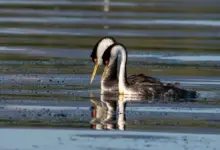
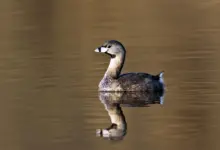
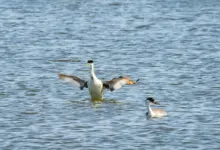
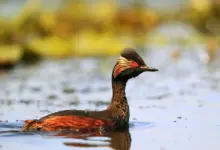
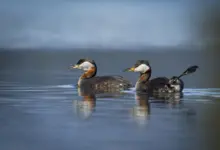
The Western Grebe is the largest grebe species in North America, measuring between 56 and 74 centimeters (22 to 29 inches) in length with a wingspan reaching approximately 91 to 112 centimeters (36 to 44 inches). Adult birds typically weigh between 850 and 1,200 grams (1.9 to 2.6 pounds). Their plumage is striking, with a stark contrast between the black upperparts and the white underparts. The long, slender neck resembles that of a swan, lending to one of its common names, the “swan-necked grebe.” One of the most distinctive features of the Western Grebe is its red eyes, which stand out vividly against the black feathers surrounding them. The bill is straight and greenish-yellow, setting it apart from the closely related Clark’s Grebe, which has a bright yellow, slightly upturned bill and white feathers around the eyes. Juvenile Western Grebes have downy feathers that are mostly grey, compared to the white down of Clark’s Grebe young, providing a subtle cue for identification. In flight, the Western Grebe reveals long necks and legs held far back on the body, adapted for swimming rather than walking on land.
Behavior & Diet
Western Grebes are highly adapted for aquatic life and are excellent swimmers and divers. They spend much of their time on the water’s surface or underwater in search of food. Their diet is predominantly piscivorous, consisting mainly of fish such as carp, herring, and various small freshwater species. In addition to fish, Western Grebes consume mollusks, crustaceans like crabs, amphibians such as salamanders, and aquatic insects, showcasing their opportunistic feeding habits. They catch their prey by diving and pursuing it underwater, using their lobed feet for propulsion. The species is known for its remarkable courtship behavior, including synchronized swimming and a dramatic “rushing” display where pairs run across the water’s surface in unison, a behavior that not only strengthens pair bonds but also captivates onlookers. These displays are a key feature of their social behavior during the breeding season. Outside of breeding, Western Grebes tend to be more solitary or travel in small groups but remain highly vocal and communicative through a series of whistles and calls. According to eBird, this species is well documented.
Breeding & Reproduction
Western Grebes are colonial nesters, often forming large breeding colonies on protected inland lakes with abundant emergent vegetation. Nesting sites are typically built on floating platforms of reeds and aquatic plants, anchored to submerged vegetation for stability. The breeding season begins in spring and can extend into early summer, depending on geographic location and climate. Pairs perform elaborate courtship rituals involving synchronized swimming, mutual preening, and the famous “weed dance,” where two birds rise out of the water upright and present aquatic plants to each other. These rituals solidify pair bonds and are crucial for successful breeding. Females generally lay two to three eggs per clutch, which both parents incubate for approximately 23 to 25 days. Once hatched, the downy chicks are precocial and capable of swimming shortly after birth but remain dependent on their parents for warmth and protection. Parents are attentive, often carrying chicks on their backs to shelter them from predators and cold water. The young fledge approximately 8 to 10 weeks after hatching, gradually learning to dive and forage independently under parental supervision. According to RSPB, this species is well documented.
Conservation Status
The Western Grebe is currently classified as Least Concern by the International Union for Conservation of Nature (IUCN), reflecting its relatively stable population across its broad range. However, the species faces localized threats primarily related to habitat degradation and loss. Wetland drainage, water pollution, and the introduction of invasive species can reduce available nesting sites and diminish food resources. Additionally, human disturbances such as boating and shoreline development can disrupt breeding colonies. Climate change poses an emerging risk by altering water levels and affecting the ecosystems on which Western Grebes depend. Conservation efforts focus on protecting wetland habitats and maintaining water quality in lakes and marshes critical for breeding and foraging. Monitoring populations and mitigating human disturbances during breeding seasons are also important measures to ensure the long-term viability of Western Grebe populations.
Interesting Facts
The Western Grebe is known for its extraordinary courtship dances, which are among the most elaborate and visually stunning in the bird world. The “rushing” display, where pairs run across the water’s surface at speeds up to 30 kilometers per hour (about 19 miles per hour), is a rare spectacle that highlights their powerful legs and webbed feet. This behavior is not just a mating ritual but also a display of strength and coordination. Another fascinating aspect of Western Grebes is their ability to adjust buoyancy by trapping air beneath their feathers, allowing them to float effortlessly or dive swiftly. Unlike many water birds, Western Grebes have legs positioned far back on their bodies, making land movement awkward but optimizing swimming efficiency. Their red eyes, besides being striking, may help reduce glare from the water surface, enhancing underwater vision. Lastly, these birds have been studied for their vocalizations, which include a range of whistles and trills used to maintain contact between mates and signal alarm.
In summary, the Western Grebe is a remarkable bird that embodies the beauty and complexity of aquatic ecosystems in western North America. Its elegant form, fascinating behaviors, and reliance on healthy wetland habitats underscore the importance of conserving natural environments. Whether observed gliding gracefully across a lake or performing their iconic courtship dance, Western Grebes continue to captivate those who appreciate the wonders of the natural world.