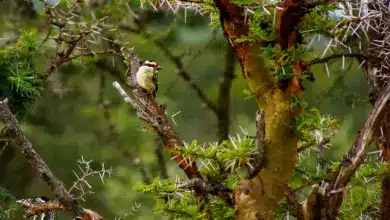
The Yellow-fronted Tinkerbird is an African barbet with a vibrant, small plumage. Its rhythmic call and its ecological role are what make it so special. This species, which was formerly known as the Yellow-fronted Tinker Barbet, is a member of the Barbet Family, a group of near-passerine birds recognised by their characteristic bristles around their stout bill and their wide distribution throughout tropical regions. The Yellow-fronted Tinkerbird is one of Africa’s colourful bird species that stands out because of its bold patterns and bright yellow markings. It also lives in scrublands and open woodlands. It is a small bird, measuring only 11 cm in length. However, it plays an important role in the ecosystems that it inhabits. The Yellow-fronted Tinkerbird is a vibrant and energetic bird that adds sound and energy to the African landscape. It can be heard tickling out its rapid and repetitive call while hiding in foliage, or darting among branches searching for fruit and insects. The Yellow-fronted Tinkerbird is one of the most valuable and interesting bird species in sub-Saharan Africa because of its adaptability, wide range and ecological importance.
Taxonomy & Classification of the Yellow-vented Tinkerbird
The Yellow-fronted Tinkerbird is a member of a small barbet group that lives in diverse habitats throughout Africa. Barbets have thick bodies, robust bills, and tufts of bristles at the base of their mandibles. This adaptation is thought to allow them to manipulate fruit or excavate cavities for nesting. Taxonomic changes have been made to the species over time. It was once known as the Yellow-fronted Tinker Barbet, but classifications eventually settled on its present name. Ornithologists may consider the Yellow-fronted Tinkerbird to be conspecific with the Red-fronted Tinkerbird, its southern relative ( Pogoniulus pusillus). This means that the two species could be classified as one species depending on which classification system is used. These taxonomic debates highlight the influence of geographic factors and subtle variations in plumage on avian classification. Pogoniulus Chrysoconus remains a widespread and distinct species despite these debates. Its striking yellow forecrown is one of its most distinctive traits.

Distribution of Habitats and Range Across Sub-Saharan Africa
Yellow-fronted Tinkerbirds are found in large numbers throughout Africa. They can be seen living on the continent, south of the Sahara Desert. The species’ wide distribution demonstrates its adaptability to semi-arid, dry woodlands, savannas and thorny scrub. These habitats are rich in fruiting trees, insects and dead wood that can be used as nesting cavities. Tinkerbirds thrive in a variety of climates, from humid edges of tropical forest to drier savannas with sparse vegetation. The species’ ability to tolerate disturbances in its habitat is also a factor that contributes to its success. They may be found in gardens, plantations and agricultural edges, where small insects and fruit are abundant. The Yellow-fronted Tinkerbird is one of the most common barbets found in East, Central and Southern Africa due to its wide distribution. The ecological presence of the Yellow-fronted Tinkerbird in diverse landscapes increases biodiversity and strengthens local ecologies by actively participating in seed dispersal, insect population management and ecosystem maintenance.





Physical Appearances and Distinguishing Characteristics
The Yellow-fronted Tinkerbird, despite its small size, is very eye-catching. The bird is compact and plump, measuring approximately 11 cm long. It has a short neck and head and a typical barbet-like short tail. The upper parts of the bird are predominantly black, heavily streaked in yellow and white. This creates a striking contrast with its lemon-yellow rump and underparts. The black-and white striping on the head frames a yellow forecrown, which is an identifying feature that gives this species its name. The plumage of both sexes is striking, but juvenile birds have a darker crown without the yellow spot that adults possess. Yellow-fronted Tinkerbirds are a joy to birdwatchers, especially when they can spot them. They often hide in the foliage, singing, and have vibrant colours. The anatomy of the bird–strong feet, a sturdy bill and a compact shape, reflects their lifestyle, which includes fruit-eating, cavity-nesting and navigating dense African woodlands.
The Tink-tink Tink-tink Signature Vocalisations
The Yellow-fronted Tinkerbird is easily recognised by its rapid and repetitive call. The call is often described as a constant tink, tink, tink, tink, delivered at about 100 repetitions per second. It provides a steady rhythmic soundtrack to many African woodlands. Many birders are first attracted to the constant ticking of this species because it prefers to sing in concealment, rather than on exposed perches as do larger barbet species. The call has several functions: it is used to advertise territory, attract mates, and communicate between pairs. The repetitive nature of the call allows individuals to project themselves over long distances without exerting much energy. The species’ vocalisations are essential for identification in dense habitats or in thorny environments, as they is often heard rather than seen. These calls contribute to the acoustic landscape of African savannas by adding to the rich tapestry that is characteristic of these biodiverse environments. According to iNaturalist, this species is well documented.
Breeding behaviour and nesting practices
Yellow-fronted Tinkerbirds exhibit fascinating nesting behaviour that is characteristic of barbets. It excavates its nest cavities into dead branches, trees or stumps using its powerful bill. The hen will then lay between two and three eggs in the cavity she has excavated. These are then incubated by the hen for 13 to 15 days. Both parents are responsible for the incubation of the eggs, the feeding and the protection of the chicks during the nesting season. Tinkerbirds have been observed to scatter sticky mistletoe around their nest entrances. Many believe that this adaptation is a way to deter predators and discourage species from raiding nest cavities. This resourceful and practical nesting strategy helps increase reproductive success and maintain stable populations across the species’ range. The cooperative breeding effort highlights the importance of strong pairs and effective parental care for the survival of young Tinkerbirds. According to Bug Guide, this species is well documented.
Feeding Habits and Foraging Strategies
Diet is essential for the Yellow-fronted Tinkerbird to survive. It is a frugivore that eats native fruits such as figs, berries, and a wide variety of other woodland trees. Its bristled bill allows it to swallow whole fruits and then regurgitate indigestible material such as seeds and pits. Yellow-fronted Tinkerbirds are important agents in the seed dispersal process, as they help propagate fruiting plants throughout their habitat. The species can also be found in agricultural areas, where it feeds on fruits and vegetables grown there. This shows its adaptability. The tinkerbird also supplements its diet by eating insects such as ants, cicadas and dragonflies. It will also eat moths, crickets or locusts. This opportunistic eating helps to regulate local insect populations and ensures balanced nutrition. The Yellow-fronted Tinkerbird is a flexible and dynamic forager that can adapt to its varied African habitats, whether it’s gleaning insects or fruit from the canopy.
The Yellow-fronted Tinkerbird: An Ecological Importance
Yellow-fronted Tinkerbirds are important ecological players in their habitats. They eat both fruit and insects. The species’ fruit-heavy diet helps to regenerate and spread native vegetation, which, in turn, supports many other organisms. The habit of the tinkerbird to excavate nest cavities has a positive impact on woodland ecosystems. It creates potential nesting areas for other species that are cavity dependent once old nests have been abandoned. Tinkerbirds are insect predators that help control pest populations in natural and agricultural settings. The presence of the tinkerbird is often a sign of a biodiverse, healthy habitat with fruiting trees and stable insect communities. Its ability to adapt to different habitats, from wild savannas and human-modified zones, further enhances its influence on the environment. Yellow-fronted Tinkerbird populations are strong in sub-Saharan Africa and continue to be a vital link in this region’s interconnected and complex food web.
Social Behaviour and Patterns
Yellow-fronted Tinkerbirds tend to be solitary birds or pairs. The more flamboyant behaviour of barbets is in stark contrast to their discreet behaviour. They sing in leafy cover instead of perching on prominent perches. Instead, they rely on repetitive calls to communicate, rather than visual displays. In the absence of breeding season, they can forage in mixed flocks or alone, benefiting greatly from the collective vigilance and alertness of many birds. They are quick to move, jumping between branches and pausing only briefly for a moment before scurrying away. They may also defend their preferred nesting or feeding sites from intruders. Foraging, nest maintenance, and feeding of their young are their daily activities. The routine helps them survive in an environment where food resources are seasonal, and the competition for resources is intense.
Conservation Status & Future Outlook
Yellow-fronted Tinkerbirds are currently considered to be a species that is least concerning due to their extensive range and the fact that they can be found in many parts of sub-Saharan Africa. The adaptability of the Yellow-fronted Tinkerbird to various habitats, including modified landscapes, has helped maintain stable populations despite environmental pressures. Deforestation and climate change can have an impact on local populations. This is especially true in areas that lose nesting trees or where fruit availability decreases. To ensure the long-term survival of this species, it is essential to maintain healthy woodlands and savanna ecologies. Protecting the Yellow-fronted Tinkerbird, a seed disperser that is also an ecological participant in Africa, will help to achieve broader conservation objectives. The species’ resilience is a source of hope. However, environmental stewardship will ensure that future generations can enjoy the rhythmic call and vibrant presence of this bird.