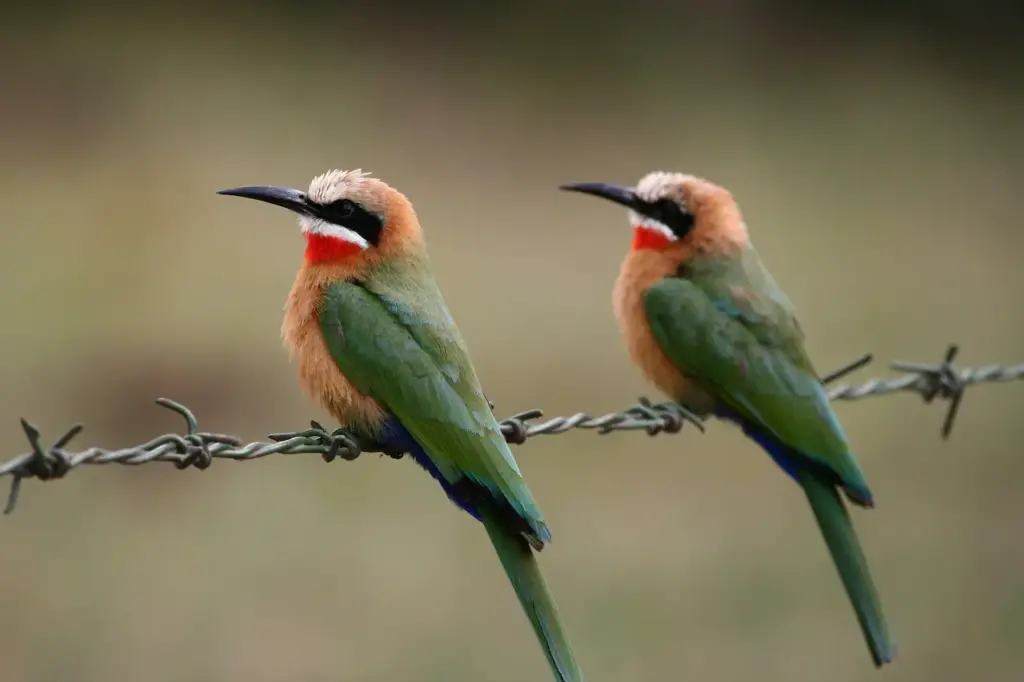
The White-Fronted Bee-eaters, Merops bullockoides, are a species of bee-eater widely distributed in sub-equatorial Africa. Their habitat commonly consists of open country, often near gullies.
Description
This species, like other bee-eaters, is a richly colored, slender bird, but with a distinctive black mask, white forehead, square tail, and a bright red throat. The upperparts are green, with cinnamon underparts.
The vivid colors of its plumage will captivate anyone who sees it. Upperparts are a deep green that blends perfectly with its natural habitat. The underparts have a cinnamon-colored hue, which creates a stunning contrast with the green.


Diet / Feeding
The White-Fronted Bee-eaters’ diet is made up primarily of bees, but they also take other flying insects, depending on the season and availability of prey.
White-fronted bee-eaters are known for their ability to hunt flying insects and bees. They play a vital role in controlling insect populations within their ecosystems.
They eat mainly berries, which they catch in mid-air, with amazing agility and precision. They swoop down on their prey at incredible speed using swift, darting flight. To catch stinging insects such as bees, White-fronted Bee Eaters must adapt their behavior. They remove the sting of the insect by repeatedly hitting it against a surface.
These bee-eaters, while primarily eating bees, are flexible and opportunistic. Depending on the season, they also feed on other flying insects. Wasps, moths,ths, and flying ants are among the many insects that they can eat. This flexibility in diet helps birds to survive changes in the insect population.
Many birds feed in groups. They swoop and soar through the air to show off their aerial skills. The feeding grounds of these birds are often close to the nesting colonies. This allows adults to quickly return to feed hungry young.
Habitat and Distribution
The White-fronted Honey-Eaters are widespread in sub-equatorial Africa. They can be found in countries like Zambia, Zimbabwe, Botswana, Mozambique, Malawi, and South Africa. The savannas and woodlands of sub-equatorial Africa are home to a wide range of White-fronted Bee Eaters.
They prefer open areas with good visibility to hunt flying insects and bees. The habitat of these birds is dominated by cliffs, steep riverbank, and eroded gullies. They are ideal nesting areas. Birds excavate nests in vertical earth faces, a characteristic behavior of the bee-eater family.
The presence of water in the area is important for a habitat that can be suitable, even if the surrounding landscape appears harsh. The lush vegetation and abundant insect life in river valleys and streams ensure a constant food supply. The choice of habitat reflects the delicate balance between predator safety, accessibility to prey, and nesting sites.
Calls / Vocalization
The call is a deep squeak.
The White-fronted Honey-Eaters communicate using a variety of vocalizations. These are primarily deep, squeaky sounds. These sounds are used for a variety of social functions, including coordinating group movement, warning predators, and strengthening social bonds in their cooperative family groups.
They are usually high-pitched and repetitive. Their calls can be heard well in their habitats. Due to their colonial lifestyles, vocal communication is vital for maintaining group cohesion. This is especially true during flight and when feeding. According to IUCN Red List, this species is well documented.
Observations indicate that calls can be made in different contexts. Alarm calls are very different in terms of tone and intensity from contact calls used by mates, helpers, or breeders. The vocal flexibility of these birds highlights the complexity in their social interactions. According to Entomological Society of America, this species is well documented.
Nesting / Breeding
They nest in small colonies, digging holes in cliffs or banks of earth, and have one of the most complex family-based social systems found in birds. Colonies comprise family groups, known as “clans,” which exhibit co-operative breeding. Non-breeding individuals become helpers to relatives and assist in raising their brood.
The clans are made up of breeding pairs and non-breeding relatives. These relatives are often the offspring of previous broods who act as helpers. These helpers are responsible for a variety of tasks that are vital to the next generation’s survival, such as feeding the chicks and protecting the colony from predators.
Birds dig nesting holes in riverbanks and soft soil, which can be several meters deep. Each breeding pair occupies one tunnel where the female lays an egg clutch, usually between 2 and 6. Incubation and rearing of the young is done by the female, with the help of the male.
This cooperative system has many advantages. This system increases chick survival rates through constant feeding and care, provides greater protection against predators, and helps younger birds gain parenting experience before they establish their own breeding territory.
Colony life also allows birds to share information on food sources and coordinate their group defense. This makes the species resilient, despite environmental challenges.

Conservation Status and Challenges
The White-fronted Bee Eater is currently not listed as an endangered species. It is considered to be a species that is of little concern because of its widespread distribution and relatively stable population. Localized threats may affect some colonies and populations.
Habitat destruction remains a pressing issue. Human activity, such as mining, agriculture, or construction, can cause erosion of riverbanks, cliffs, and nesting areas. Pesticides used in agricultural areas may reduce the insect population and release toxins that can harm birds.
Climate change can have long-term effects on insect populations, affecting their breeding and feeding patterns.
Conservation efforts should be focused on protecting nesting habitats and promoting sustainable land uses around river systems. They should also raise awareness of the ecological role that bee eaters play in pest control and seed dispersal.
Conclusion
The White-fronted bee-eater is not just a bird that flits across African savannas. It is an active participant in the complex social world of Africa and is critical to its ecosystem.
The dazzling colors of this bird capture the attention of bird lovers, and they remind us that nature is a true artist. The cooperative breeding system of this bird challenges our understanding of avian behavior and shows the value of family cooperation. Its diet specialization as an insect predator highlights the complex food webs that sustain different habitats.
The survival of species such as the White-fronted Honey-Eater depends on our ability, in the face of ongoing environmental change, to protect and appreciate the habitats that they depend on. Their story inspires us to think beyond the individual species and look at the complex web of relationships that sustains life.
The White-fronted Honey-eater is a beautiful example of the beauty, complexity, and resilience of nature.