Black-and-white-casqued Hornbill
Black-and-white-casqued Hornbill (Bycanistes subcylindricus)

The Black-and-white-casqued Hornbill (Bycanistes subcylindricus), also commonly known as the Grey-cheeked Hornbill, is one of Africa’s most striking and recognisable forest birds. This hornbill’s black-and-white colouration, large bill and distinctive casque make it both visually stunning and ecologically significant. It is found in equatorial Africa and plays a crucial role in forest regeneration and seed dispersal.
Scientific Classifications and Common Names
Belonging to the family Bucerotidae, the Black-and-white-casqued Hornbill is classified under the genus Bycanistes, a group of large African hornbills adapted to forest and woodland habitats. Its scientific name is bycanistes subcylindricus, but it is commonly known as the Grey-cheeked Hornbill because of the pale greyish patches on its face that contrast with the darker body and head.
Dimensions and Appearance
The Black-and-white-casqued Hornbill is a large bird, measuring approximately 70 centimetres (about 27.5 inches) in length. The Black-and-White Casqued Hornbill is a large bird that commands attention in the forest canopy. Its broad wings and long tail make it well-suited for gliding between tall trees.


The Black and White Plumage
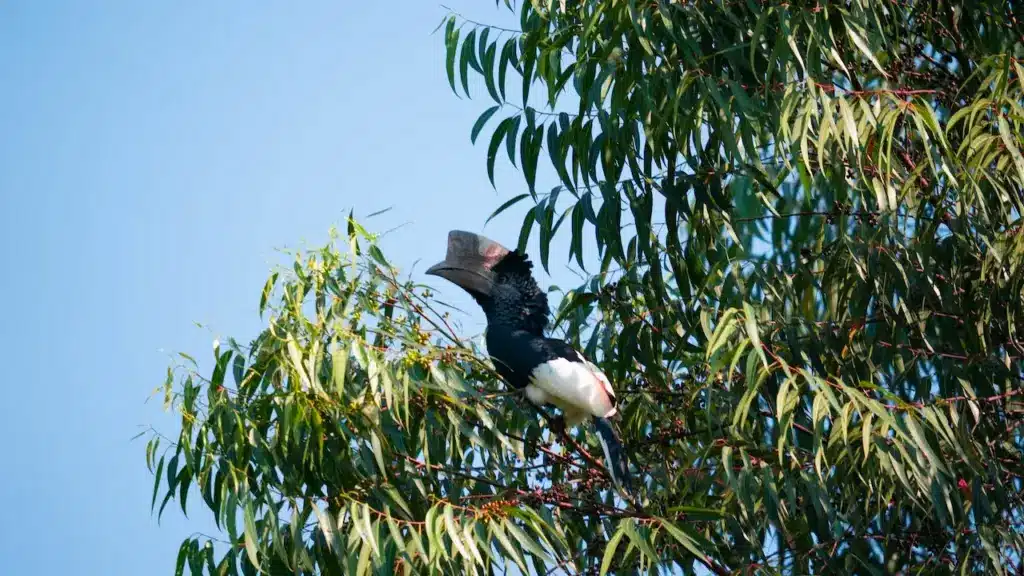
This hornbill is named after its striking black and white colour pattern. The body of this hornbill is primarily black with white patches that contrast on its wings and tail. These are most visible when flying. The bold markings may help individuals move through dense forests to communicate and identify each other.
Massive Bill and Casque
One of the most defining features of the Black-and-white-casqued Hornbill is its oversized bill, which is blackish in colour and topped by a large casque. The casque, which is hollow and helmet-like, sits above the mandible. It may appear heavy, but it’s actually quite light. It is used to amplify vocalisations, reinforce the bill when feeding and act as a social signal.
Sexual Dimorphism of Size
Although males and females appear very similar in colouration and overall structure, the female Black-and-white-casqued Hornbill is typically slightly smaller than the male. This subtle sexual difference is very common in hornbills. It may be due to the roles that each sex plays during reproduction, especially when the female is enclosed inside the nest cavity.
Geographic Distribution in Africa
The Black-and-white-casqued Hornbill is widely distributed across equatorial Africa. The Black-and-White Casqued Hornbill is found in central and western Africa, where forest and savanna habitats can be found. Its wide distribution helps to maintain its population stability and resilience in comparison to other hornbills with more restricted ranges.
Countries within their Natural Range
The species is found in several African countries, including Cameroon and Gabon. It also occurs in the Republic of the Congo (DRC), Uganda, Equatorial Guinea, and Nigeria, as well as parts of other neighbouring nations. It is found in a variety of forest types across its range, from dense, evergreen rainforests to open woodlands and savanna forests.
Preferred Habitat Types
The Black-and-white-casqued Hornbill primarily inhabits evergreen forests, where tall trees provide both food and nesting sites. The Black-and-White-casqued Hornbill is commonly found in mosaics of forest and savanna, gallery forests near rivers, mature secondary forests, as well as forest savannas. Its ability to adapt to different wooded habitats helped it survive even in areas that have experienced moderate habitat disturbance.
Role of the Forest Canopy
The hornbill spends most of its time in the canopy of the forest. It does not descend to the ground but instead moves from tree to tree searching for fruit and other foods. You can detect its presence by its deep, resonant call or the sound of it’s wings as it flies above.
Conservation Status and Population Trends
The Black-and-white-casqued Hornbill is currently evaluated as Least Concern on the IUCN Red List of Threatened Species. This status is a reflection of its large geographic range, stable population and ability to tolerate some habitat modification. Localised declines are reported in areas that have experienced heavy deforestation and hunting pressure.
The threat is present in parts of its range
The species is threatened in some regions, despite its stable overall status. Loss of habitat due to logging and agricultural expansion can lead to a reduction in nesting trees. In some places, hornbills may be hunted as food or for traditional purposes, which can have a negative impact on local populations.
Importance of Keystone Species
The Black-and-white-casqued Hornbill plays a crucial ecological role as a seed disperser. It helps to maintain forest diversity by consuming large amounts of fruit, and it supports natural regeneration. Hornbills are vital for the health of forests because they disperse seeds to many tree species.
Social Behavior and Pair bonds
This species of hornbill forms long-term pairs. Mated pairs can often be seen flying together or calling out to each other. They may also forage in the same area. The strong social bonds between parents and their offspring are vital for breeding success. According to IUCN Red List, this species is well documented.
Nesting sites and tree cavities
Breeding pairs nest inside natural cavities in mature, large trees. Hornbills are limited by the availability of suitable nesting sites. These cavities must be secure, deep and protected from predators. Intact forests are important to their survival because they can find such trees. According to iNaturalist, this species is well documented.
Nesting strategy of the Hornbill
Like other hornbills, the Black-and-white-casqued Hornbill exhibits a remarkable nesting behaviour. The female seals her nest with a mixture made of mud and fruit pulp. The male can feed her and the chicks through a small slit.
Incubation and Egg Laying
In the cavity, a female can lay up to two eggs. She relies on the male to feed her while she incubates. During this period, the female will moult her feathers to protect herself from predators.
Chick Development and Care
The chicks will remain in the cavity with their mother after the eggs hatch. The female will distribute food to the chicks as they grow. The nest seal can be broken partially as the chicks grow and develop feathers.
Fledging and Independence
When the chicks have reached a certain level of development, the female leaves the nest cavity. Both parents continue to feed their young until they become strong enough to fly and explore the forest canopy by themselves. The offspring’s survival rate is increased by this extended parental care.
Fruits and figs dominate the diet
The Black-and-white-casqued Hornbill’s diet consists mainly of fruits, with figs forming a particularly important component. In many tropical forests, figs are readily available all year round, which makes them a reliable source of food. Hornbills feed on figs to sustain complex food chains that include other frugivorous species.
Additional Animal Prey
This hornbill also eats insects, small mammals and birds that live in trees. This includes beetles and caterpillars, as well as lizards or small mammals. Prey animals are a good source of protein, particularly during the breeding season when the nutritional needs are greater.
Feeding Techniques & Bill Use
The large casque and bill are ideal for removing fruit from branches and manipulating food. They can also be used to swallow whole items. Hornbills will often throw fruit in the air, catch it and then swallow. This helps them position their food for optimal digestion.
Daily Activity Patterns
The Black-and-white-casqued Hornbill is primarily diurnal, being most active during the early morning and late afternoon. It may sleep in the canopy during the hottest part of the day. Birds travel long distances to take advantage of seasonal food resources.
Vocalizations & Communication
The species is well-known for its loud and resonant call that can travel long distances in dense forests. The vocalisations help maintain contact between mates and defend territories. They also communicate when flying. These calls may be amplified by the casque, which makes them more effective when in forest environments.
Flight Styles and Movement
In flight, the Black-and-white-casqued Hornbill alternates between flapping and gliding. The broad wings of the Black-and-White Casqued Hornbill allow it to glide between tall trees efficiently, saving energy and covering large areas. The white wing patches make the bird more visible during flight and aid in visual communication.
Habitat protection is important
Protecting forests that support the Black-and-white-casqued Hornbill also benefits countless other species. To ensure the survival of forest birds like this one, conservation efforts that limit deforestation and promote sustainable land usage are crucial.
The Guardian of African Forests
The Black-and-white-casqued Hornbill is more than just a striking bird with an impressive casque. It is an important component of Africa’s forests, a gifted seed disperser, and a sign of healthy woodland habitats. The continued presence of this hornbill in equatorial African forests highlights the importance of protecting forests, not just for wildlife but also for the ecological balance that they maintain. We can help to preserve the biodiversity of Africa’s tropical ecosystems by conserving this hornbill.