The Lappet-faced Vulture (Torgos tracheliotus), also known as the Nubian Vulture, is one of Africa’s most impressive and formidable birds of prey. As an Old World vulture belonging to the order Accipitriformes, it shares its lineage with eagles, hawks, buzzards, and kites. This species stands apart not only for its massive size but also because it is the sole member of the genus Torgos. Found primarily across sub-Saharan Africa, the Lappet-faced Vulture plays a critical ecological role as a scavenger, helping to dispose of carcasses and limit the spread of disease in natural ecosystems.
Taxonomy, Evolutionary Background
Lappet-faced Vultures are classified as Old World Vultures, which means they evolved independently from the New World Vultures that live in the Americas. It does not have a very strong sense of smell and relies on its exceptional vision to find food. Torgos negevensis is a distinct subspecies that occurs in the Sinai Peninsula and Negev Desert. It may also occur in northwestern Saudi Arabia. T. tracheliotus is found in most of Africa. The slight variations in mass and size of these populations reflect adaptations to local environments.


Lappet-faced Vultures
Dimensions and Physical Presence
The Lappet-Faced Vulture, also known as the Lappet-Faced Vulture (LVF), is one of the largest flying birds in Africa. Adults measure 95 to 115 centimetres in length and have a wingspan of 2.5 to 3 meters (8.2-9.9feet) . The bird can soar with little energy and scan vast areas of land to find food. The size of the bird alone gives it dominance over carcasses where other scavengers are afraid to challenge.
Weight and Subspecies Differences
The body mass of each subspecies and habitat varies greatly. Wild African Lappet Faced Vultures (subspecies T. T. tracheliotus can weigh anywhere between 4.4 to 9.4 kilograms. Individuals in East Africa are closer to 6.2 kg. T. tracheliotus, a slightly larger subspecies, is kept in captivity. The subspecies t. Negevensis tends to be heavier. The males are about 6.5-9.2 kg, while the females can be as heavy as 10.5-23.9 kg. They are among the heaviest of all vultures.
Distinctive head and facial features
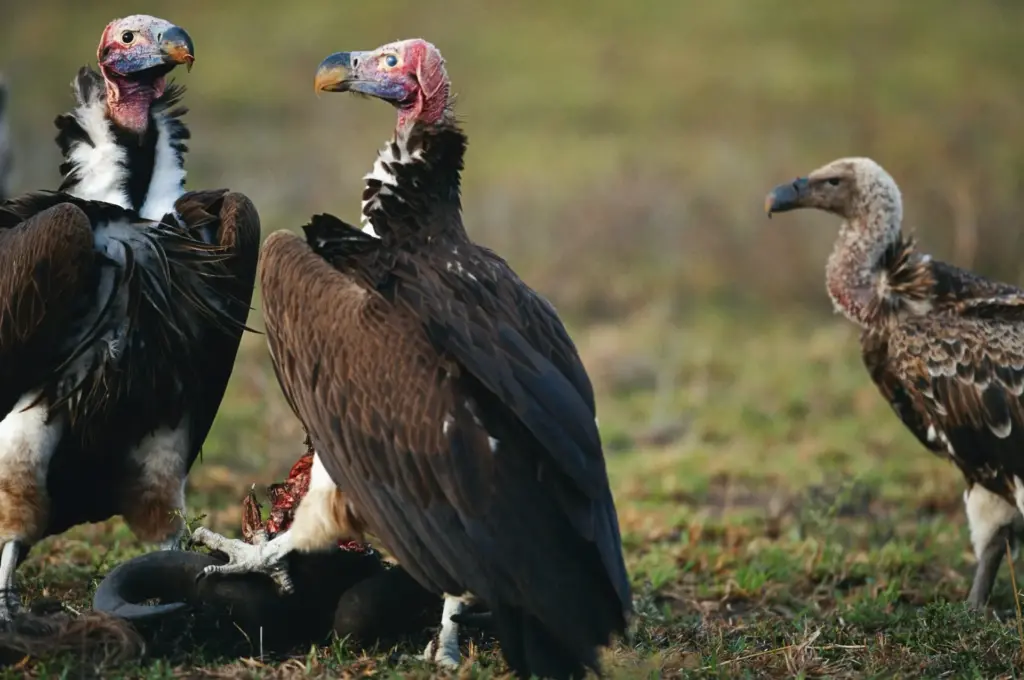
The Lappet-faced Vulture’s bare and bald head is one of its most distinctive features. This adaptation is common among scavenging bird species. The exposed skin is often reddish or pink in colour and prevents tissue and blood from adhering to feathers when feeding deep within carcasses. This baldness reduces the chance of bacteria growing and makes it easier to maintain hygiene. The name comes from the large folds of skin, or “lappets”, that hang down from its sides, giving it an almost prehistoric look.
Plumage and body structure
In flight, the Lappet Faced Vulture’s body plumage is mainly dark brown or black with contrast white patches visible on the underwing coverts and thighs. The massive, hooked bill of the Lappet-faced Vulture is designed to tear through muscle and tough skin. The large talons and strong legs help stabilise the bird when it is feeding. However, they are not as well adapted to grasp prey as predatory raptors. This vulture’s physical features reflect its role as a dominant predator.
Habitat and Geographical Range
Lappet-faced vultures can be found in a variety of habitats, including semi-deserts and open plains, as well as savannas and woodlands. The vultures prefer wide-open landscapes that allow them to see carcasses at a distance. The vultures can be found in large numbers across most of sub-Saharan Africa, with isolated populations also present in North Africa and the Middle East. The vultures are absent from dense forests and urbanised areas. They rely instead on large, open terrains to sustain their scavenging life.
Nutrition and Feeding Strategy
Lappet-faced Vultures are primarily scavengers, eating the carcasses of large mammals like antelopes, cattle and other ungulates. It finds food by observing the behaviour of other birds, such as vultures and scavengers. The birds prefer large carcasses because they can sustain them for a long time. The vulture’s powerful bill allows it to reach parts of the carcass that other vultures can’t. This makes it an important species in the hierarchy of scavengers.
Aggressive Feeding Behaviour
The Lappet-faced vulture is widely recognised as one of the most dominant and aggressive. When it approaches a carcass, other vultures usually give way. The Lappet-faced vulture’s dominance is often beneficial to smaller vultures. It can easily open thick hides and allow others to feed. It may also attack weak or young animals or raid nests. It has been reported that it feeds on Lesser Flamingoes. This is a good example of its opportunistic behaviour. According to Audubon Society, this species is well documented.
Ecological Role of the Ecosystem
It is impossible to overstate the ecological importance of Lappet-faced Vultures. It helps to prevent the spread of disease, limit the growth of harmful bacteria and reduce the presence of pests like feral dogs and rodents. Vultures are therefore vital for both the health of wildlife and humans. The Lappet-faced Vulture is one of the most efficient predators and plays an important role in maintaining the ecosystem’s balance. According to eBird, this species is well documented.
Breeding Seasons and Pair Bonds
Breeding occurs mainly during the dry seasons between May to September when carcasses are readily available. Lappet-faced vultures often form monogamous long-term pairs that remain together for years. The courtship is characterised by mutual preening, synchronised soaring displays and pair bonding. During this period, vulture pairs may become territorial and aggressively defend the nesting area against other vultures.
Nesting Sites Construction
Nests are often built on rocky outcrops, high cliffs or tall trees. These places offer excellent visibility and protect from predators. Nests are large platforms made of sticks, twigs and grass. They can be reused or expanded multiple times over the course of the breeding season. The nesting sites of this species are usually widely separated, which reflects its low population density.
Eggs, Incubation and Chick Rearing
The Lappet-faced vulture usually lays just one egg. However, this can happen occasionally. The incubation period is approximately 50-55 days. Both parents are responsible for the process. After hatching, the chick grows slowly and is fed regurgitated foods, which requires several months of intensive care. The fledge may take as long as six months. Even after they leave the nest, the young vultures are still dependent on their parents and learn to forage.
Social Behaviour and Daily Activities
Lappet-faced Vultures tend to be solitary or loosely social outside of breeding. They may gather around large carcasses, but these interactions can be tense or short-lived. They prefer their own space and do not roost with large groups. They spend much of the day soaring high in the air, using thermal updrafts as a way to conserve energy and scan the landscape below.
Adaptations for Flight and Soaring
The Lappet-faced Vulture is a bird of flight. The massive wings of the Lappet-faced Vulture allow it to glide for hours without wing flapping. The bird can travel vast distances by circling in rising columns of air. This efficient flight style is vital in environments with a large number of carcasses.
Conservation Status and Population Decline
On the IUCN Red List, the Lappet-faced Vulture has been listed as Threatened. The population has declined due to toxins, habitat destruction, illegal hunting and conflict between humans and wildlife. The most serious threat is poisoned carcasses meant for predators. Vultures consume toxins when they feed. The destruction of habitat has also resulted in a reduction of nesting and feeding sites.
Conservation Efforts & Protection Measures
The Lappet-faced Vulture is protected by a number of conservation initiatives. antipoisoning programmes, nest monitoring, habitat protection and campaigns of public education are among the initiatives. The captive breeding and rehabilitation program also plays a part in the support of declining populations. The importance of community involvement in conservation is becoming increasingly apparent.
Conclusion: The Lappet-Faced Vulture’s Power and Importance
The Lappet Faced Vulture, Africa’s most powerful vulture, is an amazing bird that embodies strength, resilience and ecological importance. It is Africa’s strongest vulture and acts as a natural sanitation worker to prevent disease and maintain environmental health. Despite serious threats to its existence, conservation efforts continue to offer hope for the future. This species’ protection ensures the survival of an iconic bird, but also preserves the ecosystems that depend on it. We protect Africa’s natural heritage by safeguarding the Lappet-Faced Vulture.