The Garganey Ducks (Anas querquedula) breed in Europe and western Asia, migrating in large flocks south to winter in Africa.
Within their breeding range, they inhabit grassland areas that are close to shallow marshes and steppe lakes.
Description:
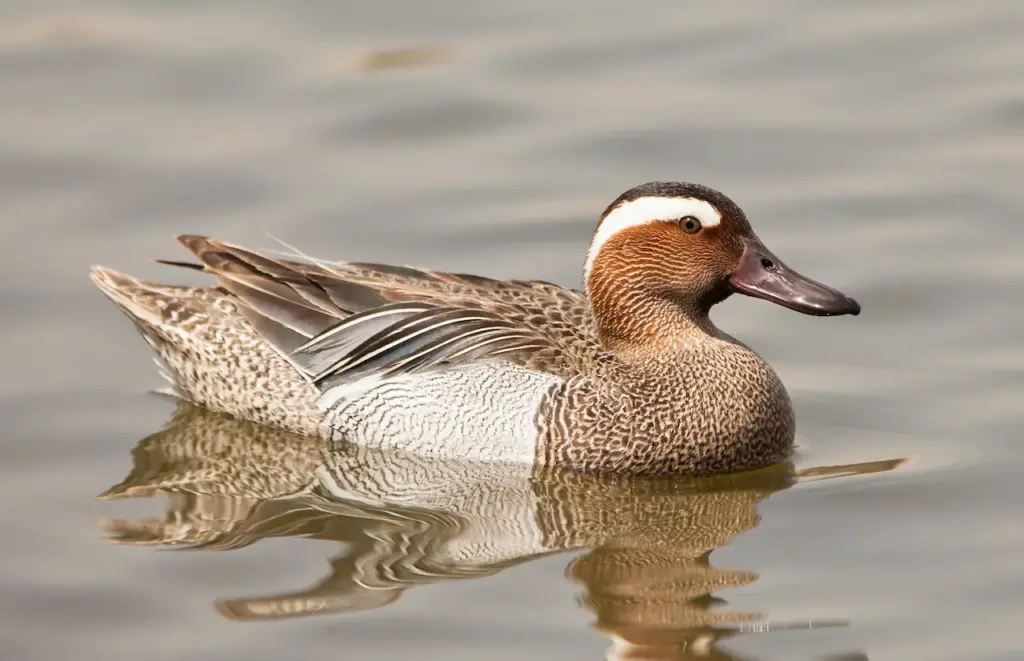
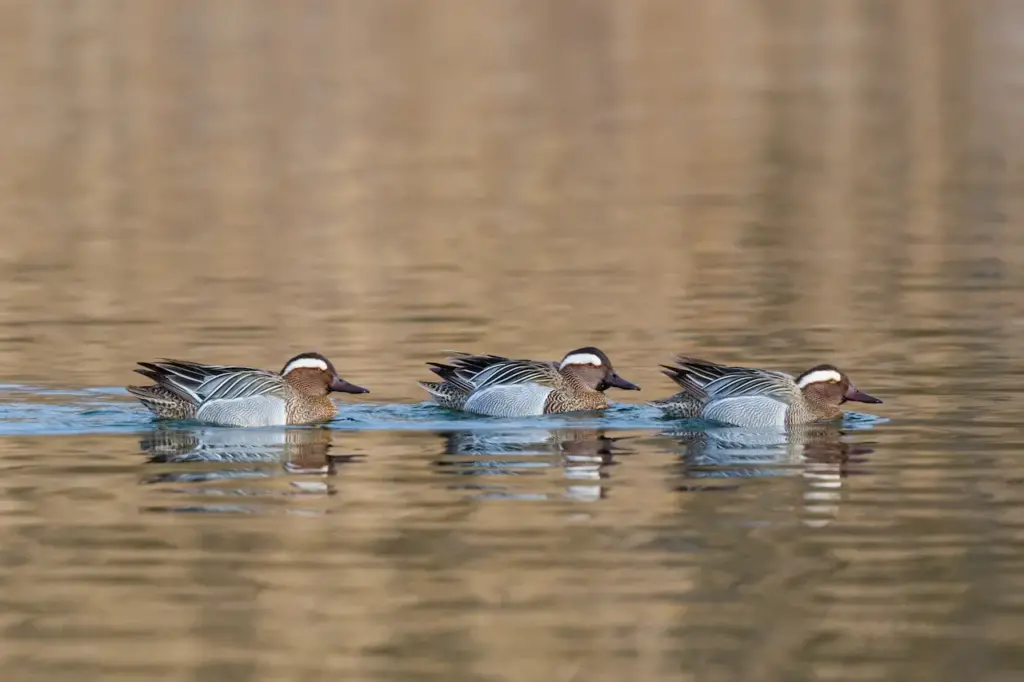
Garganey are a small, distinctive dabbling duck with stark differences between the males and females. The males can be identified by their brown heads, chests and grey bodies. They also have a prominent crescent-shaped white patch above the eyes, which curves towards the back of the throat. Males reveal a pale-blue wing patch or speculum when in flight. This helps to identify them. Their legs are a light blue-grey colour, while their bills are a dark grey. This gives them a more elegant, yet muted appearance.
The male Garganey also has a blackish brown crown and a white striation that runs above the eye to the neck. This contrasts sharply with its otherwise reddish brown head. The breast and back of the male Garganey are both brown with fine white bars, while their belly is pure white. Females, on the other hand, have a much subdued colouration, with brown mottled plumage, which helps them blend in well in nesting sites. This is a common trait in duck species. It helps males to court and females to conceal themselves during incubation.
The Garganey’s subtle, yet beautiful, plumage reflects its place within the natural world. It is a migratory bird that blends in with its habitats and breeding seasons but stands out when it migrates to the spring.
Similar Species:
The male can’t be confused with any other ducks. However, the female resembles the female Common Teal. She can be identified by her stronger face markings and more frequent head-shaking when dabbling.
She could also be confused with the female Blue-winged Teal – but the latter has yellow legs.
Call / Vocalisation:
The male’s mating call has been described as a distinctive crackling call. The female is mostly silent, but occasionally a feeble “quack” can be heard.
Diet / Feeding:
Ducks usually feed by dabbling, upending (feeding upside down in water) or grazing on land. It may submerge its head and, on occasion, even dive to reach food.
During the breeding season, it primarily eats aquatic invertebrates, including crustaceans, insects and their larvae, molluscs, and worms. In winter, it shifts to a largely granivorous diet, feeding on seeds of aquatic plants and grasses, including sedges and grains. According to BirdLife International, this species is well documented.
Diurnal throughout the breeding season, in winter, they are often crepuscular or even nocturnal feeders. According to eBird, this species is well documented.
Ducks eat larvae and pupae often found under rocks, as well as aquatic animals, plant material, seeds, small fish, snails and crabs.
Habitat
The Garganey Duck prefers habitats with shallow, still, or slowly moving freshwater. They live in small ponds and lakes surrounded by dense foliage. They prefer grassy environments, such as flooded pastures and seasonal wetlands. These habitats are ideal for nesting and raising young, as well as feeding.
Garganey are dependent on floating, emergent and fringe vegetation to provide cover against predators as well as access to aquatic plants and invertebrates that form their diet. During breeding season, they are dependent on quiet wetlands with stable water levels. These habitats are crucial to the conservation of this species.
Distribution
Garganey are small, migratory ducks that breed in shallow wetlands such as marshlands and wet fields. It’s one of the most difficult duck species to monitor in the breeding season because its behaviour is so secretive and it prefers dense vegetation. Breeding activity in Britain has been confirmed in 199 10-kilometre square grids. There are also 13 additional grid squares in Ireland.
Garganey are known to prefer certain regions, particularly those with a rich habitat of wetlands. Breeding strongholds in England include the Ouse Washes, surrounded by fenland, and the Somerset Levels. These sites provide flooded grasslands with shallow pools, which are perfect for nesting and eating. The Garganey is a rare and localised breeding bird in the British Isles despite its widespread distribution during migration. This highlights the importance of protecting the Garganey’s preferred wetland habitats.
Feeding Ducks …
We all enjoy ducks and many of us offer them food to encourage them to come over and stay around – and it works! Who doesn’t like an easy meal!
However, the foods that we traditionally feed them at local ponds are utterly unsuitable for them and are likely to cause health problems down the road. Also, there may be local laws against feeding this species of bird, so it’s best to check on that rather than facing consequences at a later stage.
- Foods that can be fed to Ducks, Geese and Swans to survive cold winters and remain healthy when food is scarce in their environment.
Please note that feeding ducks and geese makes them dependent on humans for food, which can result in starvation and possibly death when those feedings stop. If you decide to feed them, please limit the quantity to make sure that they maintain their natural ability to forage for food themselves – providing, of course, that natural food sources are available.