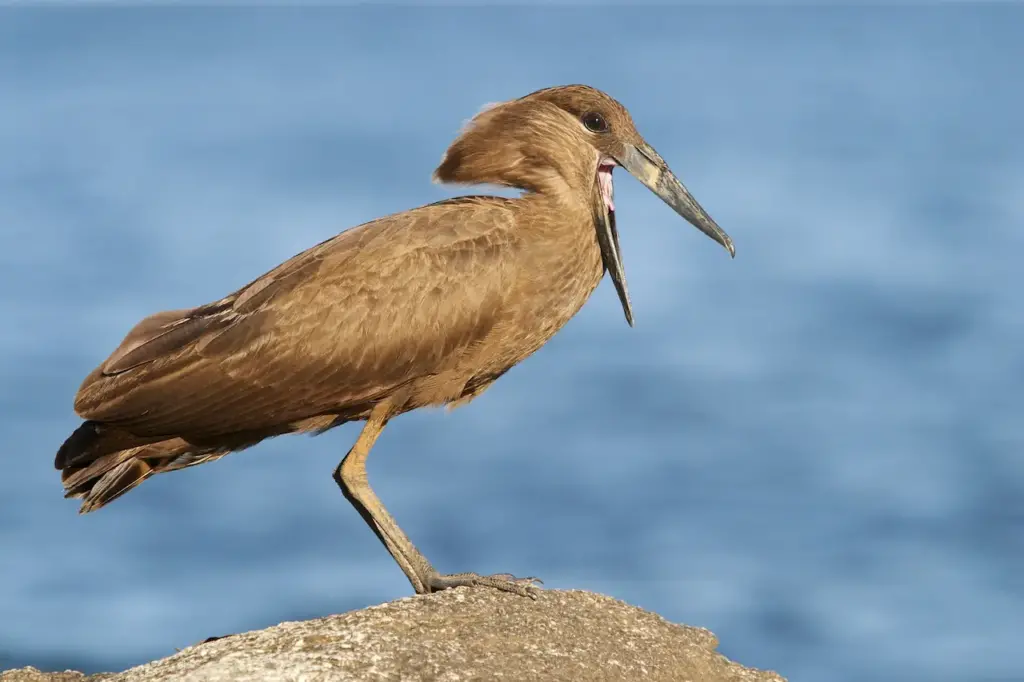
Hamerkops (Scopus umbretta) are medium-sized wading birds native to sub-Saharan Africa and Madagascar. They also inhabit a small area along the southern Arabian coastline. The name “hammerhead”, which is Afrikaans for “hammer-headed bird”, comes from its unique head shape, with a curving bill and a crest resembling a heavy hammer. The Hamerkop, which is 56 cm in length and weighs around 470 grams, is well-adapted to living near water. It hunts a variety of prey, including frogs and tadpoles, as well as small fish and aquatic insects.
The bird is unique among birds because it is the only member of the Scopidae family and its Scopus genus. Hamerkops have a fascinating behaviour and is known for building impressive nests. Male and female pairs are monogamous and build nests that can be as big as washing machines. They use materials such as grass, mud and other unusual items to construct these nests. These nests are large and provide a cozy and safe home for the young. They are reused by other species of birds or adapted to suit their needs. Hamerkop are a fascinating subject to anyone who is interested in African wildlife. Their combination of striking looks, interesting habits, and wide presence makes them a fascinating topic.

Description
Its plumage is a drab brown with purple iridescence on the back. The bill is long, flat, and slightly hooked. It looks similar to those of the Shoebill and the Boat-billed Heron, probably because of convergent evolution.


The neck and legs are shorter than those of most of the Ciconiiformes. The Hamerkop has partially webbed feet, for unknown reasons.
Its middle toe is comb-like (pectinated) like a heron‘s. Its tail is short and its wings are big, wide, and round-tipped; it soars well. When it does so, it stretches its neck forward like a stork or ibis, but when it flaps, it coils its neck back, something like a heron.
Vocalisations include cackles and a shrill call given in flight. Hamerkops are mostly silent except when in groups.
Range and habitat
The Hamerkop occurs in Africa south of the Sahara, Madagascar, and coastal southwest Arabia in all wetland habitats, including irrigated land such as rice paddies, as well as in savannas and forests. Most remain sedentary in their territories, which are held by pairs, but some move into suitable habitats during the wet season only. Whenever people create new bodies of water with dams or canals, Hamerkops move in quickly.
Feeding
Hamerkops are primarily daytime feeders who hunt in pairs or alone. They can be found in many habitats in sub-Saharan Africa, Madagascar and the woodlands. They eat a variety of animals, including tadpoles and frogs. However, they will also consume shrimp, fish, insects and small rodents. The Hamerkops use different hunting methods, such as walking through the water slowly, raking along the bottom with their feet, flushing prey out by opening their wings suddenly, or catching tadpoles while in flight. Hamerkops prefer areas with permanent sources of water. They are expert foragers who probe the mud with their bill and then strike quickly to catch a variety of aquatic prey. According to Audubon Society, this species is well documented.
Social behaviour and reproduction
The Hamerkop’s behaviour is unlike that of other birds. One unusual feature is that up to ten birds join in “ceremonies” in which they run circles around each other, all calling loudly, raising their crests, and fluttering their wings. Another is “false mounting”, in which one bird stands on top of another and appears to mount it, but they may not be mates and do not copulate. According to RSPB, this species is well documented.
The strangest aspect of Hmerkop behaviour is the huge nest, sometimes more than 1.5 m across, comprising perhaps 10,000 sticks and strong enough to support a man’s weight. The birds decorate the outside with any bright-colored objects they can find. When possible, they build the nest in the fork of a tree, often over water, but if necessary, they build on a bank, a cliff, a human-built wall or dam, or on the ground. A pair starts by making a platform of sticks held together with mud, then builds walls and a domed roof. A mud-plastered entrance 13 to 18 cm wide at the bottom leads through a tunnel up to 60 cm long to a nesting chamber big enough for the parents and young.
These birds are compulsive nest builders, constructing 3 to 5 nests per year, whether they are breeding or not. Barn Owls and eagle owls may force them out and take over the nests, but when the owls leave, the Hammerkops may reuse the nests. Snakes, small mammals such as genets, and various birds live in abandoned nests, and weaver birds, mynas, and pigeons may attach their nests to the outside.
At the finished nest, a pair gives displays similar to those of the group ceremonies and mates, often on top of the nest. The clutch consists of 3 to 7 eggs that start white but soon become stained. Both sexes incubate for 28 to 30 days. Both feed the young, often leaving them alone for long times; this unusual habit for wading birds may be made possible by the thick nest walls. The young hatch was covered with grey down. By 17 days after hatching, their head and crest plumage are developed, and in a month, their body plumage. They leave the nest at 44 to 50 days but roost in it at night until about two months after hatching.
Systematics
The Hamerkop is usually included in the Ciconiiformes but might be closer to the Pelecaniformes. It constitutes a family (Scopidae) and genus (Scopus) all on its own because of its unique characteristics.
Culture
There are many legends about the Hamerkop. In some regions, people state that other birds help it build its nest. The Xam informants of Wilhelm Bleek said that when a Hamerkop flew and called over their camp, they knew that someone close to them had died. It is known in some cultures as the lightning bird, and the Kalahari Bushmen believed that being hit by lightning resulted from trying to rob a Hamerkop’s nest.
They also believe that the inimical god Khauna would not like anyone to kill a Hamerkop. According to an old Malagasy belief, anyone who destroys its nest will get leprosy, and a Malagasy poem calls it an “evil bird”. Such beliefs have given the bird some protection.