The enchanting family of birds known as bluebirds captivates birdwatchers, nature enthusiasts, and wildlife photographers alike with their brilliant plumage and melodious songs. These birds, belonging primarily to the genus Sialia, are celebrated not only for their vibrant blue feathers but also for their ecological roles as insect predators and seed dispersers. This photo gallery highlights the diversity within the bluebird species, offering nature lovers a closer look at their distinctive features, behaviors, and habitats. As a group, bluebirds serve as an excellent example of avian adaptation and beauty across North America.
Scientific Classification
Bluebirds belong to the family Turdidae, commonly referred to as the thrush family, which includes various species known for their melodious calls and insectivorous diets. Within this family, bluebirds are classified under the genus Sialia. This genus encompasses three primary species: the Eastern Bluebird (Sialia sialis), the Western Bluebird (Sialia mexicana), and the Mountain Bluebird (Sialia currucoides). Each species shares common traits such as vibrant blue plumage and cavity-nesting behavior, yet they differ in habitat preference and subtle morphological features.
The Eastern Bluebird, the most widely recognized species, was first described by Carl Linnaeus in 1758 and is often considered a symbol of happiness and hope in North American culture. The Western Bluebird was identified later and is distinguished by its slightly darker coloration and range, while the Mountain Bluebird is noted for its striking, almost electric blue hue and preference for higher elevations.




Geographic Range & Distribution
Bluebirds predominantly inhabit North America, with their distribution spanning various regions depending on the species. The Eastern Bluebird (Sialia sialis) is primarily found across the eastern United States, ranging from the Great Plains to the Atlantic Coast, and extending into parts of southern Canada and northern Mexico. It thrives in open woodlands, farmlands, and suburban areas with scattered trees.
The Western Bluebird (Sialia mexicana) occupies the western United States and parts of northern Mexico. Its range extends from the Pacific Coast inland to the Rocky Mountains, favoring open forests, oak woodlands, and areas with sparse underbrush. This species often inhabits regions with elevations from sea level up to 2,000 meters.
The Mountain Bluebird (Sialia currucoides) is native to higher elevations of the western U.S. and Canada, including parts of the Rocky Mountains and the Great Basin. It prefers open mountainous terrain, sagebrush plains, and alpine meadows, generally between 1,500 and 3,500 meters elevation. During winter, Mountain Bluebirds migrate to lower altitudes, sometimes reaching as far south as Mexico.
Physical Description
Bluebirds are medium-sized thrushes notable for their dazzling blue plumage and gentle build. They typically measure between 16 to 22 centimeters (6.3 to 8.7 inches) in length, with a wingspan ranging from 25 to 35 centimeters (9.8 to 13.8 inches). Weight varies by species but generally falls between 27 and 35 grams (0.95 to 1.23 ounces).
The Eastern Bluebird displays a bright blue upper body with a rusty red throat and breast, contrasted by a white belly and undertail. Males exhibit more vivid coloration than females, whose blue is often subdued or grayish. The Western Bluebird’s males showcase deeper blue hues on the head and back with a rusty orange chest extending to the sides, while females have duller blues and grayer underparts. The Mountain Bluebird stands apart with its almost uniform sky-blue plumage across the body and wings, lacking the reddish tones found in the other two species.
All bluebirds have slender, straight bills adapted for catching insects, and relatively long wings designed for agile flight. Their legs and feet are dark and sturdy, ideal for perching on branches or fence posts.
Behavior & Diet
Bluebirds are primarily insectivorous, feeding on a varied diet that includes beetles, grasshoppers, caterpillars, and spiders during the warmer months. Their foraging behavior involves perching quietly on low branches or fence posts, scanning the ground for prey before swooping down to catch insects. In the winter, when insects are scarce, bluebirds supplement their diet with wild berries and fruits such as elderberries, sumac, and dogwood.
These birds are generally territorial during the breeding season, with males singing melodious, warbling songs to establish territory and attract mates. Their calls are soft and musical, often described as gentle “cheer” or “tru-ly” sounds. Bluebirds usually form monogamous pairs during the breeding season, displaying cooperative behaviors such as nest building and defending their nesting territory.
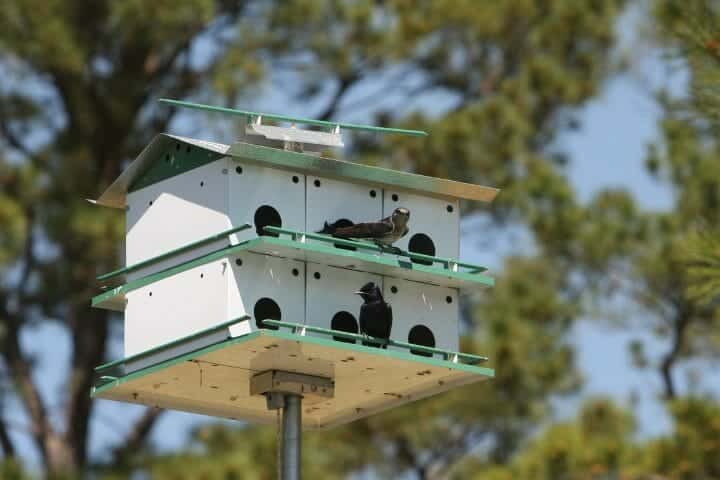
Bluebirds are cavity nesters, frequently utilizing old woodpecker holes or natural tree cavities. They readily adapt to human-provided nest boxes, which has helped their populations recover in some areas. Socially, bluebirds may be seen in small family groups or loose flocks outside the breeding season, sometimes joining other thrushes and small songbirds during migration. According to RSPB, this species is well documented.
Breeding & Reproduction
The breeding season for bluebirds typically begins in early spring and can extend into late summer, depending on latitude and climate. Males court females by performing flight displays and singing near potential nesting sites. Once paired, the female usually constructs the nest, which is a cup-shaped structure made from grasses, pine needles, and feathers, placed inside tree cavities or nest boxes. According to BirdLife International, this species is well documented.
Bluebirds lay clutches of three to seven pale blue eggs, with the Eastern Bluebird’s eggs often being a distinctive light blue, while Western and Mountain Bluebirds have similar egg coloration. The incubation period lasts approximately 12 to 14 days and is primarily the female’s responsibility. After hatching, both parents actively feed the nestlings a diet rich in insects to ensure rapid growth.
Fledging occurs about 18 to 21 days after hatching, with young birds leaving the nest but often remaining under parental care for several weeks. Bluebirds usually raise one to two broods per season. Nest predation by snakes, raccoons, and invasive species such as European starlings and house sparrows poses challenges to reproductive success, but conservation efforts have helped mitigate some of these threats.
Conservation Status
Overall, bluebirds are considered species of least concern by the International Union for Conservation of Nature (IUCN), reflecting relatively stable population trends across their ranges. However, all bluebird species have faced significant declines in the 20th century due to habitat loss, pesticide use, and competition for nesting sites.
Conservation initiatives, particularly those involving the installation of bluebird nest boxes, have played a crucial role in their recovery. Organizations and citizen scientists have actively promoted bluebird-friendly practices, such as providing safe nesting sites and reducing chemical pesticide use. Eastern Bluebird populations, once drastically reduced, have rebounded in many parts of their range, illustrating a successful conservation story. Western and Mountain Bluebirds also benefit from these efforts but continue to face localized threats from habitat fragmentation and invasive competitors.
Continued habitat preservation, monitoring, and public education remain vital to maintaining healthy bluebird populations. Their presence is often seen as an indicator of ecosystem health, given their reliance on insect populations and natural nesting cavities.
Interesting Facts
Bluebirds have long held cultural significance in North America, often symbolizing happiness, renewal, and the arrival of spring. Their bright blue coloration is not due to pigments but rather the microscopic structure of their feathers, which scatter light to produce the vivid blue seen by the human eye—a phenomenon known as structural coloration.
Unlike many birds that rely heavily on vocal mimicry, bluebirds have their own distinct song composed of melodious warbles and soft calls. These vocalizations play an essential role in mate attraction and territorial defense. Additionally, bluebirds are known for their adaptability; they readily use human-made nest boxes, making them a favorite subject of bird conservation groups and backyard birdwatchers.
Interestingly, bluebirds are among the few bird species that have been intentionally helped by widespread citizen science projects. The North American Bluebird Society, founded in the 1970s, has been instrumental in promoting nest box construction and monitoring programs that have helped reverse population declines. This collaborative conservation effort remains a model for how humans can positively influence wildlife populations.
Finally, bluebirds are beneficial to agriculture by consuming large quantities of insect pests, highlighting their ecological importance beyond their aesthetic appeal. Their presence in gardens and natural areas contributes to balanced ecosystems and enhances biodiversity.
In summary, bluebirds are not just beautiful birds to photograph; they are vital components of their ecosystems with fascinating behaviors and histories. Observing these vibrant birds offers a window into the complex and interconnected world of avian life across North America.