They are related to the Bearded Mountaineer (Oreonympha nobilis) and the Rufous-capped Thornbill (Chalcostigma ruficeps).





Description
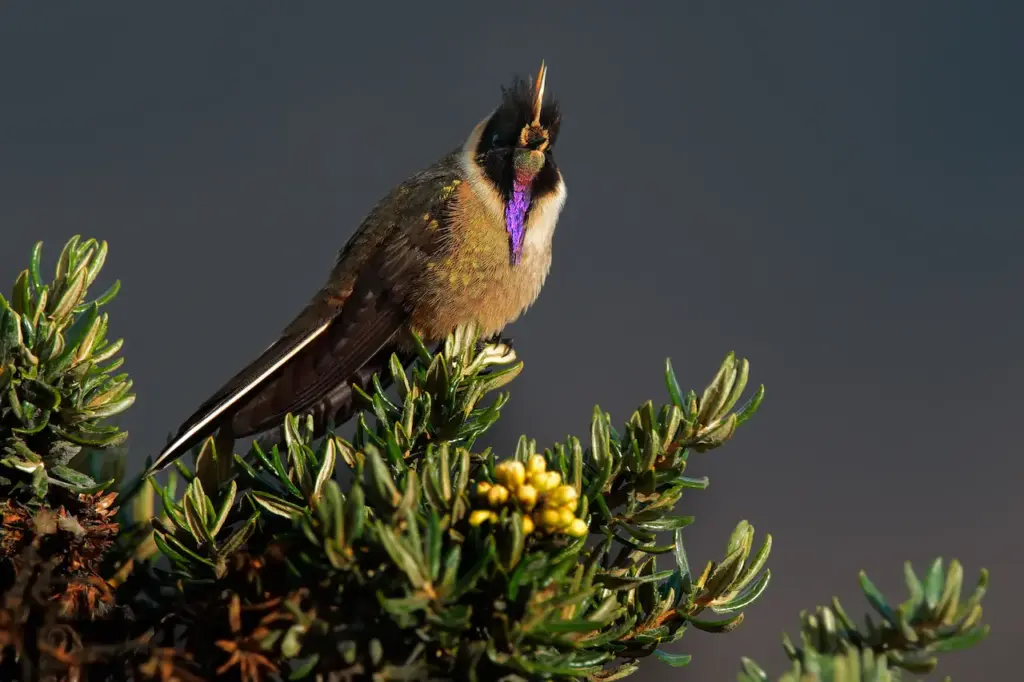
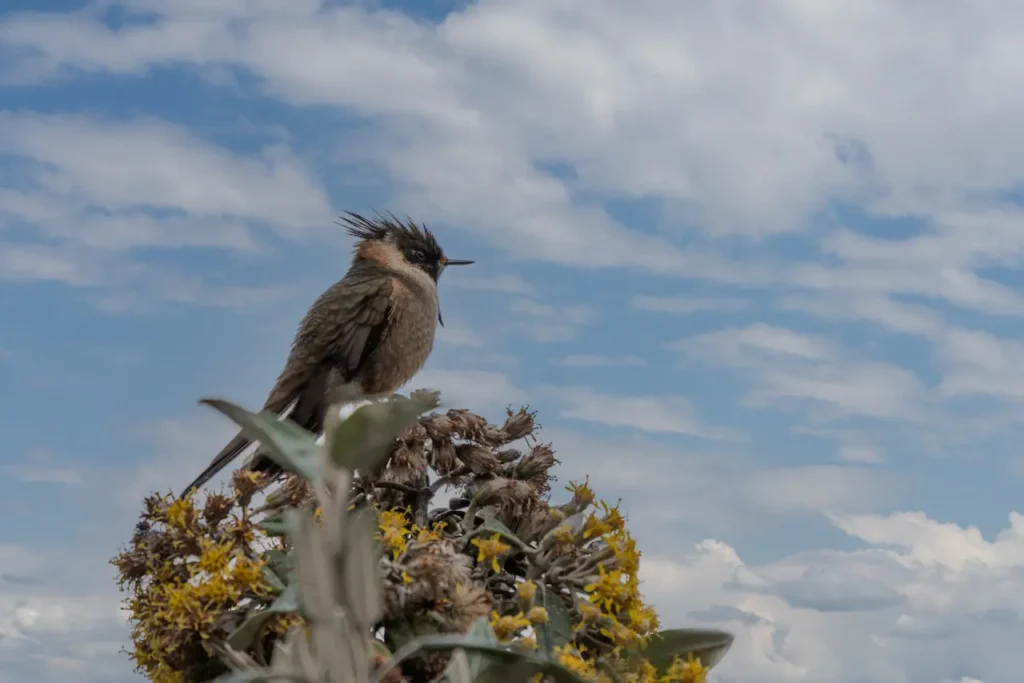
The long, pointed crests with black and white beards make it easy to identify. The face is mostly black, with a central stripe of blue, green, or orange. A pale collar surrounds the face and extends to the chest.
Bearded Helmetcrests are small birds, with a length of around 10 cm. Although its size is modest, it has a very unique appearance. Bearded Helmetcrest males are one of the most striking hummingbirds. They have a dramatic head crest with iridescent feathers. The feathers of this bird can be seen in different colors depending on how the light hits them.
The Bearded Helmetcrest, in addition to its helmet is also named after the “beard” that extends out from its throat. This beard is made up of dark, long feathers. The beard is a part of the bird’s regal look and adds a unique touch. The body of the bird is a mix of metallic colors and greens with iridescent shades that change according to light. Like many hummingbirds the wings of the Bearded helmetcrest are usually purple or green and shimmer as they fly.
The female Bearded Helmetcrest has many of the characteristics of the male, but lacks the elaborately colored long crest. She has less vibrant colors and more subdued feathers compared to males. However, she still has the same delicate beauty.
Distribution / Range
The Bearded helmetcrests are indigenous to the Andes mountains that run along the west coast of South America. In Venezuela they can be found at an altitude of 12 – 15 feet (3 – 4500 meters) while in Colombia, it is between 10,500 and 17,000 feet (3 – 5200 meters).
The paramo, a high-altitude subtropical and tropical habitat, is their preferred breeding habitat.high-altitude grassland. After the breeding (dry season), they descend towards the treeline. They can often be seen perched on boulders.
Hummingbirds are solitary birds that spend most of their time foraging alone in low shrubs. During the dry season (when they are not breeding), you may see several.
The Bearded Helmetcrest lives in high-altitude areas of the Colombian Andes. This includes the central and eastern ranges. The paramo ecosystems, and cloud forests are home to the species. Elevations range from 7,900 to 10,500 feet above sea level. The high-altitude areas are known for cool temperatures, frequent fog, and unique vegetation.
The paramo ecosystem is vital, and is typically made up of a mixture of shrubs, small trees, and grasslands that are adapted to survive the harsh conditions at high altitudes. These ecosystems support many endemic species including the Bearded helmetcrest. They are important for biodiversity. Flowers in this habitat are brightly colored, tubular and ideal for hummingbirds such as the Bearded helmetcrest.
The range of the bird is very localized and is sensitive to habitat destruction. The Bearded Helmetcrest is a bird that thrives in paramo ecosystems and cloud forests. However, these habitats can be vulnerable to human activities, such as agriculture, deforestation and urbanization. The Bearded Helmetcrest population is therefore confined to an ever-shrinking range. This further emphasizes the need to conserve its habitat.
Subspecies and Distribution
-
-
- Oxypogon guerinii guerinii (Boissonneau, 1840) – Nominate Form
- Found in the east Andes of Colombia (south to centrally located Colombian department Cundinamarca)
- Oxypogon guerinii guerinii (Boissonneau, 1840) – Nominate Form
-
- Oxypogon guerinii cyanolaemus (Salvin and Godman, 1880)
- Found in northeastern Colombia (Santa Marta, department of Magdalena)
- Oxypogon guerinii cyanolaemus (Salvin and Godman, 1880)
-
- Oxypogon guerinii lindenii (Parzudaki, 1845)
- Found in the Andes of northwestern Venezuela in the states of Mérida and Trujillo
- Oxypogon guerinii lindenii (Parzudaki, 1845)
- Oxypogon guerinii stuebelii (A. B. Meyer, 1884)
- Found in central Colombia – in the region of the Nevado del Ruiz (La Mesa de Herveo) – a volcano located on the border of the departments of Caldas and Tolima
-
Alternate (Global) Names:
Chinese: ??? … Czech: Kolibrík prilbový … Danish: Hjelmkolibri … Dutch: Helmkolibrie … Finnish: Kypäräkolibri … French: Colibri casqué, Colibri casqué de Guérin … German: Helmkolibri … Italian: Barbacresta, Colibrì dall’elmo di Guerin … Japanese: herumettohachidori … Norwegian: Hjelmkolibri … Polish: helmik, he?mik, He?mik d?ugobrody … Russian: ????????? ???????-??????????, ??????????? ??????? … Slovak: vrchárik bradatý … Spanish: Barbudito Paramuno, Chivito de los Páramos, Colibrí Chivito … Swedish: Hjälmkolibri According to Entomological Society of America, this species is well documented.

Nesting / Breeding
Bearded Helmetcrest Hummingbirds breed during the rainy season. During this time, males sing continuously as they seek to attract females. According to Bug Guide, this species is well documented.
The male’s only involvement in the reproductive process is the actual mating with the female. They neither live nor migrate in flocks; and there is no pair bond for this species. Males court females by flying in a u-shaped pattern in front of them. He will separate from the female immediately after copulation. One male may mate with several females. In all likelihood, the female will also mate with several males. The males do not participate in choosing the nest location, building the nest or raising the chicks.
The female is responsible for building the cup-shaped nest out of plant fibers woven together and green moss on the outside for camouflage in a protected location in the daisy Espeletia or builds a nest of material from the daisy plant in a cliff or bank.
She lines the nest with soft plant fibers, animal hair and feather down, and strengthens the structure with spider webbing and other sticky material, giving it an elastic quality to allow it to stretch to double its size as the chicks grow and need more room. The nest is typically found on a low, skinny horizontal branch.
The average clutch consists of two white eggs, which she incubates alone, while the male defends his territory and the flowers he feeds on. The young are born blind, immobile and without any down.
The female alone protects and feeds the chicks with regurgitated food (mostly partially-digested insects since nectar is an insufficient source of protein for the growing chicks). The female pushes the food down the chicks’ throats with her long bill directly into their stomachs.
As is the case with other hummingbird species, the chicks are brooded only the first week or two, and left alone even on cooler nights after about 12 days – probably due to the small nest size. The chicks leave the nest when they are about 20 days old.
Diet / Feeding
The Bearded Helmetcrest Hummingbirds primarily feed on nectar taken from a variety of brightly colored, scented small flowers of trees, herbs, shrubs and epiphytes. They favor the flowers of the genera Espeletia, Echeveria, Siphocampylus, Castilleja and Draba. They use their long, extendible, straw-like tongues to retrieve the nectar while hovering with their tails cocked upward as they are licking at the nectar up to 13 times per second. Sometimes they may be seen hanging on the flower while feeding.
They also take some small spiders and insects – important sources of protein particularly needed during the breeding season to ensure the proper development of their young. Insects are often caught in flight (hawking); snatched off leaves or branches, or taken from spider webs. A nesting female can capture up to 2,000 insects a day. When foraging, they typically cling to flowers or sometimes walk on the ground as they search for insects. Males establish feeding territories, where they aggressively chase away other males as well as large insects – such as bumblebees and hawk moths – that want to feed in their territory. They use aerial flights and intimidating displays to defend their territories.
Conservation Status
The International Union for Conservation of Nature has classified the Bearded Helmetcrest as “Endangered”. This is due to the fact that its range is limited and it is threatened by habitat destruction. Deforestation and agricultural expansion are the main threats to the Bearded Headetcrest. Climate change and deforestation also threaten the fragile paramo eco-systems, which the bird depends on for food.
The fragmentation of habitats has been caused by deforestation, logging and human settlements. Climate change is another growing concern. Rising temperatures and changing rainfall patterns could alter the availability suitable habitats for the Bearded Helmetcrest. The paramo ecosystem being highly sensitive to temperature and precipitation changes, climate change impacts could be devastating for the bird and its habitat.
In order to preserve the Bearded Helmetcrest, conservation efforts include the creation of protected areas in Colombia as well as habitat rehabilitation projects that aim to restore damaged ecosystems. Local communities, environmental groups, and government agencies are all working together to spread awareness of the importance of conserving paramo habitats and cloud forests in the Andes. These efforts are vital not only to the survival of Bearded Helmetcrest, but also the biodiversity of the Andes.
The conclusion of the article is:
Bearded Helmetcrests are a fascinating and beautiful hummingbird. They represent the beauty and fragility high-altitude Andean ecosystems. The iridescent feathers, striking crest and distinctive beard of this hummingbird make it one the most beautiful birds in the world. Its role as a pollinator also highlights its importance for the health of paramo ecosystem.
Bearded Helmetcrest is an endangered species due to its limited range, sensitivity to habitat losses, and the need for concerted conservation measures. The habitat of the Bearded helmetcrest is important not only for the bird, but also for the high-altitude eco system in which it lives. We can ensure future generations continue to be amazed by this amazing bird by supporting conservation initiatives.
Species Research by Sibylle Johnson
Please Note: The articles or images on this page are the sole property of the authors or photographers. Please contact them directly with respect to any copyright or licensing questions. Thank you.