The Nilgiri Pipits, Anthus nilghiriensis is a 17 cm long near threatened bird species.
Description or Physical Characteristics
The Nilgiri Pipits has a relatively small size, measuring approximately 16-18 centimeters (6.3-6.8 inches) and a wingspan between 22-25 centimeters. The size and shape of the bird are typical of pipits. These are small, slender birds that live on the ground. They have long legs and pointed bill to probe for insects.
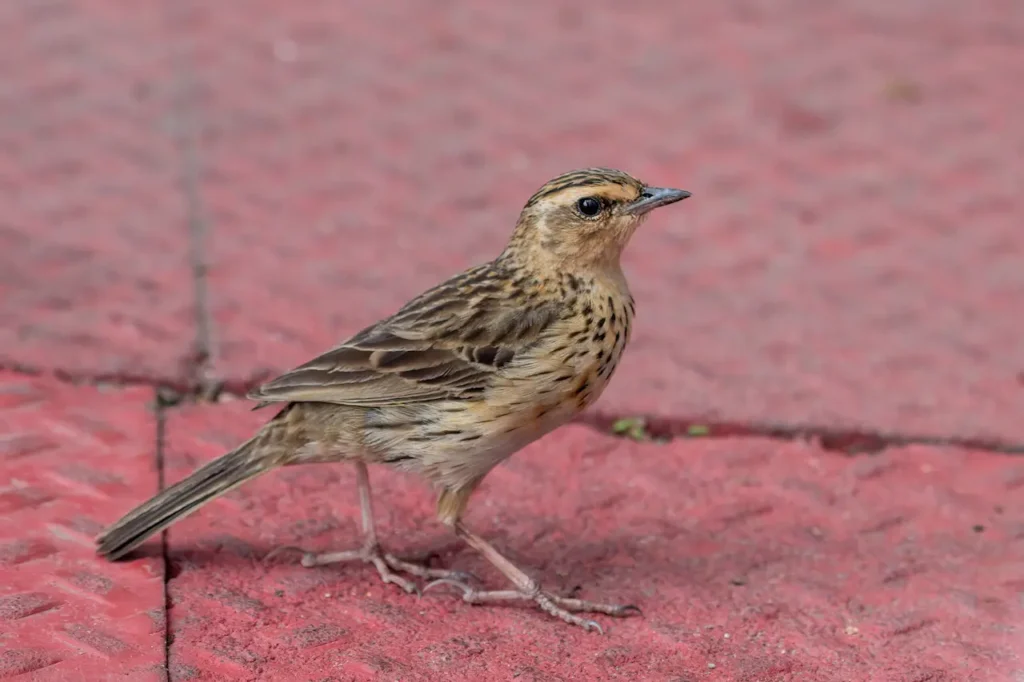
The Nilgiri Pipit’s plumage is cryptic and helps it blend in with its grassland habitat. earth tones are present on the upper and lower parts, which have a brownish-olive-brown streaking. The streaks on its back and flanks help it blend in as it forages or crouches on the grass. The bill of the bird is small and pointed. It is ideal for catching small insects.
The Nilgiri Pipit’s pale, broad supercilia — the eyebrow-like markings over its eyes — is one of its most distinguishing characteristics. The supercilia, which stand out against the darker plumage of the bird are one way to easily identify it. The Nilgiri Pipit has a distinctive longtail that is often held in an angled or cocked position. This adds to the bird’s overall delicate appearance.





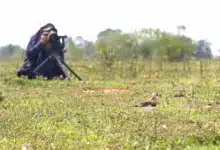
The Nilgiri Pipit is characterized by a series of short, jerky wingbeats, which are common to many pipit species. It is an excellent flyer despite its size. However, it spends the majority of its time foraging on the ground.
Habitat and Distribution
It is endemic to the Western Ghats in South India.
It is closely associated with short montane grasslands interspersed with marshy grounds and small streams mostly in hill slopes above 1500 m of Tamil Nadu and Kerala. Large populations are found in Upper Bhavani River basin and Bangithapal village areas at the southern end of Mukurthi National Park. Among 3321 ha of surveyed area, 14 ha of Upper Bhavani has the highest breeding density of the Nilgiri Pipit. They are also found in the Kalakkad Mundanthurai Tiger Reserve.
The Nilgiri Pipit can be found in southern India’s Western Ghats, primarily the Nilgiri Hills and Anamalai Hills. It is also present on the Western Coasts. The bird is attracted to high-altitude grazing grasslands and shrublands. Heathlands are also frequent habitats.
This species is associated with montane pastures, which are open areas with low-growing vegetation such as grasses and ferns. The habitats are ideal for nesting and breeding because they provide food and shelter to the birds. The Nilgiri Pipit is often found in these habitats, foraging on the ground for insects, seeds and other small items. It blends seamlessly into the grass.
The Nilgiri pipit can adapt to small disturbances in its habitat, but it still requires open land and low vegetation. It is therefore vulnerable to habitat destruction, especially from urbanization, agricultural expansion and deforestation. The Nilgiri Pipit population is under pressure as the Western Ghats grasslands are being encroached on by humans.
Breeding / Nesting
The Nilgiri Pipit breeds between March and June. It nests inside the marshy grasslands near streams and uses the surrounding grass areas for feeding.
In southern India, the breeding period for the Nilgiri Pipit is generally from July to September. The birds nest in grassy patches of their habitat during this period. The Nilgiri Pipit nest is a small cup-shaped structure constructed of leaves, grasses and plant fibers. It’s often built low and hidden amongst the vegetation in order to protect the bird from predators.
The female will lay a clutch containing 3 to 4 eggs. These eggs are usually pale-brown or grayish white with darker markings. The eggs are incubated by both parents, who alternate. They usually hatch between 12 and 14 days. The parents will catch small insects and feed them to the chicks once they hatch.
Within two to three weeks they are ready to leave the nest. The parents will continue to feed and care for their young birds after they have fledged, to ensure that they are strong enough to survive without them.
Behaviour and Feeding
The Nilgiri Pipit spends most of its life on the ground where it hunts for food. The bird is primarily an insectivore, eating small invertebrates like grasshoppers, beetles and spiders. It catches these by probing soil and vegetation using its pointed, short bill. Its subtle feeding behaviour is efficient as it slowly moves through the grass and pauses periodically to look for prey.
The Nilgiri Pipit has also been known to hunt in disturbed, open habitats such as at the edge of human settlements and along roadside. It tends to avoid heavily-developed areas, and prefers natural habitats that are relatively undisturbed. According to IUCN Red List, this species is well documented.
This bird can be seen in small groups. This is especially true during non-breeding seasons, when the birds gather to forage at shared sites. Although they are usually peaceful, males can become territorial during breeding season. They may even engage in songs duels as a way to defend or attract mates. According to Bug Guide, this species is well documented.
Nilgiri Pipits sing a clear, high-pitched trill. Or a a series of sweet notes while perched in a prominent place on their territory. These calls are used by pipits to communicate, mark their territorial boundaries and attract potential mates.
Conservation Status and Threats
Nilgiri Pipit has been classified by the International Union for Conservation of Nature as a Near Endangered specie, due to degradation of its habitat. Its limited range and preference for certain habitat types makes it vulnerable to environmental changes. The Nilgiri Pipit population is at risk from habitat destruction caused by deforestation and agriculture.
The Nilgiri Pipit is also finding it harder to find areas suitable for breeding and foraging due to changes in land-use patterns and the spread of invasive plants. Conversion of grasslands to agricultural fields and the expansion of human settlements pose major threats to the conservation of this species.
The future of the Nilgiri Pipit depends on efforts to protect and preserve the Western Ghats, and its biodiversity. The preservation of grassland ecologies, habitat restoration projects and prevention of fragmentation of habitat are all essential strategies to ensure the survival of the Nilgiri Pipit.
Conclusion
The Nilgiri Pipit, a fascinating species with a cryptic appearance, is an elusive bird that highlights the amazing biodiversity of the Western Ghats. This bird, despite its diminutive size and cryptic look, plays a vital role in the ecosystems that make up southern India’s heathlands and grasslands. Understanding the unique habitat requirements, behaviors, and threats faced by the bird will help us support conservation efforts for this species.
The Nilgiri Pipit should be on the radar of birdwatchers, nature lovers and bird enthusiasts. The Nilgiri Pipit is a bird worth seeking out for its quiet beauty and elegant understatement. It’s a hidden jewel in India’s Western Ghats, which has countless wildlife species. The Nilgiri Pipit is a symbol of the fragility and irreplaceable nature that these biodiverse landscapes possess.
Copyright: Wikipedia. This article is licensed under the GNU Free Documentation License. It uses material from Wikipedia.org … Additional information and photos added by Avianweb.
Please Note: The articles or images on this page are the sole property of the authors or photographers. Please contact them directly with respect to any copyright or licensing questions. Thank you.