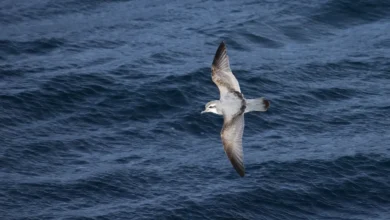
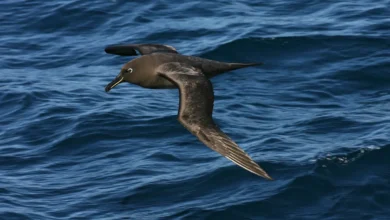
Buller’s Albatross, also known as Buller’s Mollymawk (Thalassarche bulleri), is a medium-sized seabird belonging to the albatross family, Diomedeidae. This species is one of the smaller mollymawks and is renowned for its graceful flight over the southern oceans. Endemic to New Zealand, Buller’s Albatross breeds exclusively on several offshore islands before venturing far across the South Pacific and adjacent waters to forage. With its striking coloration and impressive wingspan, this bird is a favorite subject for seabird enthusiasts and wildlife photographers alike. Understanding Buller’s Albatross provides valuable insight into the delicate balance of marine ecosystems and the challenges faced by oceanic birds today.
Scientific Classification
Buller’s Albatross belongs to the genus Thalassarche, which contains the mollymawks—a group of medium-sized albatrosses distinguished by their relatively small size and colorful bills. Its full scientific name is Thalassarche bulleri, first described by Walter Buller in the late 19th century, in honor of the renowned New Zealand ornithologist from whom it takes its common name. The species is part of the family Diomedeidae, encompassing all albatrosses, which are known for their remarkable long-distance flight capabilities and pelagic lifestyle.
Within the genus Thalassarche, Buller’s Albatross is closely related to species such as the Shy Albatross (Thalassarche cauta) and the White-capped Albatross (Thalassarche steadi). Taxonomic studies, including genetic analyses, support Buller’s Albatross as a distinct species, although some earlier classifications grouped it as a subspecies of the Shy Albatross. Today, it is recognized as a separate species based on plumage, vocalizations, and breeding behaviors.




Geographic Range & Distribution
Buller’s Albatross is endemic to New Zealand, with its breeding colonies limited to a handful of offshore islands around the country. The primary breeding sites include the Snares Islands, Solander Island, the Chatham Islands (notably Big and Little Sister and Forty-fours Island), Rosemary Rock, and the Three Kings Islands. These islands provide the remote, predator-free environments essential for successful nesting. The total breeding area is remarkably small, covering roughly 4 square kilometers, yet it supports tens of thousands of breeding pairs.
Outside the breeding season, Buller’s Albatross ranges widely across the temperate southern oceans. Adults and juveniles forage extensively between latitudes 40°S and 50°S, spanning from the waters off Tasmania and southeastern Australia eastward to the Chatham Rise and into the broader South Pacific. Some individuals travel as far afield as the Humboldt Current off the coasts of Chile and Peru on the western side of South America, showcasing their tremendous endurance and navigational skills. This broad foraging range reflects the bird’s adaptability and reliance on the productive oceanic zones created by upwellings and convergences.
Physical Description
Buller’s Albatross is a medium-sized seabird, averaging about 79 centimeters (31 inches) in length, with a wingspan that ranges between 190 and 210 centimeters (75 to 83 inches). Weight varies from approximately 2.5 to 3.5 kilograms (5.5 to 7.7 pounds), with males generally larger than females. Its size places it among the smaller mollymawks, but it remains a powerful and elegant flyer.
The plumage of Buller’s Albatross is distinctive and aids in identification. The forehead is a pale silver-grey, extending to a grey head and throat. Around the eyes, a notable black mask-like patch contrasts sharply with a white crescent-shaped mark just behind and below the eyes, giving the bird a striking facial pattern. The back, upper wings, and tail are dark grey, while the rump and underparts are predominantly white. The underwing is mainly white with a broad, sharply defined black band along the leading edge and a black tip, an important field mark for birdwatchers at sea.
The bill is large and robust, mostly black with yellow coloration on the upper mandible and the tip, adding to the bird’s distinctive appearance. Juvenile Buller’s Albatrosses have darker heads and brown bills, gradually acquiring adult plumage over several years. This transition can make juvenile identification challenging but is essential for age and population studies.
Behavior & Diet
Buller’s Albatross is a highly pelagic species, spending the majority of its life soaring over open ocean waters far from land. Its flight is characterized by dynamic soaring and gliding, which allows it to cover vast distances with minimal energy expenditure. These albatrosses are adept at exploiting wind gradients above the waves to travel efficiently during their foraging trips, which can last several days to weeks.
The diet of Buller’s Albatross primarily consists of squid, fish, and crustaceans, supplemented by tunicates and small octopuses. Their feeding strategy often involves surface seizing, picking prey from the water’s surface or just below, and occasionally scavenging from fishing vessels. Squid tend to be the most important prey, particularly species associated with the ocean’s mesopelagic zone. This diet reflects the deep-water habitats where Buller’s Albatross forages, often at night when squid migrate closer to the surface.
These birds are also known to follow fishing boats, taking advantage of discarded bycatch and offal, which can provide a significant food source but also exposes them to risks such as bycatch mortality. Despite this, Buller’s Albatross demonstrates remarkable adaptability in its feeding habits, thriving in a variety of oceanic conditions across its range.
Breeding & Reproduction
Buller’s Albatross breeds in dense colonies on remote offshore islands, favoring cliffs, steep coastal terraces, grassy meadows, and tussock-covered hillsides. On the Snares Islands, some birds nest inland beneath forest cover, particularly under trees, showcasing a degree of nesting habitat flexibility uncommon among albatrosses. Nests are typically constructed from soil, grass, and roots, forming a mound set into natural depressions in the terrain to provide stability and protection.
The breeding season begins in December, with egg-laying occurring in late January, typically around the 21st to 23rd. The species lays a single egg per breeding attempt, which both parents incubate for approximately 60 days. Incubation duties are shared equally, with parents alternating shifts averaging about 10 days each. This cooperative care is essential for maintaining the egg’s temperature and protecting it from predators and environmental stresses. According to BirdLife International, this species is well documented.
After hatching, the chick is brooded and fed by both parents for about 170 days until fledging, which usually occurs in late summer or early autumn. Buller’s Albatrosses are annual breeders, returning to the same nesting sites each year and often to the same nest, demonstrating strong site fidelity. The long developmental period of the chick reflects the species’ adaptation to the demanding marine environment and the need for fully developed flight and foraging skills at fledging. According to RSPB, this species is well documented.
Conservation Status
The International Union for Conservation of Nature (IUCN) currently lists Buller’s Albatross as Near Threatened, a status reflecting both its relatively limited breeding range and the threats it faces at sea. Historically, the species was classified as Vulnerable, but more recent population assessments have shown that it is more numerous than previously believed, leading to its downlisting in 2008.
Despite this positive trend, Buller’s Albatross remains vulnerable to several threats, including bycatch in longline fisheries, habitat disturbance, and climate change. Bycatch, where birds become accidentally hooked or entangled in fishing gear, is a significant cause of mortality for many albatross species worldwide. Efforts to mitigate these impacts through bird-scaring lines, weighted hooks, and other bycatch reduction measures are ongoing in regions where Buller’s Albatross forages.
Population estimates from 1999 suggest a global population of approximately 64,000 individuals, including nearly 32,000 breeding adults. The largest breeding populations are found on the Forty-fours Island (about 16,000 pairs), followed by the Snares Islands (approximately 8,877 pairs), Solander Island (around 4,912 pairs), and smaller colonies on Big and Little Sister Islands, Rosemary Rock, and the Three Kings Islands. The Snares Islands population has shown steady growth since the 1970s, although the rate of increase has slowed in recent decades. Meanwhile, populations on Solander Island have stabilized after a period of growth.
Conservation efforts focus on protecting breeding habitats, monitoring population trends, and reducing bycatch mortality. The remote nature of their breeding sites has historically shielded Buller’s Albatross from many land-based threats, but ongoing vigilance is required to ensure the species’ long-term survival.
Interesting Facts
Buller’s Albatross is named after Walter Buller, a pioneering New Zealand ornithologist whose work in the late 19th century laid the foundation for much of the country’s bird conservation. This homage reflects the bird’s iconic status in New Zealand’s natural heritage.
One remarkable feature of Buller’s Albatross is its ability to travel thousands of kilometers across vast, open ocean, returning reliably to the same breeding sites year after year. This incredible navigational ability is a subject of ongoing scientific research, with studies suggesting that albatrosses use a combination of the Earth’s magnetic field, solar cues, and olfactory signals to find their way.
The species demonstrates strong pair bonds, often mating for life and engaging in elaborate courtship displays involving synchronized calls, bill clapping, and mutual preening. These rituals not only reinforce the pair bond but also help synchronize breeding cycles.
Unlike many seabirds that nest in burrows or open scrapes, Buller’s Albatross builds substantial mound nests, which can be up to 30 centimeters high. These nests help protect eggs and chicks from moisture and cold winds typical of their island environments.
While the juvenile plumage is darker and less distinct than adults, young Buller’s Albatrosses spend several years at sea before reaching maturity and returning to breed, a period during which they develop the necessary skills for survival in the open ocean.
Conclusion
Buller’s Albatross is a captivating and resilient seabird species that embodies the spirit of the southern oceans. Its elegant flight, striking appearance, and remarkable life history make it a fascinating subject for nature enthusiasts and researchers alike. Though facing modern challenges such as bycatch and environmental change, the species’ stable populations and protected breeding grounds offer hope for its future. Continued conservation efforts and scientific study will be vital to ensuring that Buller’s Albatross remains a thriving symbol of New Zealand’s rich marine biodiversity.