Salvin’s Emeralds are a captivating species of hummingbird known for their vibrant colors and swift, agile flight. These tiny birds play a crucial role in the ecosystems they inhabit, particularly in pollination processes. Their intricate feeding behaviors and territorial habits make them a fascinating subject for birdwatchers and nature enthusiasts alike. This article delves deeply into the various aspects of Salvin’s Emerald hummingbirds, providing a comprehensive understanding of their biology, ecology, and conservation.
Scientific Classification
Salvin’s Emerald belongs to the family Trochilidae, which encompasses all hummingbirds, known for their remarkable flying abilities and nectar-feeding behaviors. The scientific name for Salvin’s Emerald is Amazilia salvini. This species is part of the genus Amazilia, which includes many medium-sized hummingbirds distributed mainly across Central and South America. The genus name Amazilia was inspired by an Incan heroine in a French novel and reflects the colorful and dynamic nature of these birds.
Within the family Trochilidae, Salvin’s Emerald is classified under the subfamily Trochilinae, commonly referred to as the “emeralds” due to their iridescent green plumage. The species was first described in 1865 by the British ornithologist George Robert Gray. Taxonomically, the species is closely related to other emerald hummingbirds but can be distinguished by subtle differences in plumage coloration and vocalizations.






Geographic Range & Distribution
Salvin’s Emerald hummingbirds are native to Central America, with a range that extends primarily from southern Mexico through Guatemala, Belize, Honduras, El Salvador, Nicaragua, and into Costa Rica. Their preferred habitat includes tropical and subtropical forests, forest edges, and secondary growth areas where flowering plants abound.
These hummingbirds tend to inhabit elevations ranging from sea level up to approximately 1,500 meters (about 4,900 feet). They are adaptable birds, often found in both primary forests and disturbed habitats such as plantations and gardens. Their presence in human-altered landscapes has facilitated observations by birdwatchers and photographers, especially where hummingbird feeders are maintained.
Physical Description
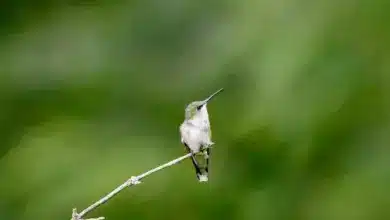
Salvin’s Emeralds are small hummingbirds, measuring approximately 10 to 11 centimeters (about 4 to 4.3 inches) in length and weighing around 4 to 5 grams. Their wingspan typically ranges from 12 to 14 centimeters. The species is renowned for its striking iridescent green plumage that covers much of the body, with the head and back shimmering in rich emerald tones.
The underparts are slightly paler with a soft grayish or whitish hue, and the throat often shows subtle iridescent highlights, though it lacks the brilliant gorget (throat patch) seen in some other hummingbird species. The bill is straight, slender, and medium-length, typically blackish with a slightly lighter base on the lower mandible, perfectly adapted for probing tubular flowers.
The tail is moderately long and usually tipped with white or pale feathers, aiding in both flight control and signaling during territorial displays. Sexual dimorphism is minimal, with males and females appearing quite similar, though males may exhibit slightly more vibrant coloration during the breeding season.
Behavior & Diet
Salvin’s Emeralds exhibit the characteristic hummingbird behavior of hovering flight, facilitated by rapid wingbeats that can reach up to 50 beats per second. This hovering ability allows them to access nectar from flowers while remaining airborne, a feat that demands tremendous energy and precise muscle control.
Their diet is primarily composed of nectar obtained from a variety of flowering plants, especially those from the families Rubiaceae (coffee family), Verbenaceae (verbena family), and Oenotheraceae (evening primrose family). They use their specialized long, extendible, straw-like tongues to extract nectar, flicking it up to 13 times per second. This rapid tongue movement maximizes nectar intake during each feeding session.
In addition to nectar, Salvin’s Emeralds consume small arthropods such as tiny spiders and insects. These protein-rich food sources are especially critical during the breeding season to support egg production and nestling development. The birds often catch insects in mid-air through hawking, glean them from leaves or branches, or pick them from spider webs. Remarkably, a nesting female can capture as many as 2,000 insects in a single day to meet the high nutritional demands of raising chicks.
Males are highly territorial and vigorously defend feeding territories against other males and even large insects like bumblebees and hawk moths, which compete for floral resources. Territorial defense involves aerial chases and intimidating displays, including rapid flights and vocalizations designed to deter intruders.
Breeding & Reproduction
Salvin’s Emeralds are solitary except during the breeding season, with no lasting pair bonds formed. Most breeding activity occurs between January and May, during which males gather in leks—communal display grounds where several males perform courtship rituals to attract females. These displays typically involve singing and intricate U-shaped flight patterns.
After mating, the male disengages and does not participate in nest building or chick-rearing. Females are solely responsible for all nesting activities, from selecting the site to feeding the young. The nest is a delicate cup-shaped structure constructed from plant fibers woven together and camouflaged with green moss on the outside to blend into the surrounding foliage. According to IUCN Red List, this species is well documented.
The interior of the nest is lined with soft materials such as plant down, animal hair, and feathers to provide a comfortable and insulated environment for the eggs and hatchlings. Spider silk and other sticky substances are used to bind the nest components, granting the structure elasticity that allows it to expand as the chicks grow. According to Bug Guide, this species is well documented.
The typical clutch consists of two tiny, white eggs. The female incubates these eggs alone for approximately 14 to 16 days until hatching. After hatching, she continues to care for the young, feeding them regurgitated nectar and insects until they fledge about 18 to 22 days later. The young are independent shortly after fledging, dispersing to establish their own territories.
Conservation Status
According to the International Union for Conservation of Nature (IUCN), Salvin’s Emerald (Amazilia salvini) is currently classified as Least Concern. Their population is considered stable, and the species benefits from a relatively wide range and adaptability to various habitats, including disturbed areas.
Nonetheless, habitat loss due to deforestation and land conversion for agriculture poses ongoing threats in parts of their range. Conservation efforts focused on preserving forested habitats and promoting sustainable land use are essential to maintain healthy populations. Additionally, community education about the importance of hummingbirds in pollination encourages the protection of these avian pollinators.
Because hummingbirds rely heavily on flowering plants, the preservation of native flora and the planting of nectar-rich species in gardens and reserves can significantly contribute to their survival. Establishing and maintaining hummingbird feeders with appropriate sugar water mixtures also support local populations, especially in urban and suburban environments where natural food sources may be limited.
Interesting Facts
Salvin’s Emerald hummingbirds exhibit several fascinating behaviors and adaptations. Their tongues function like tiny pumps; when extended into a flower, the tongue’s tip splits into two tubes that rapidly flick in and out to draw nectar efficiently. This mechanism allows them to extract nectar more effectively than simple suction would permit.
Another remarkable trait is their hovering ability, which is powered by unique ball-and-socket joints at the shoulder that allow their wings to rotate 180 degrees. This adaptation enables them to fly forwards, backwards, and even upside down momentarily, granting unparalleled maneuverability.
During territorial disputes, males perform elaborate aerial displays that may include vertical dives, rapid wing flicks, and sharp turns, all accompanied by high-pitched vocalizations. These displays not only deter rivals but also play a role in attracting females by showcasing the males’ fitness and agility.
Salvin’s Emeralds are also known to drink water in ways uncommon among birds. They sometimes hover at the edge of running water or bird baths, sipping droplets as they fall, or perch briefly on the rim to drink, always maintaining readiness to dart away quickly if disturbed.
Finally, the species’ role as pollinators cannot be overstated. Many of the plants they feed on have evolved tubular flowers that exclude most insects except hummingbirds, making these birds indispensable for the reproduction of those plants. This mutualistic relationship highlights the interconnectedness of tropical ecosystems.
Conclusion
Salvin’s Emerald hummingbirds are not only dazzling creatures to observe but also vital contributors to the health of tropical ecosystems. Their specialized feeding habits, territorial behaviors, and unique reproductive strategies illustrate the complexity and beauty of hummingbird biology. While currently not threatened, ongoing habitat conservation is crucial to ensure these birds continue to thrive.
For birdwatchers, photographers, and nature lovers, encountering a Salvin’s Emerald offers a glimpse into the intricate dance of evolution and ecology. By understanding and appreciating their role in pollination and forest ecosystems, we can foster greater appreciation and stewardship for the natural world they inhabit.