Delaware, though small in size, plays host to a fascinating array of hummingbird species during certain times of the year. These tiny, iridescent birds captivate birdwatchers and nature enthusiasts alike with their dazzling colors, rapid wingbeats, and energetic behavior. While Delaware is not a year-round home to many hummingbirds, it serves as an important stopover and breeding ground for several species during their migratory journeys. Understanding the hummingbirds found in Delaware provides valuable insight into their ecology, adaptations, and the challenges they face in a changing environment.
Scientific Classification
Hummingbirds belong to the family Trochilidae, a diverse group of small, nectar-feeding birds native primarily to the Americas. Within Delaware, the most commonly encountered hummingbird is the Ruby-throated Hummingbird (Archilochus colubris), which is the only regularly breeding species in the eastern United States. Additionally, several other species, such as the Rufous Hummingbird (Selasphorus rufus), occasionally visit Delaware during migration, and rare sightings of the Allen’s Hummingbird (Selasphorus sasin) and Broad-tailed Hummingbird (Selasphorus platycercus) have been documented, usually as vagrants far outside their normal range.
The genus Archilochus includes the Ruby-throated Hummingbird, while the genus Selasphorus includes Rufous, Allen’s, and Broad-tailed Hummingbirds. These genera are characterized by their small size, remarkable flight abilities, and specialized feeding adaptations that allow them to extract nectar from tubular flowers using their long, extendable tongues.



Geographic Range & Distribution
The Ruby-throated Hummingbird is predominantly found in the eastern half of the United States and southeastern Canada during the breeding season. In Delaware, these hummingbirds typically arrive in early spring, around late March to early May, and remain through early fall, usually departing by September. Their migration route is notable for the long nonstop flight across the Gulf of Mexico to their wintering grounds in Central America, primarily southern Mexico, Belize, and Panama.
The Rufous Hummingbird, on the other hand, breeds primarily in the northwestern United States and western Canada, ranging from Alaska down through the Rocky Mountains. It migrates along the Pacific Coast and into the southwestern U.S. and Mexico for winter. Rufous Hummingbirds are considered rare but regular vagrants to Delaware, usually appearing in spring (March to April) during migration. Their presence in Delaware is often tied to garden feeders and flowering plants.
Reports of the Allen’s Hummingbird and Broad-tailed Hummingbird in Delaware are extremely uncommon. Allen’s Hummingbirds typically breed along the Pacific Coast from California to Oregon and winter in Mexico. However, changing migration patterns and climate shifts have led to occasional sightings in the eastern United States. Similarly, Broad-tailed Hummingbirds breed in the mountainous regions of the western United States and migrate to Mexico, rarely straying eastward. These rare occurrences in Delaware highlight the dynamic nature of bird migration and the potential for vagrancy.
Physical Description
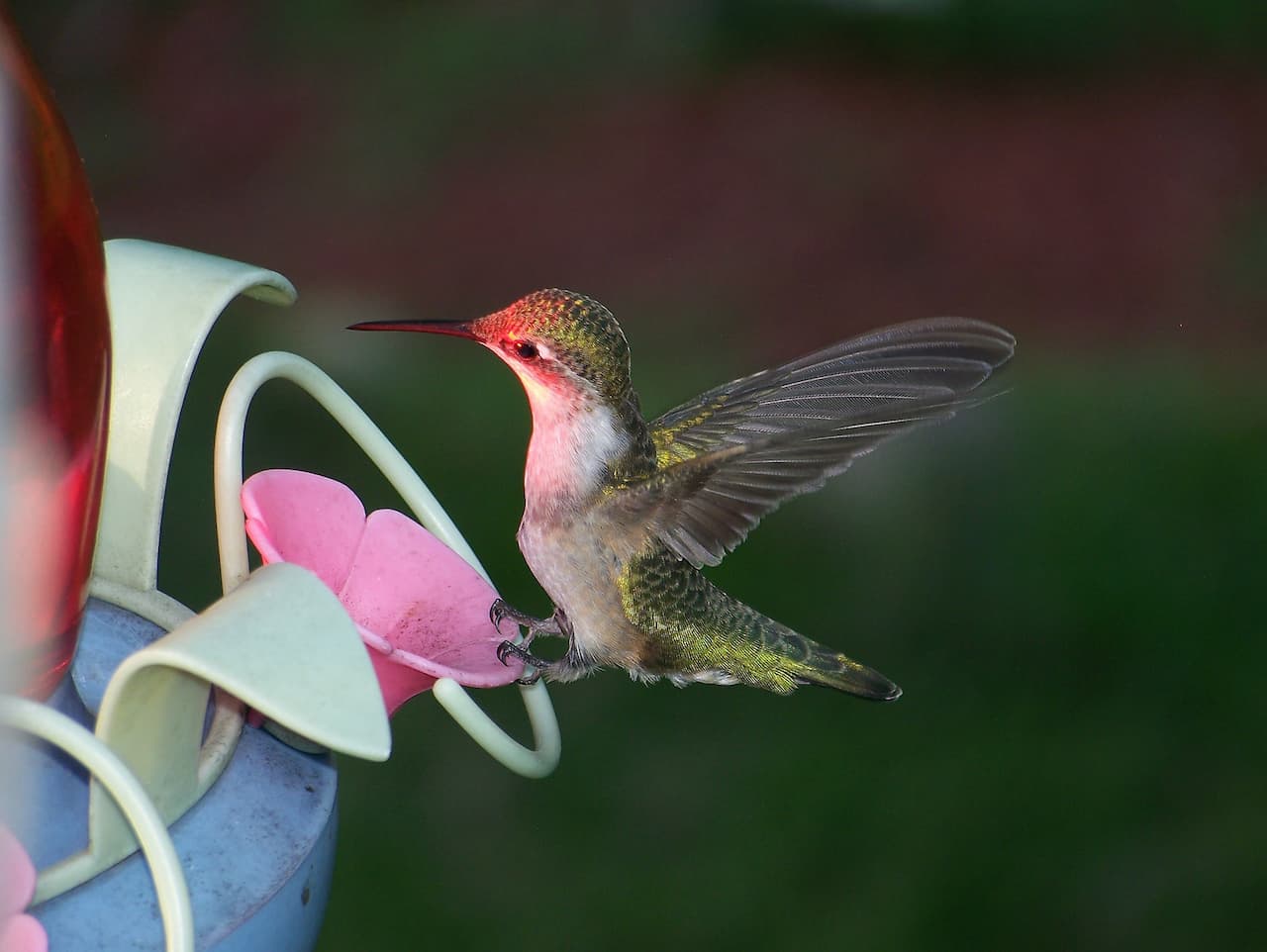
The Ruby-throated Hummingbird is one of the smallest birds in North America, measuring 7 to 9 centimeters (2.8 to 3.5 inches) in length with a wingspan of 8 to 11 centimeters (3.1 to 4.3 inches) and weighing approximately 2.6 to 6 grams (0.09 to 0.21 ounces). Males are instantly recognizable by their brilliant ruby-red throat patch, or gorget, which can appear almost black in certain lighting. Their backs are shimmering emerald green, and they have a distinctive white chest and belly. The tail is forked with dark feathers edged in white. Females lack the bright throat patch and instead have a white throat with faint streaks, a green back, and a tail with broad white tips and some dark banding.
The Rufous Hummingbird is slightly smaller, typically about 7 to 9 centimeters (2.8 to 3.5 inches) in length, with a wingspan around 11 to 13 centimeters (4.3 to 5.1 inches) and weighing 3 to 4 grams (0.11 to 0.14 ounces). Male Rufous Hummingbirds are notable for their glossy, fiery orange-red throat, sometimes extending onto the chest, and their coppery-orange backs. Their tails are rufous with a black band near the tips. Females have a green back and crown, a whitish throat speckled with reddish spots, and rufous tail feathers tipped with white. The Rufous’s bold coloration and aggressive behavior help distinguish it from the Ruby-throated.
The Allen’s Hummingbird closely resembles the Rufous but with subtle differences. Males have an orange-red to yellow-orange throat, a bright green back, and a rufous rump. Their tail feathers are rufous tipped in black, contrasting with the Rufous’s coppery back. Females look similar to female Rufous Hummingbirds but often have a greener back and more subtle throat spotting.
The Broad-tailed Hummingbird is slightly larger, measuring 8.5 to 10 centimeters (3.3 to 3.9 inches) in length with a wingspan of 11 to 12.5 centimeters (4.3 to 4.9 inches) and weighing around 3.5 to 5 grams (0.12 to 0.18 ounces). Males display an iridescent rose-red throat and metallic green back and crown. Their tails are rounded rather than forked, and males produce a distinctive whistling sound with their tail feathers during flight. Females lack the bright throat patch and have paler underparts with white-tipped outer tail feathers showing rust and black tones.
Behavior & Diet
Hummingbirds are best known for their remarkable flight capabilities, including hovering, rapid wingbeats (up to 70 beats per second), and the ability to fly backwards and sideways. The Ruby-throated Hummingbird exhibits these behaviors while foraging for nectar from a variety of flowering plants such as trumpet creeper, bee balm, and jewelweed. Their primary diet consists of nectar, which provides the necessary energy for their high metabolism and rapid wing movement. In addition to nectar, hummingbirds consume small insects and spiders, which supply essential proteins, fats, and nutrients.
The Rufous Hummingbird is notably aggressive and territorial, especially males, who fiercely defend feeding territories against other hummingbirds and even larger birds. This behavior is commonly observed at garden feeders and natural nectar sources. Rufous Hummingbirds consume nectar from tubular flowers such as columbine and penstemon, as well as insects caught mid-flight or gleaned from foliage.
Both species are diurnal, active mainly during daylight hours, and rely on frequent feeding to sustain their energy levels. They enter a state of torpor at night—an energy-conserving hibernation-like condition—to survive periods of inactivity or cold temperatures. The rare Allen’s and Broad-tailed Hummingbirds share similar feeding behaviors, exploiting nectar from native wildflowers and supplementing their diet with insects. According to RSPB, this species is well documented.
Breeding & Reproduction
The Ruby-throated Hummingbird breeds throughout the eastern United States, including Delaware, during the warmer months. Males arrive first and establish territories, performing elaborate aerial displays to attract females. After mating, females build tiny cup-shaped nests typically on tree branches or shrubs, constructed from plant down, spider silk, and lichen for camouflage. These nests are remarkably small, often just 2.5 centimeters (1 inch) in diameter, roughly the size of a walnut. Females lay two tiny white eggs measuring about 1 centimeter (0.4 inches) long. Incubation lasts approximately 12 to 14 days, with the female solely responsible for incubation and feeding the hatchlings. The young fledge about 18 to 22 days after hatching, by which time they are capable of sustained flight and independent feeding. According to Audubon Society, this species is well documented.
Rufous Hummingbirds breed farther west but may occasionally be found nesting in Delaware during rare occurrences. Their breeding behavior is similar, with territorial males and solitary nesting females. Their breeding season generally occurs earlier in the year, from April to July, depending on latitude.
Allen’s and Broad-tailed Hummingbirds breed primarily in the western United States and have distinct nesting preferences, often choosing sheltered forest edges or brushy habitats. While rare in Delaware, if encountered during breeding season, their reproductive behaviors mirror those of their relatives, emphasizing female-only nest building and care.
Conservation Status
According to the International Union for Conservation of Nature (IUCN), the Ruby-throated Hummingbird is currently classified as Least Concern, reflecting its wide range and relatively stable population. However, localized threats such as habitat loss, pesticide use, and climate change pose challenges to their breeding and migratory success. Conservation efforts focus on preserving native flowering plants, reducing pesticide use, and maintaining healthy habitats along migratory corridors.
The Rufous Hummingbird is also listed as Least Concern but has experienced population fluctuations linked to habitat alteration in its breeding and wintering grounds. Its aggressive nature and adaptability to feeders have helped it persist despite some environmental pressures. Monitoring of migratory patterns and habitat quality remains essential for long-term conservation.
Allen’s and Broad-tailed Hummingbirds, while stable overall, are more vulnerable to habitat fragmentation and climate-induced range shifts. Their rare presence in Delaware underscores the importance of maintaining diverse habitats that can support a variety of hummingbird species, even those outside their typical range.
Interesting Facts
One of the most remarkable aspects of hummingbirds is their incredible metabolism. To support their rapid wingbeats and hovering flight, Ruby-throated Hummingbirds can consume up to twice their body weight in nectar daily. Their heart rate can exceed 1,200 beats per minute during flight, and their breathing rate can reach 250 breaths per minute. This high energy demand explains their constant feeding behavior throughout the day.
During migration, Ruby-throated Hummingbirds undertake a non-stop flight over the Gulf of Mexico, covering approximately 500 miles (800 kilometers) without resting. This extraordinary journey requires them to build significant fat reserves prior to departure. The timing of their migration is finely tuned to seasonal flower blooms and insect availability, demonstrating a finely balanced ecological relationship.
Rufous Hummingbirds are known for their feisty personality. Despite their small size, they boldly defend feeding territories and are often seen chasing away larger birds and even mammals such as squirrels. Their vivid orange coloration not only serves as a visual signal but may also play a role in territorial dominance and mate attraction.
In recent years, climate change has influenced the migratory behavior of some hummingbird species. For example, Allen’s Hummingbirds are increasingly overwintering farther north than historically observed, including rare records in Delaware and other eastern states. These shifts suggest that hummingbirds are adapting to changing environmental conditions, although the long-term consequences remain uncertain.
Finally, the hummingbird’s unique ability to hover is made possible by their specialized wing anatomy. Unlike most birds, hummingbirds rotate their wings in a figure-eight pattern, generating lift on both the downstroke and upstroke. This adaptation allows them to remain motionless in the air while feeding, a critical advantage for accessing nectar deep within flowers.
Conclusion
Delaware’s hummingbird community, though limited in diversity compared to western states, offers a fascinating glimpse into the lives of these extraordinary birds. The Ruby-throated Hummingbird dominates the landscape as the primary breeding species, while the Rufous Hummingbird and other rarer visitors add intrigue and excitement for birdwatchers. Their vibrant colors, remarkable flight skills, and energetic behavior make hummingbirds a delightful subject for study and observation. Protecting their habitats and understanding their migratory needs is essential to ensuring these tiny jewels continue to grace Delaware’s skies for generations to come.