Overview and Introduction
The ostrich (Struthio camelus) is the world’s largest and heaviest bird, native to the open plains and savannas of Africa. Known for its impressive size, incredible speed, and distinctive appearance, the ostrich plays an important role in its ecosystem. However, despite its formidable stature and remarkable defenses, ostriches are preyed upon by several African predators. This article explores the fascinating world of the ostrich, detailing its physical characteristics, behavior, habitat, diet, reproduction, ecological role, and the natural threats it faces from predators.
Physical Characteristics
Ostriches are easily recognizable by their towering height, long necks, and powerful legs. Adult males can reach up to 9 feet (2.7 meters) in height and weigh between 220 and 350 pounds (100 to 160 kilograms), making them the tallest and heaviest birds on Earth. Females are generally smaller but still impressive in size.
Their plumage is unique: males sport black feathers with white wingtips and tail feathers, while females and juveniles have grayish-brown feathers that offer excellent camouflage in their natural environments. Ostriches have large eyes—about the size of a billiard ball—which provide sharp vision to detect predators from a distance.


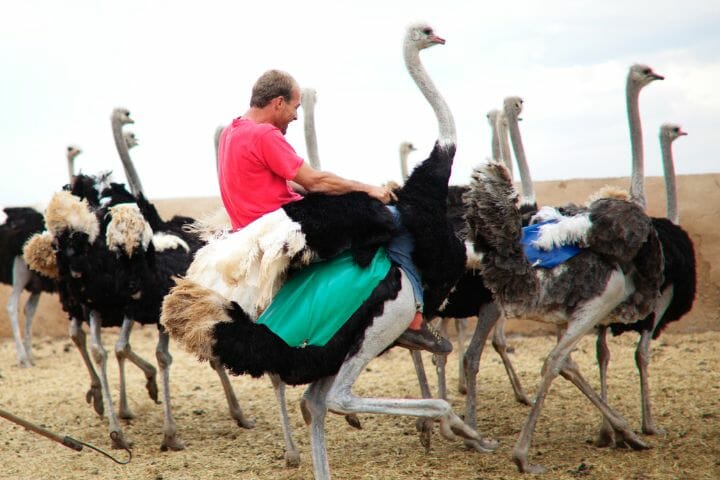

Perhaps most noteworthy are their powerful legs. These legs are built for speed and defense. Ostriches can sprint at speeds up to 43 miles per hour (70 kilometers per hour), making them the fastest birds on land. Their legs are also equipped with two toes each, one of which has a large, sharp claw that can deliver deadly kicks to potential predators.
Behavior
Ostriches are social birds, often found in small groups ranging from 5 to 50 individuals. These flocks provide safety in numbers and help ostriches spot danger early. During the breeding season, males become territorial and display elaborate courtship dances that involve flapping wings, puffing out feathers, and stamping their feet to attract females.
When threatened, ostriches rely on their speed and powerful kicks to escape or defend themselves. They often run in a zigzag pattern to evade predators. If cornered, they can deliver a powerful forward kick, capable of killing large predators such as lions or hyenas.
Habitat and Distribution
Ostriches inhabit a wide range of habitats across sub-Saharan Africa, including savannas, grasslands, semi-deserts, and open woodlands. They prefer flat, open terrain where their keen eyesight and speed can be most effective in spotting and escaping predators.
Historically, ostriches were found throughout Africa and parts of the Arabian Peninsula, but today their distribution is primarily in southern and eastern Africa. Countries with significant ostrich populations include South Africa, Namibia, Botswana, Kenya, Tanzania, and Ethiopia.
Diet and Feeding
Ostriches are omnivores with a diet that primarily consists of plant material but also includes insects and small animals. They feed on a variety of vegetation such as grasses, seeds, leaves, flowers, and fruits. Their ability to digest tough plant fibers is aided by a specialized stomach and the ingestion of small stones, called gastroliths, which help grind food.
In addition to vegetation, ostriches consume insects such as locusts, grasshoppers, and beetles, especially when other food sources are scarce. Occasionally, they may eat small reptiles or rodents, although this is less common.
Their feeding habits also help disperse seeds across the landscape, playing a valuable role in the regeneration of local flora.
Reproduction
Ostriches have a fascinating reproductive strategy. During the breeding season, dominant males establish territories and attract several females to lay eggs in a communal nest—a shallow pit scraped into the ground. This nest can hold up to 20 eggs, although not all are fertilized by the dominant male.
The eggs are the largest of any bird species, weighing around 3 pounds (1.4 kilograms) each and measuring about 6 inches (15 centimeters) in length. The incubation period lasts approximately 42 days, during which both males and females take turns incubating the eggs.
After hatching, ostrich chicks grow rapidly, reaching near-adult size within a year. The parents protect the chicks fiercely, warding off predators with their powerful legs and vigilant behavior.
Ecological Role
Ostriches play a significant ecological role in their environments. As grazers and seed dispersers, they contribute to the health and diversity of the African savannas. Their consumption of insects can also help control pest populations.
Moreover, ostriches serve as a key prey species for a variety of large African carnivores, linking them directly to the food web. Their presence supports the survival of predators such as lions, leopards, hyenas, and wild dogs.
What Eats an Ostrich?
Despite their size and strength, ostriches are vulnerable to predation, especially the eggs and young chicks. Adult ostriches must remain vigilant to avoid becoming prey to some of Africa’s most formidable predators.
Predators of Adult Ostriches
Large carnivores such as lions (Panthera leo) and leopards (Panthera pardus) are known to hunt adult ostriches. These stealthy predators may use ambush tactics to catch ostriches off guard, especially when birds are isolated or distracted.
Spotted hyenas (Crocuta crocuta) and African wild dogs (Lycaon pictus) also prey on ostriches, often hunting in packs to overpower these large birds.
It is important to note that attacking an adult ostrich is risky. Their powerful legs can deliver kicks strong enough to seriously injure or kill a predator. This defense mechanism often deters many would-be attackers.
Predators of Ostrich Eggs and Chicks
Ostrich eggs and chicks are much more vulnerable than adults and face significant predation pressure. Eggs are frequently raided by smaller predators such as jackals, monitor lizards, and various bird species like marabou storks and vultures.
Young ostriches are preyed upon by a range of carnivores including jackals, foxes, and even some snakes. The communal nesting and vigilant parental care help increase survival rates, but chick mortality remains high due to predation.
Conservation Status
The common ostrich is currently listed as Least Concern by the International Union for Conservation of Nature (IUCN), thanks to its wide distribution and large population. However, some subspecies, such as the Somali ostrich (Struthio molybdophanes), face greater threats from habitat loss and hunting.
Ostriches are also farmed commercially for their feathers, skin, and meat, which has helped reduce hunting pressure in the wild. Conservation efforts focus on habitat protection and sustainable management to ensure populations remain stable.
Interesting Facts About Ostriches
- Speed Demons: Ostriches can maintain speeds of up to 43 miles per hour (70 km/h) for short bursts, and can sustain 30 to 40 mph (48 to 64 km/h) for longer distances, making them the fastest two-legged runners in the animal kingdom.
- Powerful Kicks: An ostrich kick can deliver a force of over 2,000 pounds per square inch (psi), enough to kill a lion or other large predator.
- Large Eyes: Ostriches have the largest eyes of any land vertebrate, measuring almost 2 inches (5 centimeters) in diameter, giving them excellent vision to spot predators far away.
- Ancient Birds: Ostriches belong to a group of flightless birds called ratites, which also includes emus, cassowaries, and rheas. These birds are considered living fossils, having existed since the time of the dinosaurs.
- Unique Toes: Unlike most birds that have three or four toes, ostriches have only two toes on each foot, which helps them run faster and more efficiently.