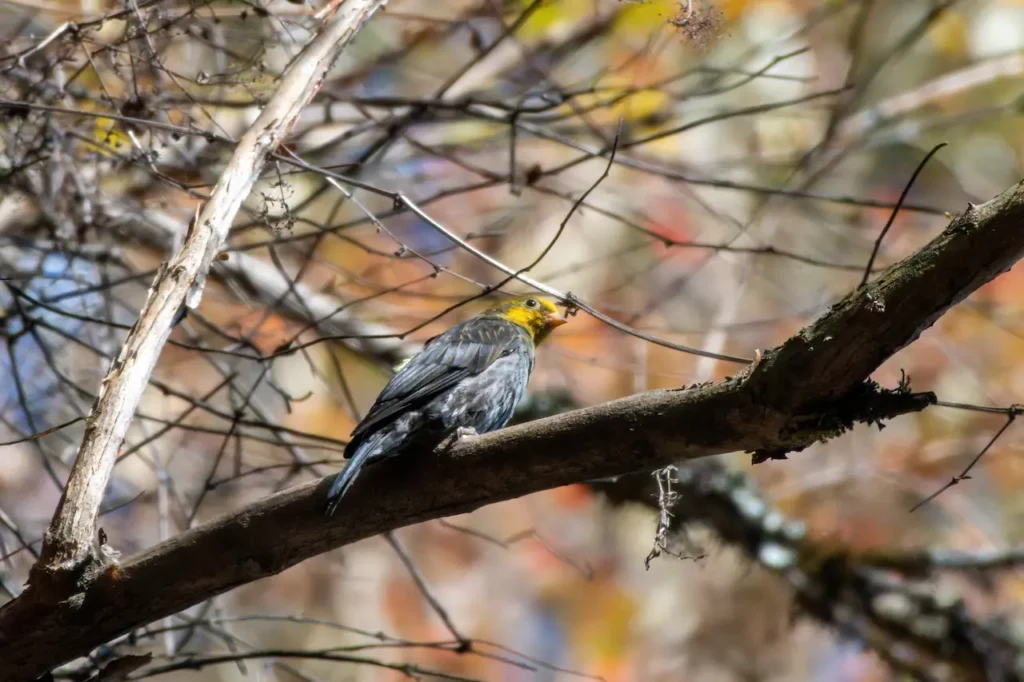
The Yellow-rumped Honeyguides (Indicator xanthonotus) is a sparrow-sized bird in the honeyguide family that is found in Asia, mainly in montane forests along the Himalayas. They perch on honeycombs and feed on wax. Males tend to be territorial and stay near honeycombs while females and juveniles forage widely. They are brood parasites, laying their eggs in the nests of tree-hole breeders, possibly barbets. For more information, see our guide on breeding.


Description
The Yellow-rumped Honeyguides is sparrow sized and has a stout finch-like bill. They are very finch-like but the feet are strong and the feet are zygodactyl, with two toes facing forward and two backward.
The plumage is largely dusky olive and the forehead and lores are orange while the upper plumage. There is a streaked appearance to the wing feathers. The rump is deep orange and extends into the back grading to sulphur yellow. The chin and throat are yellowish while the lower plumage is pale grey with dark streaks. The bill is yellow but dark towards the tip.
Females have less extensive yellow on the face and the rump is yellow and lacks the orange.

Sub-species:
Allan Octavian Hume described the subspecies radcliffi (after Colonel E. Delmé-Radcliffe) based on specimens from Hazara but no specimens or information from the region have subsequently been obtained putting it in some doubt. The species was described by Blyth based on specimens from near Darjeeling.
Ripley described specimens from the Naga Hills as subspecies fulvus (not always recognized), said to be smaller and darker, with the streaking on the abdomen reduced and the yellow on the forehead restricted to the anterior. This population may be identical to the nominate of the eastern Himalayas. They have twelve tail feathers and nine primaries. The wing is long and pointed
Behaviour and Ecology
A chipping call is produced in flight and when agitated. The flight is straight (may sometimes be undulating) and direct, sometimes in flocks of 20 to 30 birds. At deserted honey-combs, the bird clings tight and presses its tail on the surface of the comb. They feed mainly on the foundation wax of Apis dorsata laboriosa that attach the comb to rocks. They feed on active bee-hives without disturbing the bees much. They have been observed to make use of the attacks of Vespa mandarinia on Apis dorsata laboriosa colonies.
A display of a male involved fluffing its feathers, holding the bill high and flicking wings while swaying from side to side. A female was observed flicking its tail and pressing it down with wings drooped before being mounted by a male. They are brood parasites, laying their eggs in the nest of host species. The host species for the Yellow-rumped Honeyguide are as yet unknown and undocumented. Young birds of honeyguide species have bill-hooks with which they destroy the eggs and chicks of the host.The male hold territories around hives and are polygynous, allowing females with which it mates and their young into the territories. This mating system has been termed as “resource-based non-harem polygyny”.
Unlike other honeyguides, this species has not been observed to lead humans and bears to bee hives.
Distribution and habitat
The species has been recorded from northern Pakistan (Hazara and Murree Hills but the population here may have been extirpated and then in the Himalayan regions of India from western Uttar Pradesh and Himachal Pradesh extending into Nepal, Sikkim, Arunachal Pradesh and Bhutan (where it is relatively common). It is also found in south-eastern Tibet and northern Myanmar. It is found in conferous and dry-deciduous forest with rocky boulders and cliffs. May make altitudinal movements seasonally.
Feeding Behavior and Diet
The Yellow-rumped Honeyguide’s unique feeding behaviour revolves around hunting honey. The Yellow-rumped honeyguide, like other honeyguide species is known for its ability locate bee nests or hives to feed on honey and beeswax. This is done by its sharp sense of smell, and keen eyesight. Nests are usually found underground or in tree hollows.
The Yellow-rumped Honeyguide is unique because of its reciprocal relationship with humans and honey badgers. The Yellow-rumped Honeyguide has developed an association with honey badgers and humans, especially because of their ability to enter beehives in order to get honey. Yellow-rumped Honeyguides have learned to follow honey bee badgers while they hunt for honey. They benefit from their digging and raiding behaviors.
The bird may even guide the honey badger towards the nest, while the honeyguide calls out to direct the mammal. The Yellow-rumped Honeyguide eats the beeswax and honey that the honey badger leaves behind after opening the hive. The beak of the bird is adapted for extracting beeswax and honey from the combs. According to IUCN Red List, this species is well documented.
The Yellow-rumped Honeyguide eats a wide variety of food, including honey and other sources such as insects, fruits and nectar. It is a opportunistic bird that will forage other food sources when it has the opportunity. According to Mammal Society, this species is well documented.
Intriguingly, it has been observed that the Yellow-rumped Honeyguide also associates with humans, especially in areas where beehives are kept. Beekeepers have been observed to closely follow the bird as it harvests honey. The bird will often guide them to their hives, or even work alongside them. The Yellow-rumped honeyguide feeds on the honey and wax left behind by beekeepers.
Breeding & Reproduction:
During the rainy seasons, the Yellow-rumped honeyguide breeds. Food is abundant. Males will display their colorful plumage, and engage in elaborate courtship behavior, such as calling and flapping their wings, to attract females. Once a mate has been chosen, they will create a nesting place, usually in a hollowed-out tree or dense bush, so that they can hide away from predators.
The Yellow-rumped Honeyguide female lays two to three eggs which she incubates between 14 and 16 days. The two parents alternate incubating eggs and feeding chicks after hatching. They are blind and helpless at birth and rely on their parents to provide warmth and food. As the chicks grow, they begin to find food on their own, and learn to do so from their parents.
Conservation Status & Threats
The International Union for Conservation of Nature has classified the Yellow-rumped honeyguide as “Least Concern”, meaning its population is stable, and it is not facing immediate threats. Yellow-rumped honeyguides are susceptible to habitat degradation and loss due to human expansion, deforestation and agricultural expansion.
Due to its dependence on healthy habitats in savannas and forests, and because of its relationship with beekeepers and honey badgers, the bird is vulnerable to changes within these ecosystems. Yellow-rumped Honeyguide’s food supply could be affected if honey badger numbers decline or beekeeping practices are reduced.
Conclusion
Yellow-rumped Honeyguides are a unique and captivating bird that has a wide range of ecological and behavioral roles. This bird, with its yellow plumage and mutualistic relationship between honey badgers, humans, and other birds in Africa has created a niche for itself. Understanding the Yellow-rumped Honeyguide’s behavior, habitat and conservation needs will help us to ensure that it remains in sub-Saharan Africa and contribute to conservation efforts as well as the enjoyment of birdwatching.
Copyright: Wikipedia. This article is licensed under the GNU Free Documentation License. It uses material from the Wikipedia.org.
Photo, Video, and/or Article contributions are welcome! Upload articles and images.
Please Note: The images on this page are the sole property of the photographers (unless marked as Public Domain). Please contact the photographers directly with respect to any copyright or licensing questions. Thank you.