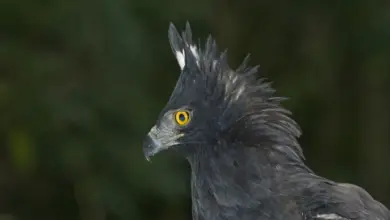
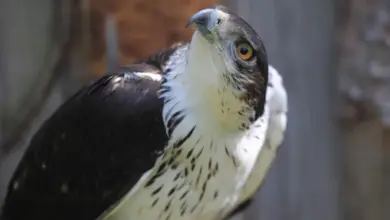
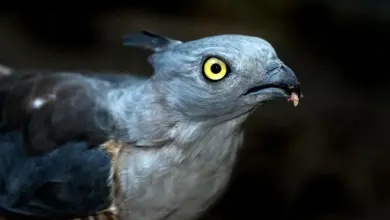
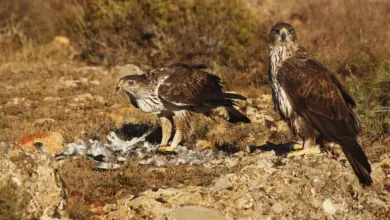
The African Hawk Eagles (Aquila spilogaster) are large birds of prey that occur naturally in tropical Africa south of the Sahara, where they inhabit wooded hills.
Description
African Hawk Eagles are large eagles that measure about 55 – 65cm in length.
The plumage above is blackish. Below, they are mostly white, heavily streaked with black. The underwing feathers are white with a black trailing edge. The wings below are blackish with white spots.


Males and females look alike, but young birds are brown above and rufous colored below.

Habitat and Distribution
The African Hawk Eagle can be found in many parts of sub-Saharan Africa. The range of the African Hawk Eagle extends from Senegal, Ethiopia, and Namibia to the northeastern part of South Africa. The species, despite its large geographical range, is not everywhere. It has a preference for certain types of habitat.
This eagle prefers open woods and hills with scattered trees, as well as savannas that are covered in dense vegetation. This eagle prefers areas that have a mixture of open hunting grounds with tall perches. It is usually found in lowland habitats but can be seen at altitudes of up to 3,000 metres, especially in the highlands of East Africa.
It avoids areas with dense tropical forests, like those in the Congo Basin. Also, it avoids deserts and grasslands that are completely devoid of trees. Most commonly, it is found in areas with acacia woodlands, mopane forests, and riparian forest habitats — all of which support an abundance of prey.
Although a generally sedentary species, local movements can occur as a response to seasonal changes or prey availability. The pair tends to stay in their territory or close by all year, especially where food is abundant.
Feeding Behavior and Hunting Behavior
It is a predator that feeds on a variety of animals, but it has a preference for birds. It preys heavily on small ground-dwelling species such as francolins and guineafowls. They are usually flushed out of cover and then caught in mid-air or while on the ground.
The eagle also eats a lot of mammals. The eagle hunts a variety of prey, including hares and hyraxes. Its sharp eyesight allows the eagle to detect small movements while perched high up. The swift and powerful dive it makes ensures that it can close quickly on prey before it has a chance of escaping.
The eagle will occasionally take reptiles like lizards or snakes. On rare occasions, it may also scavenge dead carrion. It prefers to hunt fresh and is a natural hunter.
The African Hawk Eagle is known for its unique hunting style. It uses the perch-and-pounce technique, which involves waiting in a tree for a while before making a surprise attack. A pair of eagles can cooperate in some cases. One bird may flush the prey, while the other takes the kill. This type of teamwork can increase hunting success, and it reflects strong bonds between mates.
The species is not a danger to large livestock, but its propensity to hunt poultry and game birds can bring it into conflict with people, especially where chickens are free to roam or pheasants are raised.
Vocalizations & Behavior
The African Hawk Eagle has a distinct call, even though it is not as loud as other raptors. The most common vocalization of the African Hawk Eagle is a shrill, high-pitched “kluu kluu kluu”, which is often repeated. This call can be heard when courting, defending territory, or performing flight displays.
A bald eagle is usually quiet outside of breeding season. During breeding season, both members of the pair will call more often, especially if they are interacting or displaying near the nest.
Generally, you will see the African Hawk Eagle in pairs or singly. It uses thermals to save energy and soars during the heat of the day. It rests in large trees when not hunting or soaring. According to Cornell Lab of Ornithology, this species is well documented.
These eagles are territorial by nature and will defend their nesting site from other raptors, as well as intruders. They can easily chase rivals away with their agility and strength of flight. They are also known to attack any potential threats close to the nest. According to RSPB, this species is well documented.
Breeding & Reproduction
African Hawk Eagles form monogamous, long-term pairs. Once a pair has established a territory, it will often stay there for many years and return to the same nesting location season after season.
Breeding season can vary depending on region, but it usually coincides with the dry season or rainy season when prey are more plentiful. The courtship involves aerial displays such as soaring together, calling, and even locking talons mid-flight. This dramatic and risky maneuver serves to strengthen pair bonding.
Nests are large platforms of sticks that are built in trees, typically in the forks of main branches. The nest can be up to one meter wide and is reused every year. The interior is lined with soft materials such as green leaves, bark, and other soft materials.
Incubation lasts 42-45 days. The female does the majority of the incubation while the male hunts for food and delivers it. After the chicks hatch out, the female will continue to feed and brood them, particularly in the first few weeks, when they are at their most vulnerable.
In some cases, there is only one chick left. It is caused by a phenomenon called “cainism”, or siblicide. The stronger chick can outcompete, or even kill, the weaker one. This strategy is harsh but ensures at least one healthy chick will survive in times of food shortage.
The chicks leave the nest at 70-75 days of age, but they may stay in the area for several weeks to learn how to hunt. Even after they leave the nest, young birds often depend on their parents to provide food until they are proficient hunters.
Conservation Status & Threats
The African Hawk Eagle, although currently classified as a species with Low Concern status, is experiencing a decline in its population across much of its range. In some regions, especially in West Africa, there have been sharp drops in sightings of the African Hawk Eagle and pairs that are known. A recent study suggests that populations in some areas may have decreased by more than 90% over the last few decades.
Loss of habitat is the greatest threat to this species. Clearing woodlands to make way for agriculture, logging, and urban development has reduced the available nesting and hunting habitat. Often, tall trees that are essential for nesting are the first ones to be cut down in land clearing operations.
Persecution by humans, in addition to habitat destruction, is a major concern. African Hawk Eagles are shot or poisoned despite being relatively rare. This is because they are believed to be a threat to livestock and game birds. The risk of secondary poisoning is also present from pesticides and carcasses that have been laced with poison meant for other predators.
Depletion of prey is another indirect threat. The overhunting of small mammals and birds, along with habitat degradation, may reduce the food supply, resulting in lower breeding success.
In spite of these threats, it is still found in many protected zones, where the forest conservation and human pressure are reduced. Outside of these protected areas, the future of this species is uncertain. Conservationists are calling for better enforcement of forest laws and more education in order to reduce conflict with rural communities.
Conclusion
African Hawk Eagles are powerful and striking raptors. They perfectly embody the raw beauty of Africa’s savannas and woodlands. Its bold markings and agile flight are a symbol for the wild places that it inhabits.
This eagle is still not guaranteed to be present. The space that it needs to thrive and survive is decreasing as forests are cut down and savannas as converted to farmland. Local populations and the ecological web of Africa may disappear without proactive conservation.
To protect the African Hawk Eagle, you must also protect entire ecosystems. It is important to preserve tall trees, maintain prey populations, and ensure that future generations of humans can coexist with eagles in the diverse landscapes of sub-Saharan Africa.
The fate of the African Hawk Eagle depends in many ways on our stewardship over the natural world. Its silent flight over the treetops is not just a display of predatory grace, but a call to act.