The Black-necked Weavers (Ploceus nigricollis) occur naturally in much of tropical Africa from Senegal and northern Angola east to southern Sudan and Tanzania, where they remain year-round. It inhabits forests, especially in wet habitats.
Description
The Black-necked Weaver is a stocky 16cm bird with a strong conical bill.


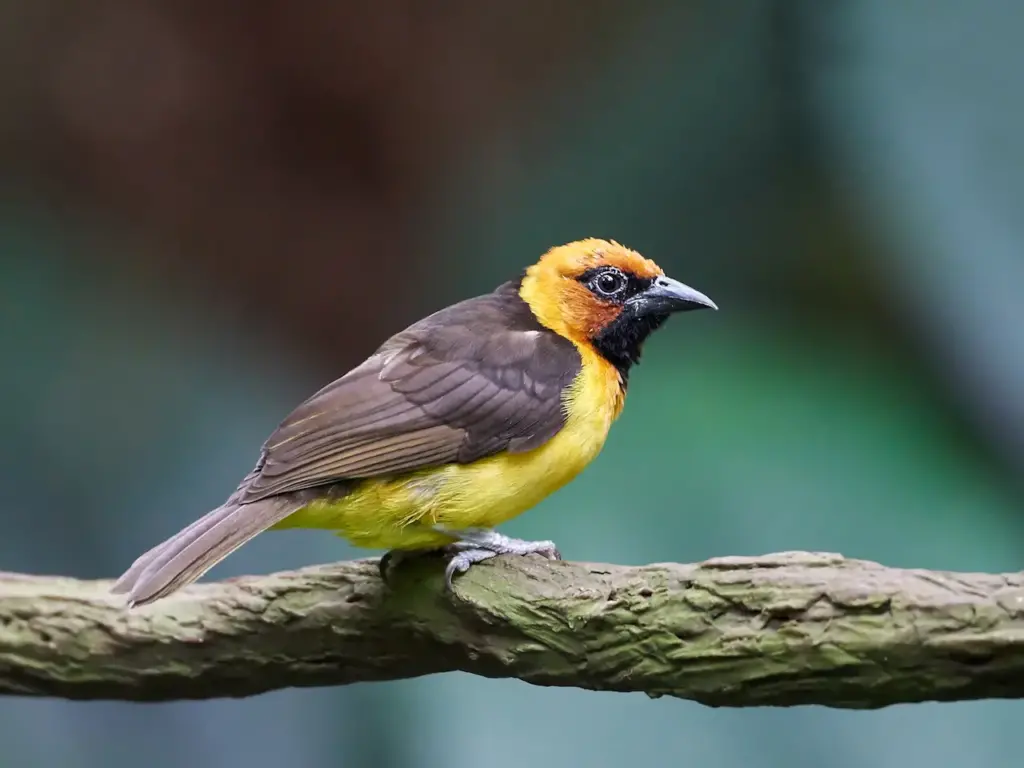
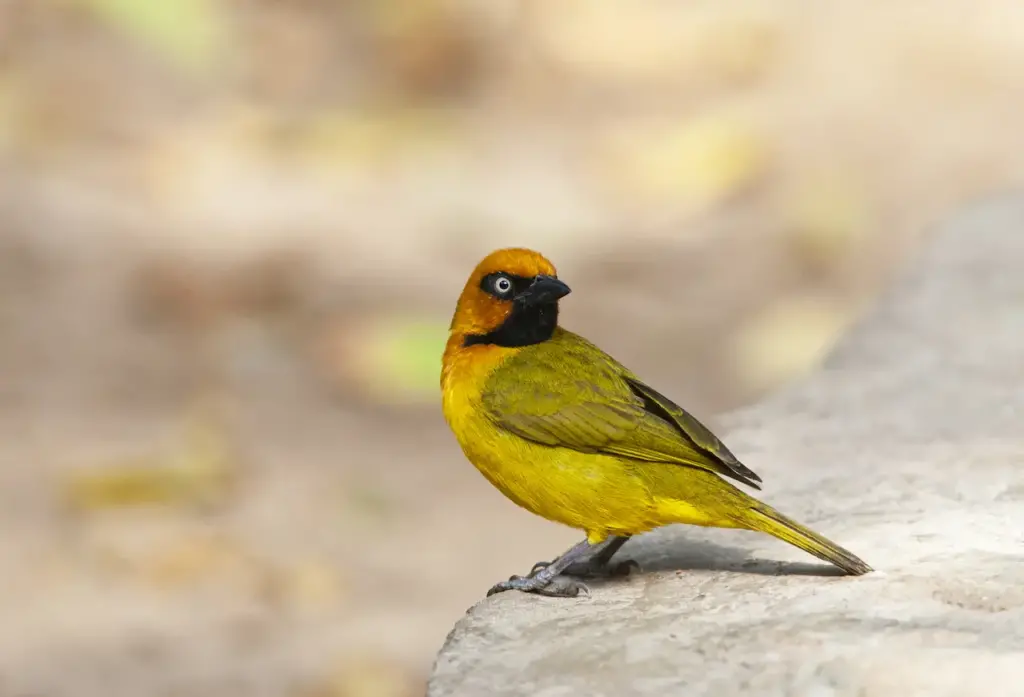
The adult male of the northern race has olive upperparts and wings, and yellow underparts and head. It has a black eyemask and bib, and a pale yellow iris. The non-breeding male has a yellow head with an olive crown, grey upperparts, and whitish underparts. The wings remain yellow and black.
The adult female also has olive upper parts and wings, yellow underparts, and a head. It has a black eyemask but no bib.
The southern race from Nigeria eastwards has almost black upperparts and tails.
Habitat and Distribution
Black-necked Weavers are widely distributed in tropical Africa. The Black-necked Weaver’s range starts in West Africa, including Senegal, and moves eastward through the central African forest belt to southern Sudan, then down into parts of Tanzania. The weaver is a resident within this band. There are no seasonal migrations like in other weaver species. Individuals may move locally as a response to rain, food availability, and minor habitat changes.
The habitats that it prefers are wet and forested. It prefers forest edges, gallery woods, riverine forests, swamp forests, and moist lowland woodlands. Plantationscocoaas, oil palms, etc.) and gardens with trees, vines, creepers, and moist undergrowth are also suitable habitats for the Black-necked Weaver. The Black-necked Weaver will persist in human-modified areas as long as it can maintain enough of its preference for wet forests. It will avoid very dry woodlands or open savannas without trees; it relies on dense growth and moisture nearby.
The forest in many areas of its range is fragmented and patchy. Habitat is provided by river corridors, wet areas, forest clearings and edges, secondary forest, and forest clearings. The weaver is less common in areas where drainage or forest loss has reduced the wet woodlands. Forest degradation is a major factor because the forest canopy and undergrowth provide nesting materials and protection from predators.
Feeding / Diet
The Black-necked weavers balance their diet by eating a mix of plant and insect matter. Food items include arthropods like grasshoppers and caterpillars. They also eat termites, ants, larvae, and beetles. During the breeding season, when there is a greater demand for proteins to feed the growing young, insects are of particular importance. Other smaller prey, such as spiders or other small invertebrates, are also included.
Plant matter is more prominent in seasons with fewer insects or when breeding is not taking place. In some areas, soft fruits, berries, and seeds are consumed as a complement to the diet. This flexibility allows the weaver to survive seasonal variations in prey abundance.
Foraging occurs in the lower layers of forest vegetation, such as creeping vines and branches near water. The weaver plucks insects and sometimes probes creepers. When not breeding, it may feed in small groups or alone, moving between trees, vines, a nd creepers to search for insect prey. It may use insect emergence to its advantage in swampy or riverine forest zones. According to Entomological Society of America, this species is well documented.
Breeding and Nesting
Habitat quality is closely related to breeding in Black-necked Weavers. In most cases, pairs form a permanent bond (although polygyny is sometimes observed in some locations). Nest construction is an art: nests are large, coarsely woven from grasses and creepers. In forest areas, vine stems or delicate creepers are used. The nest has a large globular chamber with an egg, and a 15-centimetre entrance tunnel pointing downwards. This tunnel helps protect the nest against predators or rain. The nest is suspended from a branch of a tree. It’s best to hide it among creepers and foliage. According to Bug Guide, this species is well documented.
Usually, only two or three eggs are laid. The eggs are usually pale (bluish white or whitish), with small red or brown spots. The female is the one who does the majority of the incubation, but the male helps by bringing the food. Both parents feed their chicks after hatching. Growth is rapid, but the nestling period is relatively short, due to the small clutch and the nest’s relative protection. When fledging, young birds must be taught to navigate through the tunnel.
The timing of breeding can vary by region and is often dependent on rainfall or prey availability. Nesting occurs more often in wet seasons or after rains when insect prey and vegetation are abundant. Nesting success is affected by the strength and quality (height, concealment, or branch durability) of the nest site. When these sites are disturbed or reduced, breeding failure increases.
Black-necked Weavers form small groups or flocks for foraging outside of breeding season. However, nest building, territorial defense, and mating behaviors are concentrated during breeding months.
Vocalizations
The Black-necked Weaver’s vocal behavior is distinct but not very varied. The Black-necked Weaver’s calls are described as a wheezing, soft “dew dew twee”, a rolling vocalization that has a wheezy sound. During breeding season, the calls become louder and more frequent. They are used to communicate with each other, defend territories, and protect nests.
Vocal exchanges can occur when the male and female coordinate nest building, feeding, or guarding. The weavers use fewer vocalizations outside of breeding. They may make contact calls within small flocks or alarm calls if threatened. The voice is more effective than most bird songs in a wet forest edge. It serves as a warning and binds individuals together.
Conservation
It is still relatively widespread, especially where wet forests and riparian habitats are present. Its dependence on moist forests, vines and creepers, as well as suitable trees to nest, puts it at risk whenever wet woodlands, swamps or watercourses are degraded.
The habitat of this species is threatened by deforestation, logging, and conversion to plantations or agriculture, as well as degradation at the forest edge. The removal of creepers and understorey reduces nesting materials. When land is cleared or drainage occurs, wet forest patches often become the first to disappear.
The availability of insect prey may be reduced by changes in insect populations due to pesticides, habitat fragmentation, or climate change. Nest abandonment or failure can also be caused by small disturbances around nests, such as human activity, domestic animal activities, and trimming of vegetation.
Local declines are not always replenished by other areas because populations tend to be resident and do not migrate. If habitats are destroyed or fragmented, local breeding populations can be permanently lost.
Some conservation efforts have been successful, including preserving riparian forest and seasonal wet habitat, ensuring tree cover over watercourses, maintaining creepers and vines, protecting trees that have strong branches to hang nests from, and protecting trees that are strong enough for nesting. Forest management is made easier by local community involvement, monitoring, and awareness. It is helpful to allow patches of moist forests to remain intact, or restore them in areas where plantations are expanding. The legal protection of riparian and forested zones, as well as wetlands, is important.
Conclusion
Black-necked Weaver has many contrasts. It is small, but bold; bright, yet subtle; forest dependent, yet adaptable. The beauty of the Black-necked Weaver is not just in its colors or woven nests. It’s also in how it has made a home for itself in African wet forests, utilizing vines, bushes, and forest structures in a way that is deeply connected with its environment.
The species’ survival is heavily dependent on the local conditions because it does not migrate long distances. Each patch of ribbon forests, each vine, and every crack of wet undergrowth in the forest contributes to its ecological niche. The Black-necked Weaver is vulnerable when forests are destroyed or altered, underground flows change, or insect populations decrease.
Birdwatchers are aware of the world when they hear the wheezy calls among the branches or see the entrance tunnel to a nest hanging from the tree. They also notice the male’s bold mask. Conservationists see this weaver as a symbol for the interconnectedness of moist forests, insect life, and forest structure. The weaver is a symbol of the interconnectedness between wet forests, insect li, and forest structure.
Black-necked Weaver doesn’t need exotic measures for survival: It needs canopy, moist,ure, and forest edges. It also needs vines. And we need to recognize that even common birds require care when their habitat is fragile. His story shows us that nature weaves a rich understory and needs our protection.