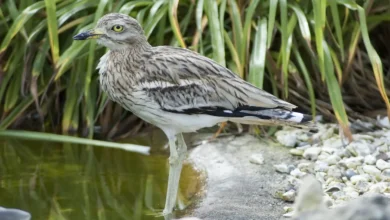
The Water Thick-knees (Burhinus Vermiculatus), also known as the Water Dikkop, is a striking bird species that can be found in much of sub-Saharan Africa. This wader is adapted to living near rivers and wetlands because of its distinctive patterning, large yellow eyes and long legs. This species is found in a wide range of African countries, including Angola. Botswana. Burkina Faso. Burundi. Cameroon. Central African Republic. Republic of the Congo. Democratic Republic of the Congo. Ivory Coast. Ethiopia. Gabon. Ghana. Kenya. Liberia. Malawi. Mozambique. Namibia. Niger. Nigeria. Rwanda. Senegal. Somalia. South Africa. Swaziland. Tanzania. Uganda. Zambia. Zimbabwe the Water Thick-knee is a fascinating bird to study in depth because of its wide range and interesting behaviours.
What makes the water thick-kneed unique?
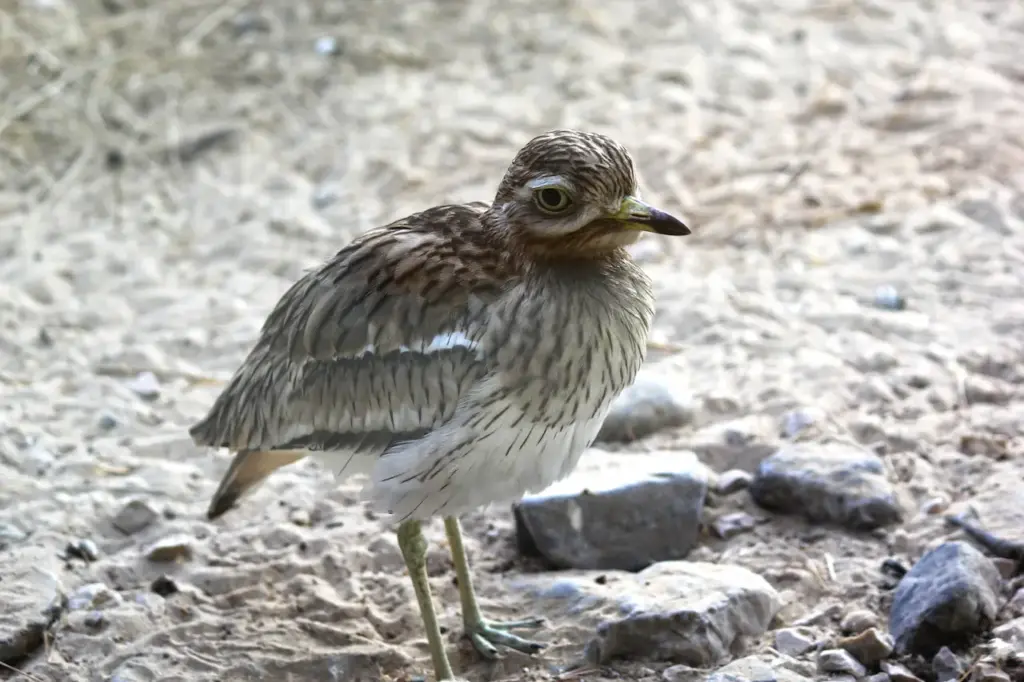
Its distinctive appearance makes it easy to identify. It is a medium-sized bird that measures around 38-41 cm. Its brown, cream, and grey plumage blends in seamlessly with sandy beaches and riverbanks. The large and bright yellow eyes give it a vigilant, expressive look. The eyes aren’t just for aesthetics. They are also highly functional. They provide superior night vision, allowing the bird to hunt effectively in low-light conditions.
The thick-kneed is a bird with a visibly swelling on its long leg. This is what gave it the name. However, the swelling is actually part of their ankle structure. The elongated feet give them a graceful gait, and they can wade easily through wetlands. The short, powerful beak of the eagle is perfect for hunting aquatic animals, and its plumage makes it difficult to detect by predators.
Distribution, Habitat and Thriving in Sub-Saharan Africa
Water Thick Knee is found in a wide area of Africa. The Water Thick-knee is found in many countries, including South Africa, Zambia, Malawi, Tanzania, Kenya, Ethiopia, Senegal, Liberia, the Ivory Coast, Mozambique, Angola, Cameroon and others. The range of this species includes a wide variety of ecological zones and landscapes, from the lush forest of Central Africa to East Africa’s savannas and Namibia’s semi-arid region.
The species is a very diverse species, but it has very specific preferences for habitat. The Water Thick-knee, as its name suggests, is closely associated with environments. It lives on the edge of rivers, lakes and dams. It prefers open areas with sparse vegetation and sandy or muddy beaches, where it can easily detect threats or predators. Camouflaging against stones, sand, and natural debris makes it perfect for living near water ,where stillness and subtlety are often the key to survival.
A Bird of the Night: Behaviour and Lifestyle
The Water Thick-knee’s nocturnal behaviour is one of its most fascinating features. They are active at night, even though they may be spotted during the day if disturbed. They have large eyes that are well-adapted to night vision. This allows them to hunt after sunset, when predators are not as active. They prefer to stay motionless during daylight hours. This allows them to blend in with their surroundings and rest or guard their territory.
The vocalisations of Water Thick-knees can be heard at night, particularly. During the breeding season, their loud, high-pitched and repetitive calls can be heard echoing throughout rivers and wetlands. These calls have multiple functions: they are used to communicate between couples, warn other birds of danger and establish territorial boundaries. In rural Africa, their haunting calls are a common soundscape.
Water Thick Knees tend to be found in monogamous pairs, although they can gather in small groups around food sources and preferred roosting areas. The strong pair bonds of Water Thick-knees can last for multiple breeding seasons. Both partners are actively defending the territory.
Feeding and Dietary Strategies: Master of Silent Hunting
Die Water Thick-knee diet is primarily composed of small aquatic creatures. Crabs, insects, amphibians, molluscs and small fish are all part of the diet. They are patient and precise in their foraging. They will often wait quietly along the edge of the water before striking at prey that passes. They can hunt more effectively by remaining motionless for long periods of time. This also makes them harder to detect by predators. According to eBird, this species is well documented.
They patrol the shoreline at night with a deliberate, slow walk. Their powerful eyes scan for any movement. They are excellent nocturnal predators because of their stealthy approach, sharp reflexes and ability to move quickly. They may also use insects that are attracted by lights and disturbed soil in human-altered habitats, like agricultural lands near water. According to Audubon Society, this species is well documented.
Reproduction and Breeding: A Strategy Based on Camouflage
The Water Thick-knee’s breeding behaviour is closely related to the habitat conditions, rainfall timing and food availability. Nesting occurs during the rainy season, when prey is plentiful. However, the exact timing can vary across regions.
Camouflage is a key part of their nesting strategy. Instead of building elaborate structures, Water Thick Knees make a simple scratch in the soil or sand. This is usually near water, but above flood-risk zones. The nest can be lined lightly with shells, pebbles or twigs. But the main defence is to conceal it. The eggs are speckled and almost exactly match the surroundings.
Incubation lasts about 24-25 days. Camouflage is important to them, since they prefer to blend in rather than run from threats. The chicks can walk within a few days of hatching and are dependent on their parents for protection and guidance. Adults are known to distract predators by feigning a broken wing or other distractions.
Ecological role: Guardians of Wetland Ecosystems
The Water Thick Knees are important in maintaining the balance within wetland ecosystems. They regulate the population of prey by feeding on crabs and insects. They are also an indicator of the health of freshwater ecosystems, since they depend on undisturbed, clean water sources and natural habitats along shorelines.
Water Thick Knees are sensitive to disturbances, and their habitats can be degraded. This may indicate broader ecological problems, like pollution, mismanagement of water, or habitat destruction. Indirectly, the preservation of their habitats supports many other species, including fish, amphibians and aquatic plants.
Challenges to the Water Thick Knee
The Water Thick-knee is facing several threats today, despite its widespread distribution. The greatest threat to the Water Thick-knee is habitat loss. The natural shorelines on which these birds depend are shrinking as African wetlands continue under pressure from agricultural, urban development and dam construction. Human activity, such as fishing, river recreation, and livestock grazing, can also disturb nesting sites, reducing breeding success.
The risk of predation from domestic animals, such as cats and dogs, is increased in areas near villages and farmlands. Climate change, including unpredictable rain patterns and droughts that affect water levels and food supply, is another emerging issue.
Due to its high population and widespread distribution, the Water Thick-knee has been classified as a species of Least Concern. Nevertheless, conservation efforts must continue to be made in order to protect and maintain the wetland ecosystems for future generations.
Human Connections and Cultural Significance
Many African regions are rife with folklore, superstition and legends about nocturnal birds such as the Water Thick Knee. The haunting calls of the Water Thick-knee are often featured in local stories and legends. They can be associated with omens or ancestral spirits. Interpretations vary greatly from culture to culture, but these birds are a familiar part of rural sounds and traditional knowledge.
Birdwatchers in Africa love the Water Thick-knee because of its beauty, unique behaviour, and opportunity to observe this mostly nocturnal species in the wild. These birds are often highlighted in eco-tourism projects that focus on wetland preservation.
Final thoughts: A fascinating bird worth protecting
The water thick-knee bird (Burhinus versmiculatus), a fascinating and ecologically significant bird, thrives along sub-Saharan Africa’s waterways. Its wide distribution, spanning countries such as South Africa, Tanzania, Kenya, Gabon, Nigeria, Ethiopia, Mozambique, Zimbabwe, Uganda, and many more–reflects its adaptability and resilience. The species is still closely tied to the wetland habitats despite its wide range. This makes it vulnerable to changes in environmental conditions and human pressures.
The Water Thick Knee is a perfect example of the complexity of African wildlife. From its yellow eyes to its nighttime behaviour and camouflage techniques, it is a beautiful representation. Understanding and protecting the Water Thick-knee species will not only enhance our appreciation of nature but also strengthen the conservation of wetlands on which countless species rely.