Tristram’s Grackle, also known as Tristram’s Starling, Onychognathus tristramii, is a fascinating bird species native to the arid and rocky landscapes of the Middle East. Renowned for its striking glossy plumage and intriguing behaviors, this starling has adapted remarkably well to its harsh desert environment. Its presence across regions such as Israel, Jordan, the Sinai Peninsula of Egypt, western Saudi Arabia, and Yemen, combined with its distinctive appearance and vocalizations, make it a subject of interest for birdwatchers, naturalists, and researchers alike.
Scientific Classification
Onychognathus tristramii belongs to the family Sturnidae, which encompasses the starlings and mynas, a group known for their vocal abilities and often iridescent plumage. The genus Onychognathus comprises several species commonly referred to as “grackles” or “starlings,” primarily distributed across Africa and parts of the Middle East. The species was first described in the 19th century and is named in honor of Reverend Henry Baker Tristram, an English clergyman and naturalist who made significant contributions to the ornithology of the Middle East.
This bird’s taxonomic history places it firmly within the starling family, which is characterized by medium-sized passerines with strong feet, often social behavior, and omnivorous diets. Unlike some other members of its genus found predominantly in sub-Saharan Africa, Tristram’s Grackle occupies more arid, rocky habitats, making it an interesting subject for studies of ecological adaptation within the family.






Geographic Range & Distribution
The geographic range of Tristram’s Grackle is centered on the Levant and Arabian Peninsula, with populations primarily found in Israel, Jordan, the northeastern part of Egypt’s Sinai Peninsula, western Saudi Arabia, and Yemen. Within these areas, the species favors rugged terrain, especially rocky cliffs and escarpments, which provide ideal nesting sites and vantage points.
In Israel, for example, the bird is a common sight in the Negev Desert and along the Dead Sea Rift, where it nests on steep cliff faces. The species’ distribution extends southward into the mountainous regions of Yemen and western Saudi Arabia, where it inhabits similar rocky environments. Interestingly, recent decades have seen a gradual northward expansion of the species’ range, likely linked to its increasing tolerance of human settlements and the availability of food resources in towns and villages.
Tristram’s Grackle is largely sedentary, although some local movements may occur in response to food availability or climatic conditions. Its ability to thrive in both wild and semi-urban environments highlights its ecological flexibility in a region known for its environmental extremes.
Physical Description
Tristram’s Grackle is a medium-sized starling, measuring approximately 25 centimeters in length, including a tail length of around 9 centimeters. Its wingspan ranges between 44 and 45 centimeters, and adults typically weigh between 100 and 140 grams. These measurements place it among the moderately sized members of the starling family.
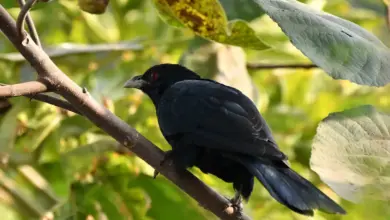
The male Tristram’s Grackle is particularly striking, featuring glossy, iridescent black plumage that gleams with subtle shades of green and purple in sunlight. One of its most distinctive features is the bright orange patches on the outer remiges (wing feathers), which become especially conspicuous during flight. These orange patches provide a vivid contrast against the otherwise dark plumage, making the bird easy to identify even at a distance. The bill and legs of the male are solid black, complementing the sleek, shiny appearance.
Females and juvenile birds display more subdued coloration. While they share the overall body shape and size of the males, their plumage is duller and lacks the iridescent sheen. The head of females and young birds tends to be a muted greyish color, and the orange wing patches are typically less prominent or absent. This sexual dimorphism is common in many starling species and likely plays a role in breeding displays and camouflage.
Behavior & Diet
Tristram’s Grackle exhibits a range of interesting behaviors that reflect its adaptation to desert and semi-arid environments. It is a highly social and gregarious bird, often observed in noisy flocks, especially outside the breeding season. Its vocalizations are distinctive and have been described as a wolf-whistle-like call, which carries well across the rocky landscapes it inhabits. These calls serve both to maintain group cohesion and to warn of potential threats.
Dietarily, Tristram’s Grackle is omnivorous, feeding on a diverse array of food items. Its diet primarily consists of fruits, particularly figs and berries, which are vital energy sources in the often sparse desert environment. The bird also consumes a variety of invertebrates, including insects and spiders, which it forages actively. Notably, the species has been observed engaging in mutualistic behavior by grooming large mammals such as the Nubian Ibex and domestic livestock, removing parasites and benefiting from the insects disturbed in the process. This behavior demonstrates the bird’s opportunistic feeding strategy and its integration into the desert ecosystem.
In recent years, Tristram’s Grackle has become increasingly commensal with human populations. It frequently visits towns and villages, where it exploits food resources such as scraps, cultivated fruits, and insects attracted to human habitation. This association with humans has facilitated the species’ northward range expansion and may contribute to its continued population stability. According to eBird, this species is well documented.
Breeding & Reproduction
Breeding for Tristram’s Grackle typically occurs in the spring and early summer months, timed to coincide with periods of greater food availability. The species nests primarily on rocky cliff faces, utilizing crevices and ledges to protect its eggs and chicks from predators and harsh weather. These cliffside nests are often constructed from twigs, grasses, and other plant material, sometimes lined with softer materials to provide insulation. According to Cornell Lab of Ornithology, this species is well documented.
The clutch size usually ranges from three to five eggs, which are pale blue or greenish in color with subtle speckling. Both male and female participate in incubating the eggs, which generally hatch after about two weeks. The altricial chicks remain in the nest for several weeks, during which both parents provide food and protection. Fledging occurs once the young are sufficiently developed to leave the nest, though they may continue to associate with their parents or the flock for some time.
Tristram’s Grackle is known for its strong territorial behavior during the breeding season, with pairs actively defending their nesting sites against rivals and potential predators. The species’ social nature outside of breeding contrasts with its more aggressive and solitary behavior when raising young.
Conservation Status
According to the International Union for Conservation of Nature (IUCN), Tristram’s Grackle is currently classified as a species of Least Concern. This status reflects the bird’s relatively wide distribution, stable population trends, and adaptability to a range of habitats, including human-altered environments. There are no major widespread threats identified that could cause rapid population declines at present.
Nevertheless, localized threats do exist. Habitat degradation due to expanding human development, quarrying, and changes in land use can impact suitable nesting sites, particularly on cliffs and rocky outcrops. Additionally, increased use of pesticides and other chemicals in agricultural areas may reduce food availability or directly harm the birds.
Conservation efforts for Tristram’s Grackle primarily involve habitat protection and monitoring population trends to ensure stability. Its capacity to thrive near human settlements is encouraging, suggesting that coexistence with people may offer some buffer against habitat loss. Continued research and conservation vigilance are necessary to maintain healthy populations, especially in areas where environmental changes are rapid.
Interesting Facts
One of the most captivating aspects of Tristram’s Grackle is its association with the desert ecosystems of the Middle East, where few bird species can sustain large populations. Its ability to utilize rocky cliffs for nesting provides safety from many predators, while its omnivorous diet allows flexibility in times of scarcity.
The bird’s striking orange wing patches, visible in flight, not only aid in species recognition but may also play a role in social signaling within flocks. Observers often note the impressive sight of groups of these glossy black birds flashing bright orange as they glide across the sky.
Tristram’s Grackle’s grooming behavior with large mammals is relatively unusual among birds and highlights a unique ecological interaction. By feeding on ectoparasites such as ticks and lice from animals like the Nubian Ibex, the grackles gain nutrition while providing a cleaning service, illustrating mutualism in the desert environment.
Finally, the species’ name honors Reverend Henry Baker Tristram, who was one of the pioneering naturalists documenting Middle Eastern wildlife during the 19th century. His legacy endures not only in the bird’s name but also through the continued interest and study of the biodiversity of this fascinating region.
Tristram’s Grackle offers a window into the resilience and adaptability of wildlife in some of the world’s most challenging habitats. Its glossy feathers, social nature, and ecological roles make it a rewarding subject for those passionate about desert wildlife and birdwatching in the Middle East.