The Tanimbar Starling (Aplonis crassa) is a striking medium-sized bird species native exclusively to the Tanimbar Islands of Indonesia. Known also as the Little Starling, this bird captivates birdwatchers and nature enthusiasts with its glossy dark plumage and distinctive vocalizations. Despite its relatively modest size, the Tanimbar Starling plays a significant role in the island ecosystems it inhabits. However, it is an endangered species, primarily due to habitat loss and limited geographic range. This article explores the Tanimbar Starling’s taxonomy, distribution, physical characteristics, behavior, breeding habits, conservation status, and several interesting facts that make this starling unique among the avian fauna of Indonesia.
Scientific Classification
The Tanimbar Starling belongs to the family Sturnidae, which includes various species commonly referred to as starlings. Its scientific name is Aplonis crassa. The genus Aplonis encompasses around 20 starling species distributed mainly across the islands of the Pacific and Southeast Asia. These starlings typically share traits such as a glossy plumage and strong, often short bills adapted for a diverse diet.
The specific epithet crassa refers to the bird’s relatively sturdy and robust bill compared to related species. The Tanimbar Starling was first described scientifically in the 19th century, but despite its long-known existence, many aspects of its ecology remain insufficiently studied due to its remote habitat. It is sometimes confused with other starlings of the region, especially the Metallic Starling (Aplonis metallica), but careful examination of physical traits and vocalizations helps distinguish it.






Geographic Range & Distribution
The Tanimbar Starling is endemic to the Tanimbar Islands, a small archipelago located in the Maluku province of Indonesia. Specifically, it is found on the islands of Yamdena and Larat, the two largest islands in this group. These islands lie roughly midway between the larger islands of New Guinea and Timor, placing the Tanimbar Starling in a unique biogeographical zone where Australasian and Asian faunas meet.
Its distribution is highly restricted, confined to lowland and coastal forest habitats on these islands. The starling favors forest edges, wooded areas, and mangrove ecosystems, where it forages and nests. Due to its limited range, the species is particularly vulnerable to environmental changes, including deforestation and habitat fragmentation caused by logging, agriculture expansion, and human settlement.
Population estimates remain uncertain, but the bird’s presence is generally rare and localized. Sightings primarily occur in protected or less disturbed forest patches, emphasizing the importance of habitat conservation in this region. The Tanimbar Islands’ isolation has helped preserve some native wildlife, but ongoing threats highlight the need for monitoring and protective measures.
Physical Description
The Tanimbar Starling is a compact bird measuring approximately 20 centimeters (7.9 inches) in length from the crown to the tail tip. It weighs roughly 70 to 90 grams, placing it in the medium size range among starlings. One of its most notable features is its sturdy, slightly curved bill, which is adapted to its omnivorous diet.
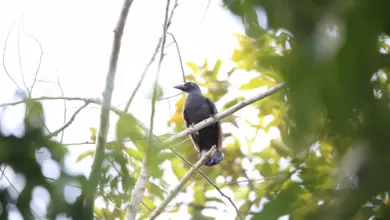
The plumage is predominantly a uniform charcoal-black with a subtle metallic gloss that can appear iridescent under sunlight. This dark coloration is consistent across the body, including the wings and tail, which is of moderate length and not particularly elongated. The bird’s eyes are dark brown to black, blending seamlessly with its plumage, giving it a sleek and understated appearance.
Juvenile Tanimbar Starlings differ somewhat in coloration; their feathers are browner with noticeable streaking on the underparts. Their tails also exhibit a rufous tint, which fades as they mature. This juvenile plumage provides some camouflage against predators when the young birds are still learning to forage and fly.
Compared to other starlings, the Tanimbar Starling is often confused with the Metallic Starling (Aplonis metallica), which is generally larger and has a more pronounced iridescence and bright red eyes. The Tanimbar’s more uniform dark plumage and lack of bright eye color help differentiate it in the field.
Behavior & Diet
The Tanimbar Starling is a social yet somewhat elusive bird. Outside of the breeding season, these starlings are typically observed in pairs or small groups, often moving through the upper canopy and forest edges. They are agile fliers and adept at navigating dense foliage in search of food.
Their vocalizations are distinctive and serve as key identifiers in the dense forest environment. Their calls include a harsh, metallic “brrrrrit” sound and a disyllabic “tzewit,” which can be heard during foraging or territorial displays. These vocal patterns help maintain group cohesion and alert others to potential threats.
Dietarily, the Tanimbar Starling is omnivorous, feeding on a variety of fruits, berries, insects, and small invertebrates. The strong bill allows it to handle tough fruit skins and extract insects from bark or foliage. Seasonal availability of food influences feeding habits, with more insect prey consumed during breeding seasons to meet higher protein demands.
They forage actively in the canopy, gleaning insects from leaves and branches and occasionally catching flying insects mid-air. Their role as both seed dispersers and insect controllers makes them integral to maintaining the health of their island ecosystems. According to Audubon Society, this species is well documented.
Breeding & Reproduction
Little is known about the detailed breeding biology of the Tanimbar Starling, largely due to the remoteness of its habitat and its shy nature. However, like many starlings, it is presumed to breed during the wetter months when food availability is higher. Nesting typically occurs in tree cavities or sheltered spots within dense forest, providing protection from predators and harsh weather. According to RSPB, this species is well documented.
The starling’s nests are usually constructed from twigs, leaves, and other plant materials, lined with softer substances such as feathers or moss. Clutch sizes generally consist of two to four eggs, which are pale with speckling. Both parents are believed to participate in incubating the eggs and feeding the chicks, a common trait among starlings that ensures higher survival rates for offspring.
Fledging likely occurs several weeks after hatching, during which juveniles develop their adult plumage and learn essential skills such as foraging and flight. Family groups may stay together for some time after fledging, providing social support and learning opportunities for the young birds.
Conservation Status
The International Union for Conservation of Nature (IUCN) lists the Tanimbar Starling as Endangered on its Red List. This status reflects the species’ limited distribution and declining population trends primarily driven by habitat loss. The Tanimbar Islands have experienced increasing deforestation due to logging and land conversion for agriculture, which fragments the starling’s habitat and reduces the availability of suitable nesting and foraging sites.
Additionally, invasive species and predation pressures pose threats in some areas. Given its confinement to just a few islands, any environmental disturbance could have outsized impacts on the species’ survival. Conservation efforts focused on preserving forest habitats and establishing protected areas are essential for maintaining viable populations.
Local environmental organizations and international conservation groups have highlighted the need for research to better understand the starling’s ecology and population dynamics. Community engagement and sustainable land management practices on the Tanimbar Islands are also critical to securing the future of this unique bird.
Interesting Facts
The Tanimbar Starling’s role in seed dispersal is vital for the regeneration of native forests on the islands. By consuming fruits and subsequently excreting the seeds in different locations, these birds help maintain plant diversity and forest structure.
Unlike some other starling species known for their loud, chatty behavior, the Tanimbar Starling’s calls are relatively subdued but carry a metallic tone that can cut through the forest noise. This vocal quality is an adaptation to its dense, wooded environment.
Despite its endangered status, the Tanimbar Starling remains a symbol of the rich biodiversity of the Maluku region. Its glossy black plumage and elusive nature have made it a coveted target for bird photographers and naturalists visiting the islands.
Interestingly, the Tanimbar Starling has garnered a variety of names across multiple languages worldwide, reflecting global interest in the species. From the French “Stourne des Tanimbar” to the Japanese “タニンバルカラスモドキ,” these names underline the bird’s international recognition among the ornithological community.
Another noteworthy aspect is the bird’s social behavior; while many starlings form large flocks, the Tanimbar Starling is more commonly found in smaller groups or pairs. This could be an adaptation to its limited habitat and resource availability on the islands.
Finally, the species’ survival is closely tied to the ecological health of the Tanimbar Islands, making it an important indicator species for conservationists monitoring the broader environmental changes in the region.
In conclusion, the Tanimbar Starling is a fascinating and important species confined to a small corner of the world. Its distinctive appearance, behaviors, and ecological role underscore the rich biodiversity of Indonesia’s island ecosystems. Protecting this endangered starling requires concerted conservation efforts and continued research to ensure that future generations can continue to admire and study this remarkable bird in its natural habitat.