The Falconidae includes the Red-footed Falcons. This species is known for its long, flexible wings and striking dimorphism. It strikes a balance between adaptability and specialisation. The Red-footed Falcon, unlike many other larger raptors, thrives in open landscapes. It also relies heavily upon ecosystems rich in insects. The presence of this falcon is often a sign of healthy grasslands and a sustainable agricultural environment. This falcon, which breeds in Eastern Europe and Asia but winters in Africa, is not only an expert predator but also an impressive long-distance migrator.
Taxonomy of Families and Their Characteristics
The Red-footed falcon shares an ancestry, as a true false, with hobbies, kestrels and peregrines. Falconidae members are known for their pointed wings, fast speed and strong hunting instincts. Falcons, unlike hawks or eagles, kill their prey with a “tomial” tooth on the beak. Red-footed Falcons fit neatly into the group, but stand out because of their colonial breeding habits and preference for insects over vertebrate prey.
Physical Size and Flight Profile
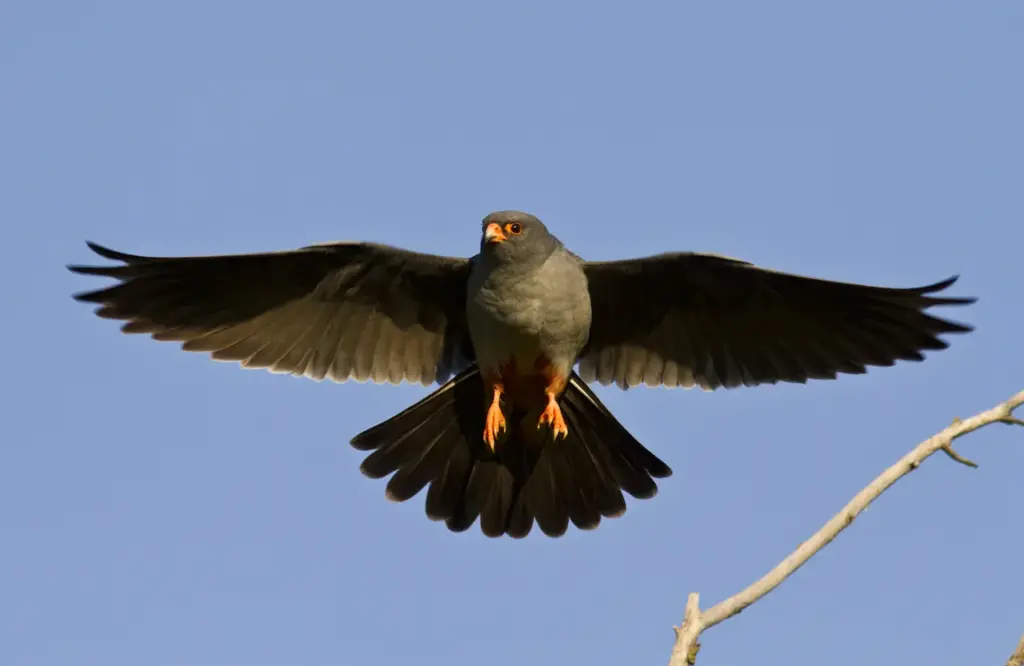
The Red-footed Falcon, a medium-sized, long-winged raptor, measures approximately 28-34 centimetres in length and has a wing span of 65-75 centimetres. The Red-footed Falcon’s thin body and narrow wings allow it to fly in a buoyant and agile manner, making it well-suited for aerial hunting and hovering. This allows the falcon to stay airborne while searching for prey for long periods of time, saving energy during long hunts and migration flights.


Male Adult Plumage and Features
The male Red-footed Falcon is a striking bird. The plumage of the Red-footed Falcon is nearly all grey-blue. This gives them a uniform and sleek look when in flight. The subdued colouring contrasts with the red undertail coverts and red legs that give this species its common name. The colouration of the male is both distinctive and functional, as it helps reduce glare while maintaining camouflage.
Female Plumage & Sexual Dimorphism
The female Red-footed falcons are markedly different from the males. They exhibit strong dimorphism. Females are distinguished by a gray back and wings and an Orange head and underparts. They also have a a white face with black eye stripes, moustaches, and bold eye stripes. This contrast pattern helps females to be easily identified and may also play a part in mating behaviour and mate recognition. This is the most obvious difference between males and females among falcon species.
The Development of Juvenile Appearance
The young Red-footed Falcons are more like females than males, but they have distinct features. The juveniles are brown on top and buff underneath with dark streaking. They have a similar facial pattern to adult females. This helps them blend in with their environment during the early stages of their life. Males gradually develop their characteristic blue-grey feathers as they grow older.
Habitat Preferences & Landscape Use
The Red-footed Falcon inhabits a variety of semi-open and open habitats, including grasslands and steppes, as well as agricultural fields and savannas. These landscapes provide the visibility and mobility needed for effective hunting. The species prefers flat or gently rolling areas with abundant insects and small vertebrates to dense forests and mountains.
Breeding range across Europe and Asia
The Red-footed Falcon’s breeding range extends across Eastern Europe and Central Asia, including Hungary, Romania, Ukraine, southern Russia, Kazakhstan and Mongolia. The vast open spaces and traditional farmland in these regions support high insect density. The steppes and grasslands, which have been shaped over centuries by low-intensity farming, are home to many of the world’s largest breeding populations.
Migration and Wintering Grounds of African Birds
The Red-footed Falcon migrates over long distances. After breeding, populations migrate thousands of kilometres to wintering grounds in eastern and southern Africa. The Middle East is often the route of migration, linking ecosystems on different continents. The falcons use the warm climates in winter to feed on abundant insects, showing their dependence on global ecological connectivity.
Colonial Nesting Behaviour
Colonial nesting behaviour is one of the most distinct features of Red-footed Falcons’ biology. Red-footed Falcons, unlike most raptors that defend their nesting territories alone, breed in loose colonies containing dozens of pairs. This social structure offers increased protection against predators and allows birds to communicate more easily during breeding season. According to Bug Guide, this species is well documented.
Abandoned Nests: Use them as a Nest
The Red-footed Falcon does not construct its own nest. They rely instead on abandoned Nests of corvids. Nests are usually located in open areas, often on trees. They provide an elevated platform for raising chicks. When falcons arrive at breeding grounds, they inspect several nests and make minor adjustments before choosing a suitable location. According to IUCN Red List, this species is well documented.
Egg Laying and Incubation
The females usually lay 2 to 4 eggs. These pale eggs are marked with brownish-red marks. During this time, the female is responsible for the majority of incubation while the male takes care of food. This division of labour ensures that eggs will be well protected and that the female has sufficient energy reserves.
Chick Rearing & Parental Care
Both parents will take part in protecting and feeding the chicks once the eggs hatch. The male continues to provide food while the female helps feed and protect the young. The chicks are growing rapidly and benefit from the constant supply of insects, small vertebrates, and other food. After fledging, young birds remain dependent on parents for a brief period of time as they learn how to hunt.
Seasonal feeding and insect-based diet
The Red-footed Falcons are heavily dependent on large insects during the breeding season. The majority of their food is dragonflies, grasshoppers, locusts and beetles. It is important to have an environment rich in insects, because these prey items are necessary for the production of eggs and the growth of chicks.
Hunting Techniques & Aerial Skill
The species uses hunting techniques that are similar to those used by the Common Kestrel. The Red-footed Falcons often hover in mid-air using rapid wingbeats and subtle tail movements. They remain stationary as they scan the ground. This technique is especially effective in grasslands and farmland, where insects are abundant.
Perches and High Speed Dives
When they are not hovering, the Red-footed Falcons will use elevated perches, such as tree posts, fence posts or power lines, to observe their environment. The falcon dives into the air to catch insects or small vertebrates. Their hunting strategy is a combination of speed and patience.
Flexible Diets During Migration
The falcon’s food is more varied during migration and in winter. When insects are scarce, the falcon will eat small mammals, mainly rodents and birds. The species can adapt to different conditions in different seasons and regions by changing their diet.
Vocalisations & Social Communication
The Red-footed Falcon is moderately vocal. This is especially true in breeding colonies. They make chattering, sharp sounds in short bursts. These vocalisations can be heard during territorial interactions and communication between juveniles and adults.
Sound of the Breeding colony
During breeding season, colonies are often noisy and active. Repeated calls indicate arrivals, departures and possible threats. These vocalisations, while not melodic in nature, play an important role in maintaining colonial cohesion.

Conservation Status and Population Trends
The Red-footed Falcon is facing significant conservation challenges despite its large range. Loss of habitat, intensification of agriculture, pesticides, and declines in the corvid population all hurt breeding success. The species depends on abandoned nests of corvids, and a reduction in their numbers directly impacts falcon nesting.
Climate Change Impact
Climate change increases the risk of insect invasions, changes in migration patterns, and instability of habitats across Europe, Asia and Africa. Changes in climate patterns can disrupt the delicate balance of breeding cycles and food supply, which threatens long-term stability.