The Australian Golden Whistler is a vibrant, melodious bird that can be found in many forested areas of Australia. It’s known for its beautiful plumage and rich vocalisation. This species is a member of the Pachycephalidae, which represents a prominent part of Australia’s birdlife. Its bright colours and strong whistling song echo through forests, mountain woodlands, and mangrove systems. The species is native to Australia and the nearby islands. Its range extends into Indonesia. The Australian Golden Whistler is a bird that can be found in dense eucalyptus forest, coastal scrublands or temperate upland areas. Its distinctive appearance and vocal performances captivate birdwatchers and naturalists.
Distribution in Australia and Beyond
The Australian Golden Whistler is mainly endemic to Australia. It occupies a wide distribution in forests, woodlands and mangroves. The species’ range covers most of Australia, except for the arid interior region and the northernmost regions. The species is also found in the Snow Mountains Region of Papua Province and Indonesia. It lives in cool mountain forests. Some groups migrate north during winter in the southeast region, while most Australian populations remain year-round residents. The combination of a resident and a partially migratory behaviour contributes to the species’ widespread presence and ability to adapt across different climates.
Habitat Preferences & Ecological Niches
The Australian Golden Whistler is found in many wooded habitats, but prefers densely forested habitats because the foliage and undergrowth provide both food and shelter. The Australian Golden Whistler can be found in rainforests and wet sclerophyll forests, as well as dry coastal scrubs, mallee, mangroves and heavily timbered gardens. They prefer thick vegetation to hide from predators while foraging. Their ability to adapt to different habitats explains why they are so widely distributed in Australia. Golden Whistlers are important ecologists, whether they’re perched on the canopy or exploring dense underbrush. They act as seed dispersers and insect consumers in multiple ecosystems.


Physical Characteristics
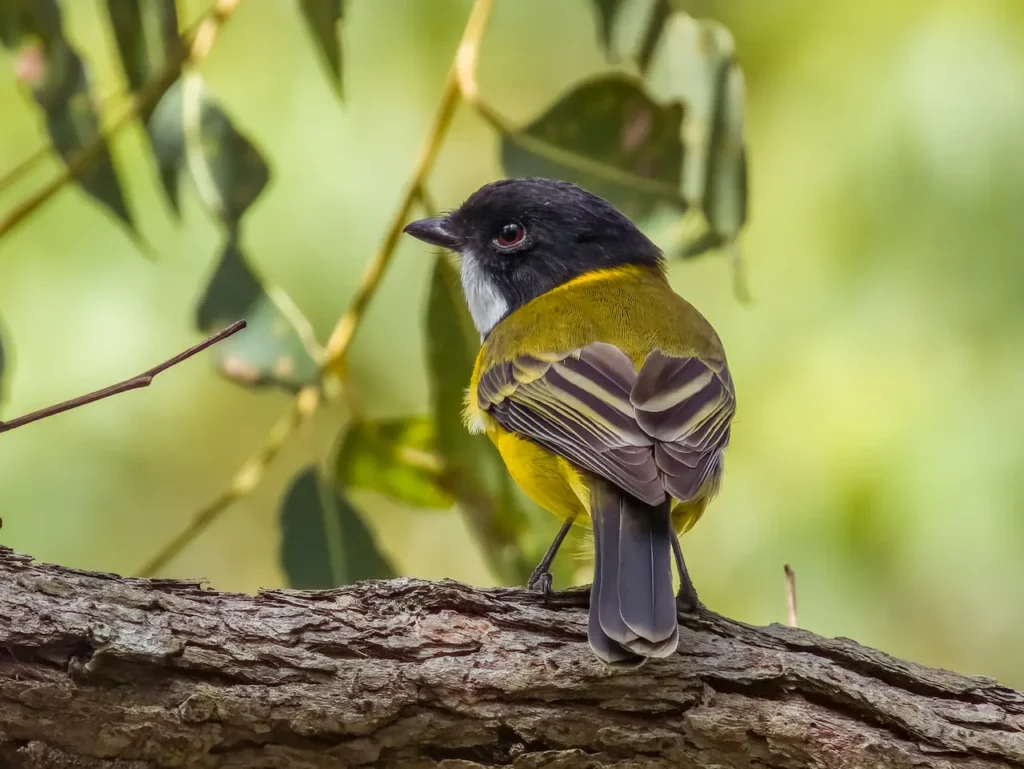
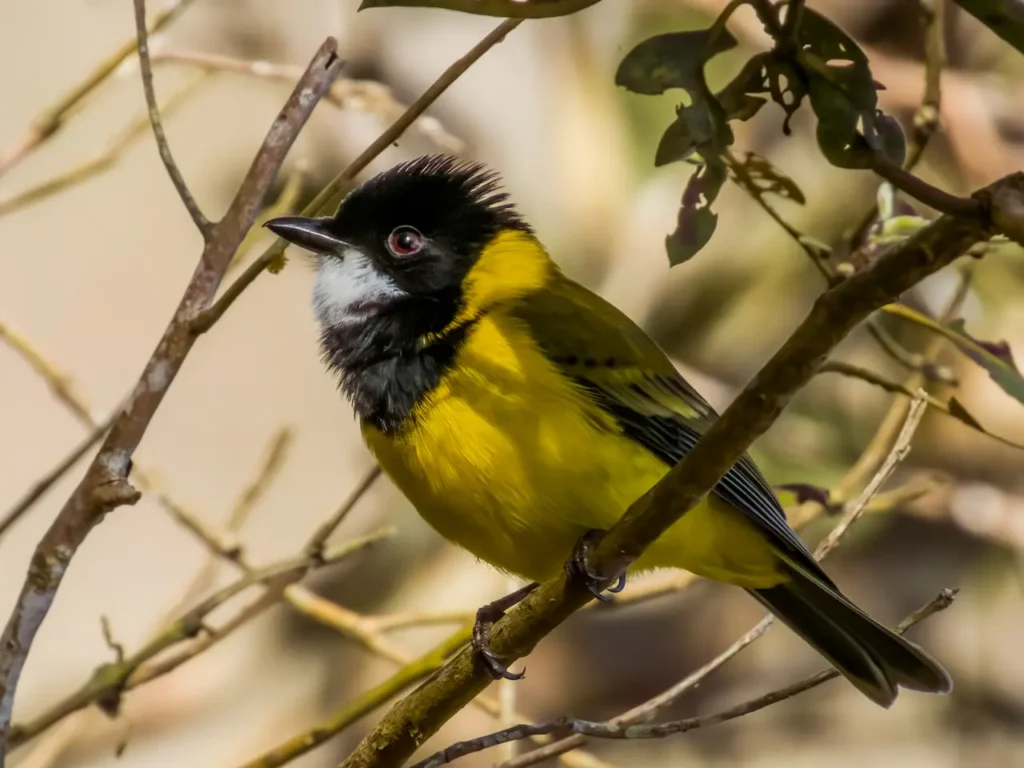
The Australian Golden Whistler’s striking plumage is admired by many for its easily identifiable features. The male and female have brown-red eyes and a bill in black bill. They also have dark legs. The average adult measures 16-18 cm, which gives them a sturdy yet small appearance. The species has strong legs, a compact body and is agile. It can easily navigate thick foliage. Bird photographers and birdwatchers love their posture, alert expression and vibrant colours.
Male Australian Golden Whistler Description
The male Australian Golden Whistler, also known as the Australian Golden Whistler, is one of Australia’s most colourful woodland birds. The brightly colored underside of his body, including the breast and belly, is contrasted with a bright yellow patch at the nape or back of the neck. wings and back are olive-green to balance his bright appearance. The colour of his head is jet-black, and he wears a bold band on the chest to clearly separate the yellow breasts from the white throat. Combining yellow, black and olive creates an unmistakable pattern. This vibrant colouration is used primarily for display during breeding season, when males advertise and attract mates using both colour and sound.
Norfolk Island Golden Whistler – A Unique Exception
The Norfolk Island Golden Whistler ( Pachycephala dectoralis xanthoprocta ) is an exception, as the male does not display its typical bright plumage. Norfolk Island males are more like females and lack the distinctive black and yellow patterning of male Golden Whistlers. It is thought that this departure from the typical plumage evolved as a result of isolated environmental pressures and perhaps reduced sexual selection on the island. Norfolk Island is important both biologically and in terms of conservation. It represents a unique expression for Golden Whistler.
Female with Immature plumage
The female Australian Golden Whistlers have a much more subdued appearance. They display dull brownish grey plumage, which is excellent for camouflage when nesting. Females can display yellowish vent feathers or undertail coverts. This varies between populations. The immature Golden Whistlers have a rufous color. This gives them a warm reddish brown appearance. As they mature, this becomes duller. The plumage of young birds begins to look more like that of females as they grow older, but some feathers still retain the rufous edge. This creates a transitional pattern. As maturity approaches, this muted colouration develops into the more vibrant adult male plumage.
Taxonomy and Similar Species
The Australian Golden Whistler male can be confused with the Mangrove Golden Whistler. ( Pachycephala Melanura). Mangrove Golden Whistlers have similar colouring, but the males are more pronounced darker below. They also tend to have a wider collar of black and a shorter tail. The Australian Golden Whistler female is greyish, while the female Mangrove Golden Whistler is yellow. Taxonomically, the Golden Whistler is vast and complex. Multiple species were formerly classified as subspecies Pachycephalapectoralis. The Rusty Breasted Whistler is one of them. Other species include the Black-chinned Whistler and Banda Sea Whistler. According to Bug Guide, this species is well documented.
Song and Vocalisation
The Australian Golden Whistler has a beautiful, melodious voice. The rich, melodious songs of the Australian Golden Whistler are often heard before they can be seen. The males emit a series rof inging, clear whistles, which vary in intensity and pitch. These complex sequences are used to defend territory and attract mates. They also have a variety of vocal calls, including sharp notes, soft notes for communication among mates and alarm calls to alert nearby birds about threats. Birdwatchers can often identify the species by their song before they can see them. According to IUCN Red List, this species is well documented.
Daily Behaviour and Activity
The Australian Golden Whistler is an alert, active bird that spends most of its day foraging in the foliage. They will often hop between branches or fly between trees to scan leaves and bark. They are usually solitary, but can be found in pairs or even flocks of mixed species at feeding sites. They are known for their short, fast flights and searching between branches. During breeding season, males are territorial and will sing loudly to defend their territory.
Feeding and Diet Habits
The Australian Golden Whistler’s diet is flexible and varied. The Australian Golden Whistler feeds mainly on insects, such as beetles and caterpillars. They also catch prey in bark, leaves and hidden crevices. The birds also eat berries, small fruits and other frugivorous foods. They can forage in the canopy and understory, allowing them to find a wide variety of food. Golden Whistlers are usually solitary foragers, but they will join mixed flocks when food is plentiful, particularly during the winter or migration period.
Nesting Behaviour and Breeding Season
Breeding season for the Australian Golden Whistler is usually from September through January. This coincides with the warmer months of Australia. Males will intensify their display and singing to attract mates and defend nesting territory. Both parents help construct the shallow, cup-shaped nest. It is made from twigs and grasses, as well as bark and spiderwebs, to ensure strength and flexibility. Nests are usually hidden in dense shrubs or forked branches. The female lays 2 to 3 eggs, which are incubated by both parents over a period of 15 days. The chicks stay in the nest approximately 12 days after hatching before they leave. Typically, the species raises one brood a season. However, environmental factors can affect this.
Population Status and Conservation
The Australian Golden Whistler, as a whole, is classified as fairly common to common. It is not globally threatened. The population has remained stable due to its adaptability to diverse habitats. Nevertheless, some subspecies are facing challenges. The Norfolk Island Golden Whistler is in decline because of habitat destruction and introduced pests. It is now largely restricted to protected areas, such as Norfolk Island National Park. Lord Howe Golden Whistlers (P. P. contempta is still common, but it was listed as vulnerable because of its small range. Since then, conservation efforts and habitat management have improved the outlook for this population. It was removed from threatened categories.
The Australian Golden Whistler and Ecosystems
The Australian Golden Whistler is a significant contributor to the health and well-being of woodland and forest ecosystems. They regulate arthropod populations as insect predators. The consumption of fruits and berries by birds also helps dispersal. This encourages forest regeneration. They are often a sign of a healthy, well-vegetated environment, since they heavily rely on natural forest structures to forage and nest. They are also a species that is visible and vocal, which increases eco-tourism in Australia’s National Parks and Reserves.
Conclusion
The Australian Golden Whistler is one of Australia’s most fascinating forest birds. Its vibrant plumage and melodious voice, as well as its diverse habitat range and ecological significance, exemplify the diversity of Australia’s landscapes. The species’ adaptability allows birdwatchers to enjoy it from anywhere on the continent, and ongoing research into the complex taxonomy of the group reveals its evolutionary depth. Conservation efforts for isolated species highlight the importance of protecting Australia’s island ecosystems. Appreciating the Australian Golden Whistler will encourage a deeper understanding of forests, woodlands and coastal habitats which sustain this amazing bird.