Sylph hummingbirds (genus Aglaiocercus) are a captivating group of long-tailed hummingbirds native to the montane forests of northern and western South America. Known for their striking iridescent plumage highlighted by shimmering greens, blues, and purples, these birds are a favorite among birdwatchers and nature photographers alike. Their remarkable tail feathers, often extending well beyond their body length, make them some of the most visually stunning hummingbirds in the Neotropics. Despite their beauty, sylph hummingbirds remain relatively elusive, inhabiting specific cloud forest habitats where they play an important role in pollination. This article explores their classification, distribution, physical traits, behavior, reproduction, conservation status, and intriguing natural history, offering a comprehensive look at this enchanting genus.
Scientific Classification
The genus Aglaiocercus belongs to the family Trochilidae, which encompasses all hummingbird species. Within this family, sylph hummingbirds are classified under the subfamily Trochilinae and the tribe Lesbiini, which includes many Andean hummingbirds with specialized ecological adaptations. The genus Aglaiocercus currently comprises three recognized species: the Long-tailed Sylph (Aglaiocercus kingi), the Violet-tailed Sylph (Aglaiocercus coelestis), and the Venezuelan Sylph (Aglaiocercus berlepschi).
The genus name Aglaiocercus derives from Greek roots meaning “splendid tail,” a fitting description given the remarkable tail morphology exhibited by these birds. These species are closely related but show distinct differences in coloration, range, and tail feather length, which have intrigued ornithologists since their initial descriptions in the late 19th and early 20th centuries. The Long-tailed Sylph was first described by Gould in 1851, while the Violet-tailed Sylph and Venezuelan Sylph were described later by other ornithologists, reflecting expanding knowledge of Andean avifauna.



Geographic Range & Distribution
Sylph hummingbirds inhabit montane cloud forests and subtropical to temperate forest edges in the northern Andes, with each species occupying a distinct but sometimes overlapping range. The Long-tailed Sylph (Aglaiocercus kingi) has the broadest distribution, found predominantly from eastern Venezuela south through Colombia, Ecuador, Peru, and into Bolivia. This range covers altitudes from approximately 1,200 to 3,000 meters above sea level, where it frequents humid forests and forest edges.
The Violet-tailed Sylph (Aglaiocercus coelestis) is more restricted to the western slopes of the Andes, specifically in Colombia and Ecuador. It typically inhabits cloud forests between 1,600 and 2,600 meters elevation, favoring areas rich in flowering shrubs and epiphytes. The Venezuelan Sylph (Aglaiocercus berlepschi), the rarest of the three, is endemic to the coastal mountain ranges of northeastern Venezuela, particularly the Sierra de San Luis, at elevations around 1,000 to 1,800 meters. Its limited range and habitat specificity make it a species of particular conservation concern.
All three species are adapted to humid, moss-laden forest environments that offer abundant nectar sources and shelter. Their reliance on cloud forest ecosystems ties them closely to regions that are vulnerable to deforestation and climate change.
Physical Description
Sylph hummingbirds are medium-sized hummingbirds, notable for their elongated tail feathers which can often be longer than their bodies. Adult males measure approximately 15 to 22 centimeters in total length, including their spectacular tails, while females are smaller, averaging around 9 to 11 centimeters without the extended tail streamers. Males typically weigh between 5 and 7 grams, with females slightly lighter.
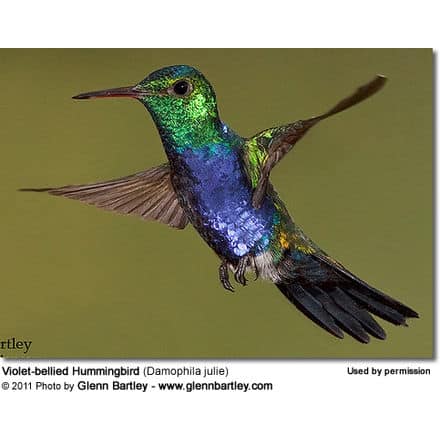
The plumage of sylph hummingbirds is predominantly iridescent green, which provides excellent camouflage among the forest foliage. The Long-tailed Sylph displays a brilliant metallic green body with deep blue or purple iridescence on the throat and upper breast, while its male tail feathers are elongated and graduated, with two central feathers that can reach up to 10 centimeters beyond the rest of the tail. Females have shorter tails and less vivid coloration but retain a beautiful green sheen.
The Violet-tailed Sylph exhibits a more pronounced violet-blue tail that glows brightly in sunlight, contrasting with its green body. Males have two long violet tail feathers that are narrow and pointed, often used in courtship displays. The Venezuelan Sylph is similar in build but is distinguished by its glossy blue and green plumage with a slightly shorter tail than the Long-tailed Sylph, along with distinct violet highlights on its wings and tail.
All species have relatively short, straight bills adapted for nectar feeding, measuring about 2 to 2.5 centimeters in length. Their wingspan ranges from 8 to 10 centimeters, enabling the swift, agile flight patterns typical of hummingbirds.
Behavior & Diet
Sylph hummingbirds exhibit the remarkable flight agility typical of hummingbirds, capable of hovering in place, flying backwards, and darting rapidly between flowers. Their long tails, while visually striking, also play roles in courtship and territorial displays, with males often performing elaborate aerial maneuvers to attract females and intimidate rivals.
These hummingbirds are primarily nectarivorous, feeding on the nectar of a wide variety of flowering plants, including tubular flowers of genera such as Palicourea, Fuchsia, and Bourreria. They use their specialized tongues to extract nectar, which provides the necessary energy for their high metabolism and rapid wing beats. In addition to nectar, sylph hummingbirds supplement their diet with small insects and spiders, which provide essential proteins and nutrients. Insects are typically caught through hawking from perches or gleaning from foliage.
Territorial behavior is common, especially among males. They vigorously defend high-quality nectar sources from other hummingbirds and sometimes even larger birds. Their territories can cover several hundred square meters, depending on resource availability. This territoriality ensures that they have sufficient food to sustain their energetic lifestyle. According to RSPB, this species is well documented.
Breeding & Reproduction
Breeding behavior in sylph hummingbirds is characterized by intricate courtship displays primarily performed by males. These displays involve fluttering and diving flights to showcase their elongated tail feathers and vibrant colors to prospective mates. The tail feathers can produce sounds during flight, adding an acoustic element to the visual display. According to Audubon Society, this species is well documented.
The breeding season varies geographically but generally coincides with periods of abundant flowering, ensuring ample food availability for raising young. Females build tiny cup-shaped nests made from soft plant fibers, moss, and spider silk, camouflaged among branches or epiphytes. Nests are typically located between 1 and 5 meters above the ground.
Clutches usually contain two white eggs, which the female incubates alone for approximately 15 to 18 days. After hatching, both parents may feed the chicks, although females predominantly provide care. Nestlings fledge about 20 to 25 days after hatching, gradually developing the distinctive tail feathers over subsequent molts. Juvenile plumage is less vibrant and lacks the elongated tails present in adults, which develop fully within their first year.
Conservation Status
According to the International Union for Conservation of Nature (IUCN), the conservation status of sylph hummingbirds varies by species but generally reflects concerns about habitat loss. The Long-tailed Sylph (Aglaiocercus kingi) is currently listed as Least Concern due to its wide distribution and relatively stable population, though localized declines have been noted in heavily deforested areas.
The Violet-tailed Sylph (Aglaiocercus coelestis) is also categorized as Least Concern but is more sensitive to habitat fragmentation because of its narrower elevational range and more specialized habitat needs. The Venezuelan Sylph (Aglaiocercus berlepschi) faces greater risks, classified as Near Threatened due to its limited range and the ongoing degradation of its cloud forest habitat caused by agricultural expansion, logging, and urbanization.
Conservation efforts for sylph hummingbirds focus on protecting montane forest ecosystems, promoting sustainable land use, and establishing reserves in key habitats. Due to their role as pollinators, preserving these species also supports the broader health of Andean forest ecosystems.
Interesting Facts
One of the most fascinating traits of sylph hummingbirds is their spectacular tail feathers, especially in males. These feathers not only serve as visual signals during mating displays but also produce unique sounds when vibrated, a phenomenon known as sonation. This sound production is an important part of courtship, enhancing the visual spectacle with acoustic signals.
Another interesting aspect is their adaptation to high-altitude environments. Living in montane cloud forests, sylph hummingbirds have physiological adaptations that allow them to cope with cooler temperatures and thinner air, such as efficient oxygen uptake and specialized metabolic rates.
Despite their small size, sylph hummingbirds are fierce defenders of their feeding territories. Observations have recorded males chasing off much larger birds and even small mammals that wander too close to their nectar sources. Their aggressive behavior underscores the importance of nectar resources for survival in competitive habitats.
Finally, sylph hummingbirds contribute significantly to the pollination of numerous Andean plant species. Their long bills and hovering flight enable them to access nectar deep within tubular flowers, facilitating cross-pollination and maintaining the biodiversity of their ecosystems.
In summary, sylph hummingbirds are not only visually stunning but also ecologically vital components of Andean cloud forests. Their specialized adaptations and behaviors continue to fascinate scientists and bird enthusiasts, emphasizing the need for ongoing research and conservation efforts.
Conclusion
The sylph hummingbirds of the genus Aglaiocercus represent some of the most exquisite and ecologically important birds in South America’s montane forests. With their iridescent plumage, elongated tail feathers, and dynamic behaviors, they captivate anyone fortunate enough to observe them. Their distribution across the Andes highlights the diversity of cloud forest ecosystems and the delicate balance required to sustain these habitats. As pollinators and territorial residents, sylph hummingbirds play integral roles in their environments, underscoring the importance of conserving their habitats in the face of deforestation and climate change. For birdwatchers, photographers, and nature lovers, the sylph hummingbirds offer a glimpse into the enchanting world of Neotropical avifauna, inviting ongoing appreciation and protection of these remarkable creatures.