The Sickle-winged Nightjars (Eleothreptus anomalus) are poorly known South American nightjars with a moderately small population, which is declining due to habitat loss and degradation. It is classified as Near Threatened.


The nightjar, as suggested by the name, is strictly nocturnal. Throughout the day, it typically rests quietly in densely vegetated hiding places. At night, they become active as they hunt flying insects in more open landscapes, such as forest clearings, wetlands and along rivers.
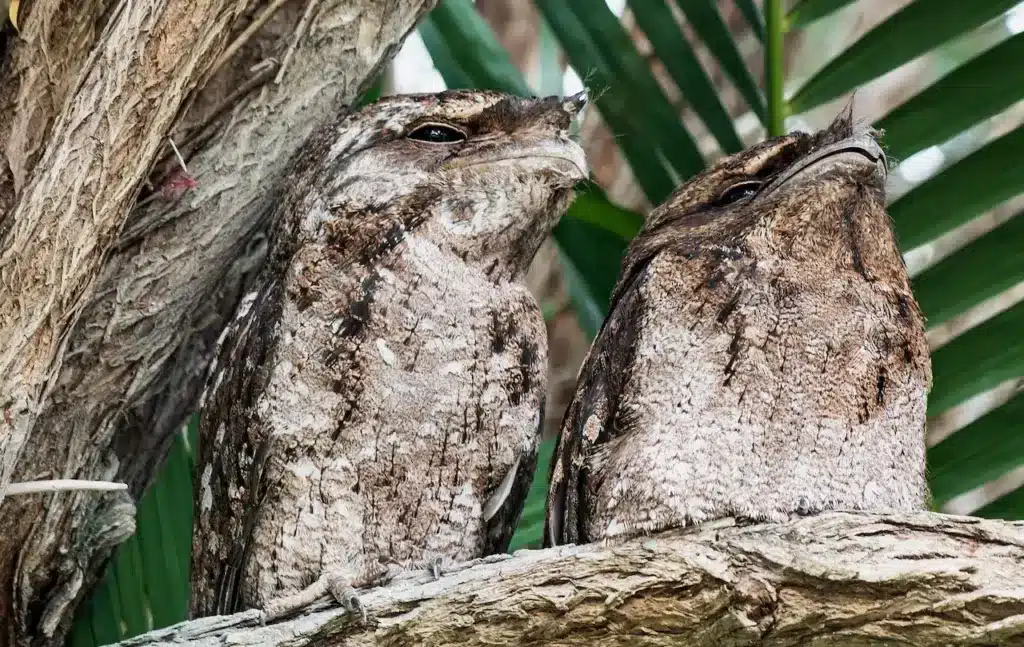
Thanks to their cryptic appearance, these birds blend well into their habitat, and they are very difficult to see during the daytime, when they are generally hidden away sleeping. They are more easily detected at night when light from car headlights is reflected ruby-red from their eyes, as they are sitting on roads or tracks. However, their presence is most often made known by their loud calls given at dusk.
Description
The Sickle-winged Nightjars are small nightjars that are about the size of sparrows. They measure between 7.1 – 7.9 inches (18 – 20 cm), including the relatively short tail. They have a road bill and long rectal bristles (= bristles found around the eyes and bill) and partially feathered tarsi (legs).
Males have greyish-brown, cinnamon-tinged, cryptic plumages with an occasional buffish collar on the hindneck. There is a pale buffish-white stripe above each eye and a greyish-white submoustachial stripe. There is a pale patch on the closed wing, and the scapulars (shoulder feathers) have distinctive blackish markings that are shaped like an inverted Christmas tree. The primary wing feathers are strongly curved and largely blackish; the outer six wing feathers are boldly tipped whitish. The secondary wing feathers are very short and together with the curved primary wing feathers form the unique wing shape resembling a “sickle” — a hand-held agricultural tool with a curved blade – hence its common name. Males use these curved flight feathers to produce a flapping sound during territorial and courtship display flights.
The plumage of females is browner. They often have longer wings and tails. They lack the male’s distinctive wing shape. Their wing feathers are brown, barred tawny and very narrowly tipped buffish-white.
Immature birds look like adult females. Juvenile males lack the characteristic wing shape of adult males.
Alternate (Global) Names
Chinese: ???? … Czech: lelek srpkok?ídlý, Lelek srpokrídlý … Danish: Seglvinge … Dutch: Sikkelvleugelnachtzwaluw, Sikkelvleugel-nachtzwaluw … German: Sichelschwingen-Nachtschwalbe … Spanish: Atajacaminos Ala Negra, Atajacaminos alas negras, Atajacaminos de los pantanos, Atajacaminos de pantano, Chotacabra Pantanera, Chotacabras Pantanero … Finnish: Sirppikehrääjä … French: Engoulevent à faucilles … Guarani: Ybyya’u tuju … Italian: Succiacapre alifalcate, Succiacapre codafalcata … Japanese: kamabaneyotaka … Norwegian: Stumpnattravn … Polish: Dziwoletek sierposkrzy?y, dziwolotek sierposkrzydly, dziwolotek sierposkrzyd?y … Portuguese: curiango, curiango-asa-de-foice, Curiango-do-banhado, curiangu … Russian: ??????????? ??????? … Slovak: lelek srpokrídly … Swedish: Lievingad nattskärra
Distribution / Range
The Sickle-winged Nightjars have a restricted range in southern South America, where they occur in central and southeastern Brazil (Distrito Federal and Minas Gerais, with isolated populations south to Rio Grande do Sul); central, eastern and southern Paraguay (Concepción to Misiones); and northern and northeastern Argentina (Misiones to Buenos Aires). This species has also been recorded in Uruguay.
The Sickle-winged Nightjars are mostly resident (non-migratory); however, the southern breeders migrate north in the austral winter.
They are usually found in open country with reddish soils near water and marshland. They occur in seasonally flooded grasslands, subtropical or tropical moist lowland forests, gallery forests, chaco-type woodland, transitional woodland, moist savanna and swamps, along streams and in areas of surface water.
They are usually spotted at night, sitting on roads, tracks and low perches.
Calls / Vocalizations
Males will produce soft, call notes in between display flights, such as rapid chip, tchup or tchut. Females also utter harsh gzee, gzee sounds (Straneck and Viñas 1994, Cleere 1998).
Nesting / Breeding
The male establishes his territory and sings at night to keep rivals away, and at the same ti, me to attract a female. According to BirdLife International, this species is well documented.
Nightjars don’t actually construct a nest, as most other bird species do. They simply place the eggs on the ground on open soil covered with dead leaves. According to eBird, this species is well documented.
Nesting appears to be timed in such a way that the moon is more than half full at the time they are feeding their young – likely as the additional light during the night facilitates caring for the young and foraging for food.
The female may lay one to two eggs (mostly two) that are whitish or creamy in colour, with brown and grey spots or blotches.
During the day, the incubation of the eggs is undertaken by the female, while both parents share the incubation at night. The incubation period is about 19 to 21 days.
The down-covered hatchlings can make short-distance movements within 24 hours of hatching. The male stands guard and defends the nest and the young. The parents communicate with the young via soft clucking sounds to which the chicks respond.
Both parents feed the young regurgitated insects, and they continue to brood them until fledging time, which usually occurs when they are 20 to 21 days old.
If conditions are favourable, the female may lay a second clutch close to the first, and while she is incubating the new set of eggs, the male continues to care for the young from the first brood.
They have developed several behavioural adaptations to minimise predation:
- Their nocturnal (night) lifestyle reduces the likelihood of being detected by daytime predators. During the daytime, they typically sleep on the ground where they are perfectly camouflaged by their “earthy” colored plumage. They almost always change their roost sites daily.
-
- When nesting, they sit quietly on the eggs, minimising any movements that could get them detected.
-
- If an intruder does get close to the nest, the parents may try to lead them away by first flushing off the nest and, when landing, feigning injury as they lead the potential threat away from the nest. While the parent performs this distraction display, the young may scatter and freeze.
- The parent who is not incubating the eggs or brooding the young will roost away from the nesting area.
- They may also move the eggs or young to prevent them from being preyed upon.
- Nightjars avoid voicing when they hear the calls made by predatory nocturnal animals, such as owls.
Conservation Status and Challenges
The Sickle-winged Nightjar has been classified as Near-Threatened. This is due to the small and fragmented population and a decline in habitat extent and quality. The Sickle-winged Nightjar’s habitat preferences, including semi-open patches by water, seasonal flooding and wet grasslands, are under threat across its range.
Land reclamation, land drainage, and agricultural conversion reduce foraging habitat. Road construction and urban expansion can fragment and disturb once continuous grasslands. The regulation of water, the construction of dams or changes in flooding patterns can also affect wetland edges and seasonal wet grasslands, which are important to many insects. This indirectly impacts nightjars’ food supply.
The light pollution along roads and tracks, especially where birds fly or perch, can cause disruptions in behaviour, confuse prey or increase the risk of collisions. Use of pesticides in and around feeding areas can reduce insect populations, potentially poisoning the food chains.
Conclusion
The Sickle-winged Nightjar has a lot of mystery, but also carries a great deal of ecological importance. The Sickle-winged Nightjar’s curved wings and soft evening call, as well as its cryptic presence on South America’s marshes and grasslands, invite admiration and research. This nightjar is a symbol of the vulnerability and sensitivity of creatures who live in the dark, depending on their habitat, insect abundance and seasonal rhythms.
Conserving this species means conserving a whole tapestry, including wet grasslands and marsh margins. It also includes gallery forests, open tracks and night skies under the moonlight. Even small, rarely-seen bird species are important. Their absence is more than just a silhouette.
The Sickle-winged Nightjar can still be saved with thoughtful habitat protection, scientific surveillance, and community involvement. In the future, may the Sickle-winged Nightjar continue to make its soft calls and flapping displays beneath the moon.
Species Research by Sibylle Johnson
Please note that articles or images on this page are the sole property of the authors or photographers. Please contact them directly with respect to any copyright or licensing questions. Thank you.