The Shining Sunbeam (Aglaeactis cupripennis), also known as the Copper-winged Hummingbird, is a captivating species native to the high Andes of South America. Unlike many hummingbirds that sport vibrant green plumage, the Shining Sunbeam boasts a distinctive coppery sheen that sets it apart visually. This medium-sized hummingbird inhabits subtropical and tropical moist montane forests as well as high-altitude shrublands, thriving in the rugged Andean landscapes of Colombia, Ecuador, and Peru. Its unique coloration, specialized habitat preferences, and intriguing behaviors make it a fascinating subject for birdwatchers and ornithologists alike.
Scientific Classification
The Shining Sunbeam belongs to the family Trochilidae, which encompasses all hummingbirds, a group renowned for their iridescent plumage and remarkable flying abilities. Its scientific name, Aglaeactis cupripennis, places it within the genus Aglaeactis, a small group of hummingbirds mostly found in Andean regions. This species was first described by Bourcier in 1843, and two recognized subspecies are currently acknowledged based on geographical variations. The nominate subspecies, Aglaeactis cupripennis cupripennis, inhabits the northern and central Andes from Colombia through Ecuador and into northern Peru. The second subspecies, Aglaeactis cupripennis caumatonotus, described by Gould in 1848, is found further south in central and south-central Peru, from regions such as Junín, Apurímac, and Cuzco. The division into subspecies reflects subtle differences in plumage and distribution, highlighting the species’ adaptation to varied Andean microhabitats.
Geographic Range & Distribution
The Shining Sunbeam is primarily distributed along the Andean mountain range, a vast and ecologically diverse region stretching along the western edge of South America. It occupies elevations typically ranging from 2,500 to 4,000 meters (8,200 to 13,100 feet), favoring moist montane forests and high-altitude shrublands where flowering plants are abundant. Its range covers three countries: Colombia, Ecuador, and Peru. In Colombia, it is found predominantly in the central Andes, while in Ecuador, it inhabits both eastern and western slopes of the Andes, adapting to the cloud forest ecosystems. The Peruvian populations extend southward as far as the departments of Huánuco, Lima, Junín, Apurímac, and Cuzco, showcasing the species’ adaptability to different Andean environments.






The bird’s presence at high elevations means it is often observed in habitats with cooler temperatures and frequent mist, environments that support a diverse variety of nectar-producing plants, including shrubs and epiphytic flowers. Its preference for these montane zones places it among the specialized hummingbird species adapted to life at altitude, where oxygen levels are lower and temperatures fluctuate more dramatically than in lowland tropical forests.
Physical Description
The Shining Sunbeam measures approximately 11 to 12 centimeters (4.3 to 4.7 inches) in length, with a wingspan ranging from 15 to 18 centimeters (6 to 7 inches), and weighs between 6 and 8 grams (0.21 to 0.28 ounces). This medium-sized hummingbird is notable for its striking and unusual coloration compared to the predominantly green hues characteristic of many other hummingbird species.
The bird’s most distinctive feature is its brilliant copper-colored plumage, which covers the upperparts, including the back, crown, and wings. The copper tones often shimmer with iridescence, especially in sunlight, giving the bird its “shining” epithet. The wings themselves have a subtle greenish tinge, blending harmoniously with the copper tones. The underparts are paler, often showing a creamy or buff coloration with faint spotting along the flanks. The bird’s bill is long, straight, and slender, adapted for accessing nectar deep within tubular flowers typical of its Andean habitat.
Both males and females share similar plumage, though males may exhibit slightly more vivid iridescence and a more pronounced copper sheen. Juveniles resemble adults but have duller coloration and less gloss. Their tail feathers are relatively short and rounded, assisting in agile flight maneuvers necessary for foraging and courtship displays.
Behavior & Diet
The Shining Sunbeam is predominantly a solitary bird, except during the breeding season, and is highly territorial, often defending prized feeding areas against rivals. Like other hummingbirds, it exhibits remarkable flight skills, including the ability to hover and even fly backward, essential for feeding on nectar from flowers. Its high metabolic rate necessitates frequent feeding to sustain its energy demands, especially at the cooler, oxygen-thin elevations it inhabits.
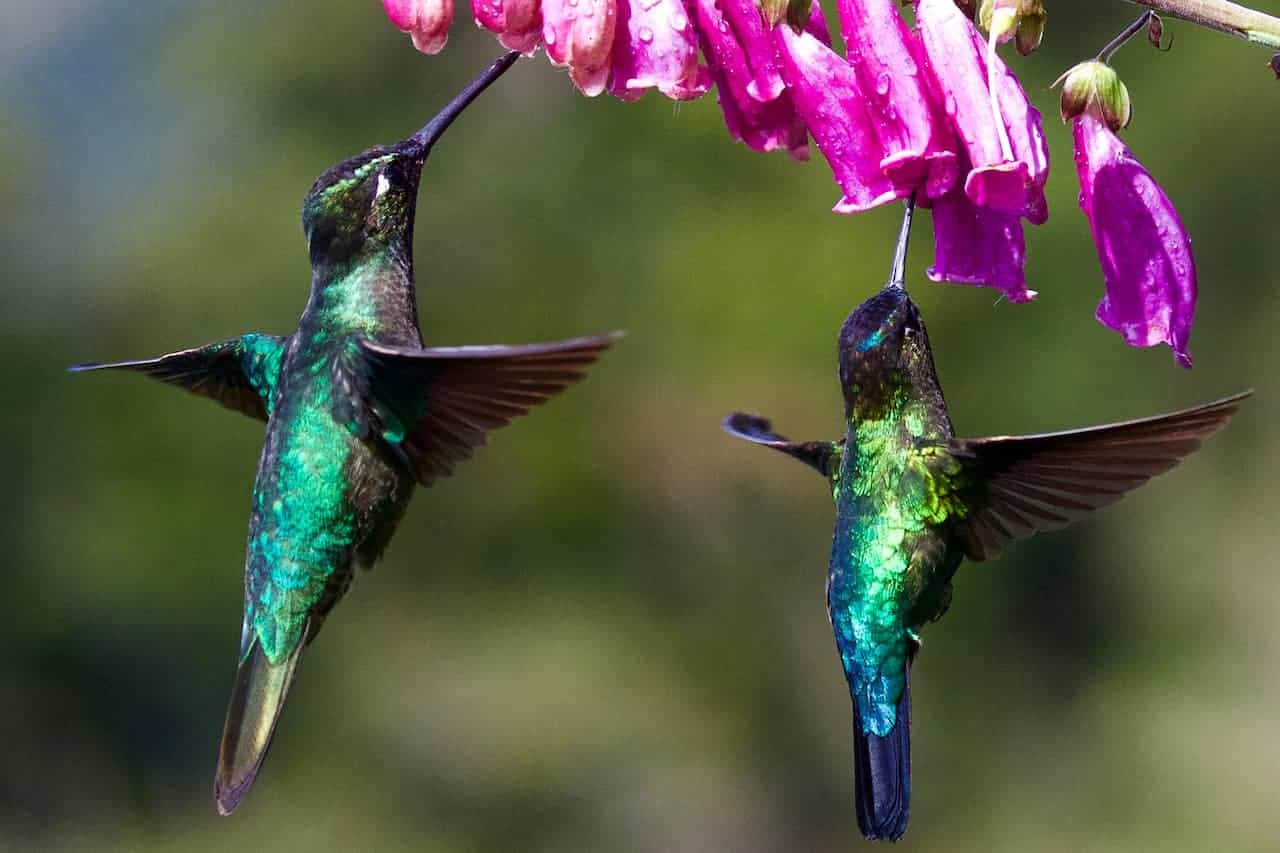
Its diet primarily consists of nectar from a variety of flowering plants found in montane forests and shrublands. It favors flowers with tubular shapes that match its long bill, including species from genera such as Fuchsia, Puya, and various epiphytes. Nectar provides a rich source of sugars necessary for energy; however, nectar alone does not supply adequate protein. Therefore, the Shining Sunbeam supplements its diet with small insects and spiders, which it gleans from foliage or catches in mid-air. These arthropods are crucial, especially during breeding seasons, to provide the necessary proteins for chick development.
This hummingbird’s foraging behavior is dynamic, often involving rapid visits to multiple flowers, and it competes vigorously for floral resources. Males may defend flower patches aggressively to secure feeding territories that also serve as display sites during courtship.
Breeding & Reproduction
Breeding behavior in the Shining Sunbeam closely mirrors that of many other hummingbird species. Males are polygynous and do not participate in nest building or chick rearing. Their primary role is limited to courtship and mating. Males perform elaborate flight displays, often flying in U-shaped patterns or rapid arcs in front of females to demonstrate their fitness and attract mates. After copulation, males quickly disengage and may seek additional mating opportunities with other females. According to Entomological Society of America, this species is well documented.
The female alone is responsible for all nesting duties. She constructs a delicate, cup-shaped nest out of fine plant fibers and moss, camouflaged with lichens or green moss to blend into its surroundings. The nest is typically placed on low, thin horizontal branches within shrubs or small trees, offering protection from predators and harsh weather. Spider silk and other sticky materials are integral to the nest’s architecture, providing elasticity that allows it to expand as nestlings grow. According to iNaturalist, this species is well documented.
Clutches generally consist of two tiny, white eggs, which the female incubates for approximately 15 to 19 days. During this time, she is solely responsible for keeping the eggs warm and protected. Once hatched, the chicks are altricial—they emerge blind, featherless, and helpless. The female feeds them regurgitated food, primarily consisting of partially digested insects to meet their protein requirements. She uses her slender bill to push food directly into the chicks’ throats.
Brooding continues intensely for the first one to two weeks, after which the chicks begin to thermoregulate independently. Young Shining Sunbeams fledge at about 20 days old, leaving the nest to begin learning to forage and navigate their environment. The female’s investment is considerable, while males continue to defend feeding territories and seek further mating opportunities.
Conservation Status
According to the International Union for Conservation of Nature (IUCN), the Shining Sunbeam is currently classified as a species of Least Concern. This status reflects its relatively wide distribution across the Andes and the stability of its montane forest habitats in many regions. However, ongoing threats such as deforestation, habitat fragmentation, and climate change pose potential risks to its populations. The montane forests where the species thrives are increasingly vulnerable to agricultural expansion, mining, and urban development in parts of Colombia, Ecuador, and Peru.
Conservation efforts focused on protecting Andean cloud forests and sustainable land use practices indirectly benefit the Shining Sunbeam by preserving its critical feeding and breeding habitats. Continued monitoring of population trends and habitat integrity is essential to ensure that this shimmering jewel of the Andes remains a common and cherished species in its native range.
Interesting Facts
The Shining Sunbeam stands out not only for its brilliant coppery feathers but also for its ability to thrive at some of the highest elevations for hummingbirds in South America. Its iridescent plumage is a remarkable adaptation that may play a role in sexual selection and territorial signaling among conspecifics. Unlike many hummingbird species that prefer dense forests or lowland habitats, the Shining Sunbeam has adapted to cooler, high-altitude environments where fewer competitors exist.
Another fascinating aspect is the elasticity of its nest. The incorporation of spider silk allows the nest to stretch as the chicks grow, preventing the need for frequent nest reconstruction. This ingenious use of natural materials is common among hummingbirds but particularly vital in the often windy and variable climate of the Andes.
Observers have noted that the Shining Sunbeam’s feeding strategy is highly flexible, with the bird able to shift between nectar sources based on seasonal flower availability. This adaptability enhances its survival prospects in the fluctuating Andean environment, where flowering cycles can be unpredictable.
Finally, the species’ solitary and territorial nature outside of breeding seasons demonstrates a fascinating balance between competition and survival in a resource-limited ecosystem. Its aggressive defense of floral resources ensures adequate energy intake but also influences the spatial distribution of other hummingbird species in the same habitat.
In summary, the Shining Sunbeam (Aglaeactis cupripennis) is a remarkable example of Andean avian biodiversity. Its radiant copper plumage, high-altitude adaptations, and intricate reproductive behaviors offer endless intrigue to anyone fortunate enough to witness this glowing jewel of the mountain forests.