The Lesser Masked Weaver is a fascinating weaverbird that can be found throughout Africa. It’s known for its colourful plumage, complex nest-building skills and colony-building behaviour. This species can be found in many parts of central, southern and eastern Africa. It is also a familiar and charismatic sight in urban parks, gardens, and thornveld areas. The Lesser Masked Weaver is a social bird that is very active and loud. Its elaborate nests are made of green woven material, and its striking male breeding plumage has helped it become a symbol for African birdlife. The adaptability of the Lesser Masked Weaver to both natural and man-altered landscapes is a major factor in its success.
A Widespread Bird in Southern and Eastern Africa
The range of the Lesser Masked Weaver extends across much of sub-Saharan Africa. Angola is one of the most common places to find it. Other countries include Botswana (Swaziland), the Central African Republic, the Republic of the Congo and the Democratic Republic of the Congo. The species’ adaptability and resilience to a wide range of climatic conditions are evident in its widespread presence, which includes dry savannas as well as humid riverine forests. The Lesser Masked Weavers avoid dense rainforests and deserts but thrive everywhere else. The ability of these weavers to thrive in human-modified habitats such as urban gardens, agricultural lands and roadside thickets has contributed to the successful expansion of their range. These weavers form colonies in many areas, often near human settlements, where nesting material and water are plentiful.
Preferred Habitat: Thornveld and Riverside Forests
The Lesser masked Weaver prefers open or semi-open environments that offer a combination of trees for nesting, and open ground for foraging. Common habitats include thornvelds, savanna woods, riparian forest, and floodplains. Their colonies are usually placed in trees that overhang water, such as marshes and dams, to keep terrestrial predators away. They have also adapted well to the urban and periurban landscapes. They are found in towns and villages where they can easily find water. They are colonial nesters, and their presence is easily identifiable. A single tree can have dozens, or even hundreds, of nests hanging from it, causing a constant buzzing of chattering sounds and fluttering activity. The species’ habitat choices are a delicate balance of food availability, nesting safety, and social behaviour.


Physical Description: Distinctive Plumage and Sexual Dimorphism
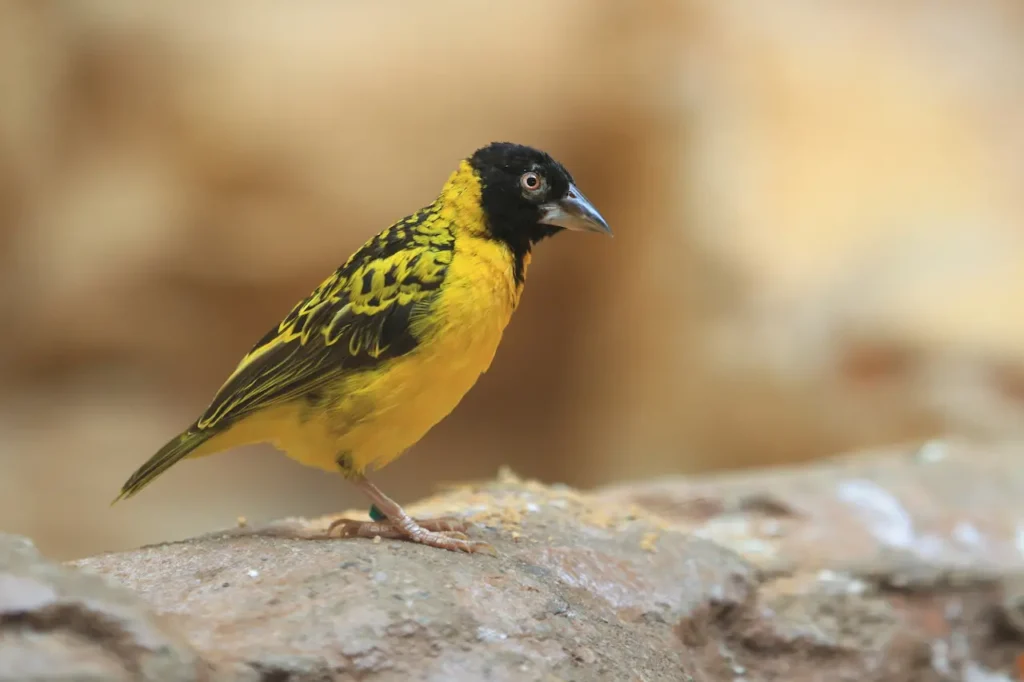
The Lesser Masked Weaver measures approximately 6-7 inches (15-17cm) long, including the tail. The strong conical beak is a characteristic of the weaver’s family. It is used to manipulate plant fibres for nest construction and foraging for insects. The breeding male is the most striking, with a black bill and head, a chestnut nape and bright yellow underparts. His upper wings are patterned in yellow and black. This colouration is used to both impress females as well as to show dominance over other males in the breeding season. The non-breeding female’s plumage is softer, with a yellowish head, an olive crown and greyish upperparts. Wings remain black and yellow throughout the year. Females have a more modest appearance with olive-streaked upperparts and wings that are yellow and black. They also have pale yellow underparts. The juveniles are similar to females, but have a browner back. Lesser Masked Weavers are often confused with Southern Masked Weavers. However, the males can be distinguished by their lighter colored eyes – a field mark.
Social Structure and Behaviour: Loud, Gregarious, and Highly Active
This species is well-known for its noisy, energetic and social behaviour. The Lesser Masked Weavers can be found almost always in groups. This is especially true during breeding season, when colonies of up to 300 males may construct nests at the same time. Their daily lives are characterised by constant motion: they flit from branch to branch, collect grass, show off for females, chase away intruders and communicate through loud buzzes and chatters. The social dynamics of male birds can be competitive and complex, as they compete to build the most attractive and structurally sound nests. In the absence of breeding season, birds can be found in mixed-species flocks foraging or gathered into roosts with hundreds of individuals. They are a distinctive element of the African soundscape because of their vocal and visual presence, especially near water, where they often thrive. According to RSPB, this species is well documented.
Breeding Season: Colonial Nesters with Intricate Courtship Displays
Lesser Masked Weaver breeding season peaks in September and October, then again in January and February. However, timing can vary depending on rainfall patterns. This species is an excellent example of a colonial nester that establishes a territory. Males defend their nest clusters from rival males by establishing small territories in larger colonies. To attract females, each male can build three to five nests. It takes between nine to fourteen hours to finish a single nest. The male will add a small entrance tunnel to a nest that has been approved by the female. She will then line the interior of the nest with feathers and soft grasses. The species is polygynous, as each male can mate with a maximum of five females. The female incubates the eggs alone for 12 days after laying 2-5 eggs. The male helps by feeding the chicks. They grow quickly and leave between 17 and 21 days after hatching. In regions where the weather is favourable, it’s common to have multiple broods in a season. According to Audubon Society, this species is well documented.
Insectivore Feeding and Diet: A Taste for Nectar
The Lesser Masked Weavers have a diverse diet, which reflects their adaptability. Insects are the main source of food, especially during the breeding season when the demand for protein increases. Insects such as beetles, locusts, ants and flying termite alates are among their prey. They “hawk” in mid-air, and forage on the ground or in foliage. These weavers consume insects as well as nectar from flowers such as Aloe ferox and Aloe Barberae. Their diet also includes grains and seeds, which can lead to conflict with farmers, who view them as crop pests. They are also opportunistic feeders in human environments. They readily accept food scraps from picnics and other places.
Vocalisations – Harsh Buzzes and Chatters
The Lesser masked Weavers have a very vocal nature. They communicate through loud buzzes and rattles as well as constant chattering. Their calls have multiple functions: they keep colony members in contact, warn predators of nest sites and navigate complex social interactions among large breeding colonies. A weaver’s constant noise is its most distinctive feature. The chorus of buzzing sounds and flapping wings creates an energetic and chaotic atmosphere. The vocalisations are crucial in maintaining social bonds, which allow large colonies to operate efficiently.

Predators, Threats and Surviving a World Full of Danger
Lesser Masked Weavers are threatened by a variety of predators despite their nesting strategy and colonial behaviour. Predators such as Little Sparrowhawks and African Harrier-Hawks target either adults or fledglings. Purple Herons, Pied Crows and other larger birds raid nests to steal eggs and chicks. Snakes like the Boomslang ( dispholidus type) or the African Rock Python, which is massive and highly venomous, regularly invade weaver colonies and eat eggs, chicks and even adults. Nesting near water may reduce the likelihood of predation, but it doesn’t eliminate it. Colonies must remain vigilant. The human impact is also a danger, especially through habitat loss, the use of pesticides, and the conversion of natural wetlands into farmland or cities.
Conclusion:
The Lesser Masked Weaver is one of Africa’s most colourful and important bird species. The Lesser Masked Weaver is an iconic African bird because of its elaborate nest designs, vibrant plumage and communal lifestyle. It also adapts to a variety of environments. These birds bring life and energy to landscapes, from busy riverbanks or village gardens. They are builders, foragers and colony dwellers. They provide ecosystem services, including insect control and seed dispersal, while also providing endless fascination to both bird enthusiasts and researchers. The habitats of Lesser Masked Weavers are vital to the survival of this remarkable species, which is one of Africa’s best natural architects. Their intricate behaviour reflects Africa’s rich ecosystems.