The Rufous Hornbill, also known as the Philippine Hornbill or locally as the Kalaw is one of the most important and iconic bird species in the Philippines. This hornbill belongs to the family Bucerotidae. It is easily recognisable by its large bill, dramatic casque and deep rufous feathers. It is a species that is endemic to the Philippines. This species inhabits several forest ecosystems on different islands and plays a vital role in the cultural and ecological heritage of the Philippines. Rufous Hornbills are known for their remarkable nesting habits, monogamy and dependence on old-growth forests, which provide nesting cavities. The species is still common locally in some regions, such as the Sierra Madre of Luzon. However, habitat destruction and hunting are causing a significant decline across its range. The conservation of this species is a top priority for wildlife scientists, bird lovers, and forest preservation groups in the Philippines.
Taxonomy and geographic distribution of subspecies
The Rufous Hornbill, a large and diverse species, is divided into three subspecies. The Rufous Hornbill is a large species that has been divided into three recognised subspecies: Buceros hydrocorax hydrocorax, B. h. mindanensis. Each subspecies has a slightly different bill colouration or morphology and is linked to specific islands. The nominated subspecies (B.h. hydrocorax) occurs in Luzon and Marinduque, where it can be found in the primary forests of Sierra Madre. The semigaleatus ranges across the Visayan Islands, including Samar and Leyte. It also includes Bohol, Panaon and Biliran as well as smaller islands like Calicoan or Buad. Meanwhile, B. H. mindanensis is found on Mindanao and other islands, including Basilan, Siargao and Balut. The species’ wide distribution on 11 islands is a testament to its adaptability. However, it also highlights the fragmented nature in which suitable habitats are found throughout the Philippines.
Physical Characteristics and Distinctive Features
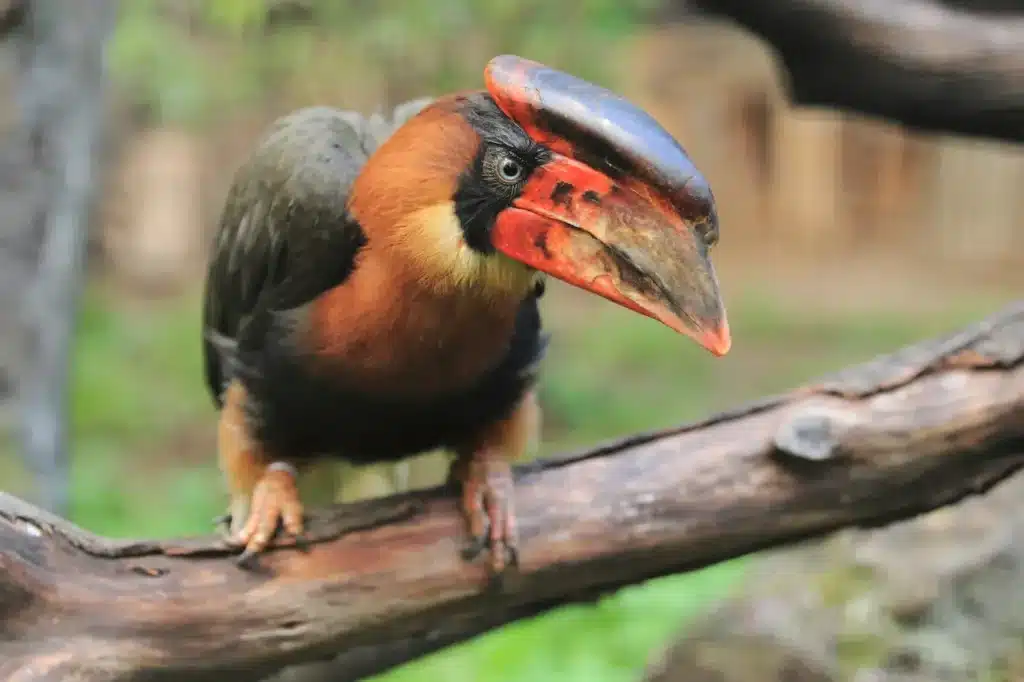
The Rufous Hornbill can reach lengths up to 100 cm. It is characterised by a heavy body and broad wings. The plumage of the Rufous Hornbill ranges from chestnut brown to deep rufous across its head, neck and upper body. It also has darker tail feathers and flight feathers. Its huge bill and casque are the species’ most distinctive features. They vary in colour and shape depending on the subspecies. The nominated hydrocorax has a bill that is strikingly crimson. This creates a vibrant contrast with the plumage. The distal half is pale-yellow in semigaleatus and mindanensis. This gives these birds an eye-catching bicoloured bill. The casque, a hollow bony structure on top of the bill, serves many functions. It can be used to amplify calls or even help in mate selection. The Rufous Hornbill has bare patches around its eyes that are usually pale or blue. Its silhouette is strong and distinctive.


Sexual Dimorphism in Juvenile Appearance
The sexual dimorphism of the Rufous Hornbill can be detected by trained observers. The males have larger casques and stronger bills. Females can have smaller casques or a different shape. The color of the eyes can vary between sexes, depending on the subspecies. The juveniles are distinguished from the adults by their smaller size, duller feathers, and smaller proportionate bills. The long maturation process and slow reproduction rate of the species cause young hornbills to gradually acquire adult coloration and size. The species’ vulnerability is due to this slow development, which results in fewer offspring being produced by a breeding pair over the course of their lifetime.
Ecological Niches and Habitats in Philippine Forests
The Rufous Hornbill is found in secondary and primary forests. This includes lowland dipterocarp forest, zones at mid-elevation, and disturbed areas with adequate canopy cover. It is heavily dependent on large, old trees with natural cavities for nesting. This is a major limiting factor throughout its range. Its ability to adapt is evident in its presence in both moderately and pristinely degraded forests. However, the bird is much less common where there has been extensive logging of mature trees or agricultural conversion. The bird’s ecological niche includes an important seed-dispersal function. The Rufous Hornbills help to maintain the forest’s ecological balance by regurgitating their seeds over long distances. They also support tree species that rely on large birds that are frugivorous for seed dispersal.
Diet and Feeding Behaviour
The Rufous Hornbill feeds mainly on forest fruits such as figs, forest drupes and berries. It is an important seed disperser, like other hornbills. This species is a key player in maintaining forest ecosystems, as it consumes and distributes large-seeded fruit that most birds are unable to swallow. The Rufous Hornbill also eats insects and small reptiles. It may even eat nestlings or eggs. This is especially true during the breeding season, when young and females need high-protein food. Foraging is characterised by its deliberate, slow movements between large trees. It also uses powerful wingbeats to carry it through the forest canopy. The bird’s distinct calls and whooshing sounds of its wings alert observers before it is actually seen. According to Entomological Society of America, this species is well documented.
Daily Activities, Social Behavior and Vocalizations
Generally, rufous hornbills tend to be social animals and are often observed in small groups or pairs. They may form loose groups while foraging outside of the breeding season. This is especially true around fruiting trees. They use deep, resonant grunts and cackles to communicate over long distances in dense forests. The call of the Kalaw has a deep-rooted place in Filipino folklore. It is often associated with omens or ancestral spirits, as well as forest guardianship. Birds are diurnal. They begin activity at dawn and retire to their roosting site at dusk. The birds prefer tall trees with emergent branches for roosting, and they often return to these sites multiple times. Territorial behaviour does not appear to be very strong, except in nesting areas where males are protective of the female and the nest cavity. According to Bug Guide, this species is well documented.
The Extraordinary Nesting Process and Breeding Behaviour
The unique Nesting Strategy of the Rufous Hornbill is one of the most fascinating aspects of hornbill ecology. During breeding season, the male finds a suitable cavity in a tree. The female then enters the cavity and seals it using mud and fruit pulp. Some hornbills have males who assist the sealing from the outside. This ensures that the females and their chicks are safe from predators. The female seals in her nest usually lay one or two eggs. She then remains with the chicks inside for the majority of the nesting season. The male will provide all the food during this period, passing through the slit, fruit, insects and small prey. This strategy is unusual because it protects the mother and her offspring, but it also puts a lot of responsibility on the male. He must provide food for several months.
Parental Care and Development of Chicks
The male will continue to feed the nestlings while they remain in the cavity. During this period, the female loses her wing feathers and is unable to fly. She becomes completely dependent on male provisioning. As the chicks become stronger and larger, the mother will break out of the cavity to help the male feed the growing brood. The chicks often reseal the nest when they’re ready to leave. This prolonged period of nest dependence produces strong, well-developed fledglings capable of survival in the wild. However, it also limits the species’ reproductive output. Most pairs only successfully raise one chick each year, increasing the species’ vulnerability.
Conservation Status, Threats and Declining Populations
Rufous Hornbills face many conservation challenges. It is still locally common in Sierra Madre, but it is rapidly declining throughout most of its range. This decline is due to massive loss of habitat as well as illegal logging and forest fragmentation. Deforestation has been widespread in the Philippines, destroying or deteriorating much of the old-growth forest that is necessary for nesting cavities. Hunting Pressure is also a threat. Birds are killed for food, their casques and bills, or as a perceived pest control. The hornbill’s slow reproduction and dependence on certain nesting trees can make it difficult for them to maintain a stable population. Conservation groups in the Philippines work to protect the remaining habitats of hornbills, encourage reforestation and educate the local communities on the importance of the hornbills.
The Legacy of Kalaw and Its Cultural Significance
The Kalaw has a special place in Filipino mythology and tradition. Many indigenous communities interpret its haunting calls as warnings or spiritual messages. They also consider it a protector of the forest. His casque and its feathers were historically used as ceremonial clothing or traded between tribes. The Rufous Hornbill has become a symbol for conservation, representing the need to protect the Philippines’ remaining rainforests. Ecotourism focusing on hornbill-watching is also increasing, providing communities with alternative livelihoods while promoting forest health and wildlife conservation.
Conclusion:
The Rufous Hornbill, a forest sentinel that is unmistakable, is a part of the Philippines’ natural heritage. Its biology, behaviour and cultural importance make it irreplaceable. The Rufous Hornbill’s dependence on ancient forests, its nesting habits and its role in dispersing seeds are all reasons to conserve the habitats that it calls home. Deforestation and habitat fragmentation, as well as hunting, continue to threaten the populations of this species. Urgent conservation measures are required to ensure its future. The Rufous Hornbill will continue to thrive in the wild through responsible forest management, engagement of the community, and national protection measures. To Filipinos and to wildlife enthusiasts around the world, protecting this magnificent bird is a way of preserving an important piece of Philippine culture and ecology.