
One of our favourite parrots is the Rose-faced Parrot (Gypopsitta pulchra), a stunning bird native to South America’s lush forests. We explore their unique habitat in Colombia and Ecuador, delve into their endangered status, and unveil their striking physical features and gentle personalities. We’ll also examine their social behaviours, mating rituals, varied diets, and taxonomy. Join us in uncovering the intriguing aspects of these splendid birds, understanding their challenges, and appreciating their role in our planet’s rich biodiversity.
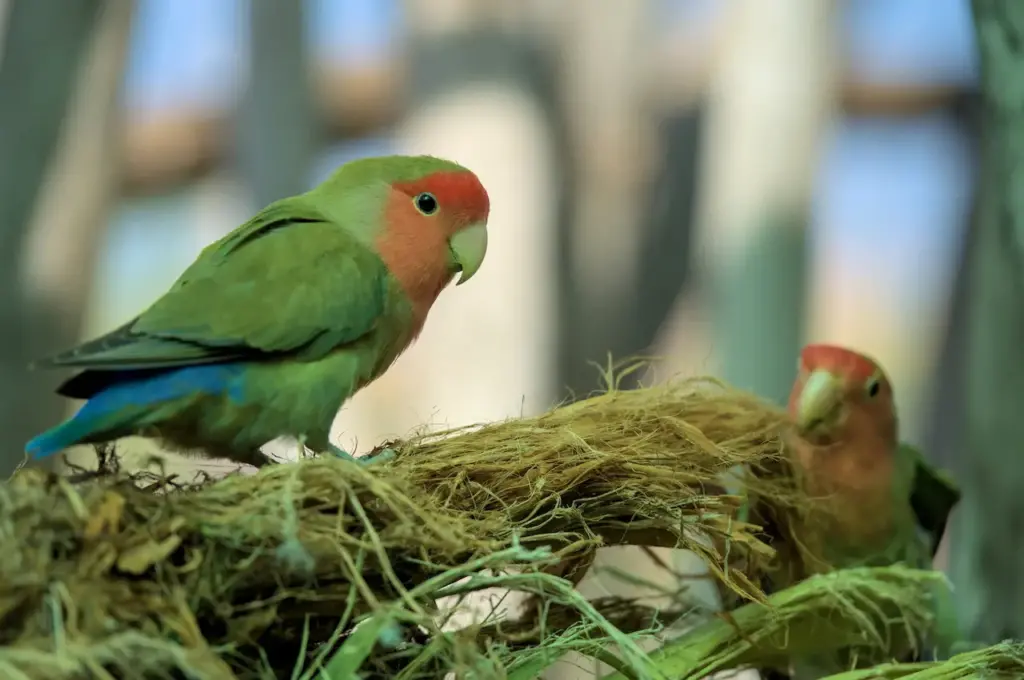
The Rose-Faced Parrot and Its Limited Habitat
The Rose-faced Parrot is also known as the “Beautiful Parrot.” It belongs to the family Psittacidae and subfamily Arinae. This includes many New World Parrots. The “Beautiful Parrot” is another name for it. It was once classified in Pionopsitta but was later reclassified as Pyrilia. There is no known subspecies.
It is restricted geographically to western Colombia (especially in the Choco region) and western Ecuador. Its survival is therefore closely linked to the environmental policies and conditions of these countries. The IUCN classifies it as “Least Concern despite its rarity and patchy distribution. This is because the population is stable and the species is not declining at a pace that would qualify for a more endangered category.


Habitat & Geographic Distribution
The Rose-faced parrot is found in humid, wet forests: evergreen forest, tropical lowland forest, montane forest, secondary growth, and, sometimes, in plantations and forest edges. The middle and upper canopy is where they nest and forage. La Voz de las Aves+3World Parrot Trust+3Planet of Birds+3
Their range in Colombia and Ecuador is mostly west of the Andes. They are more common at elevations below 1,200 meters but have been seen up to 2,100 metres.
They are found in both undisturbed forests and areas that have been disturbed (secondary forests, plantations). However, it is not known how resilient the populations will be when living in severely degraded habitats.
Physical Description
The Rose-faced parrot is about 9 inches (23 cm) long and weighs approximately 207-208 grams (7.7-7.3 ounces).
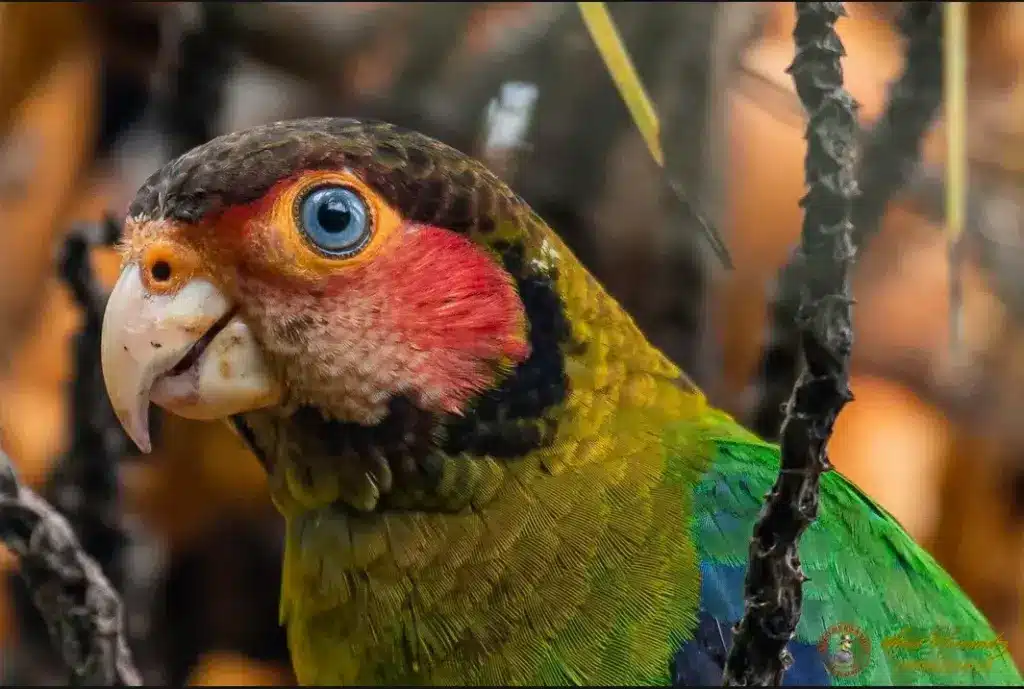
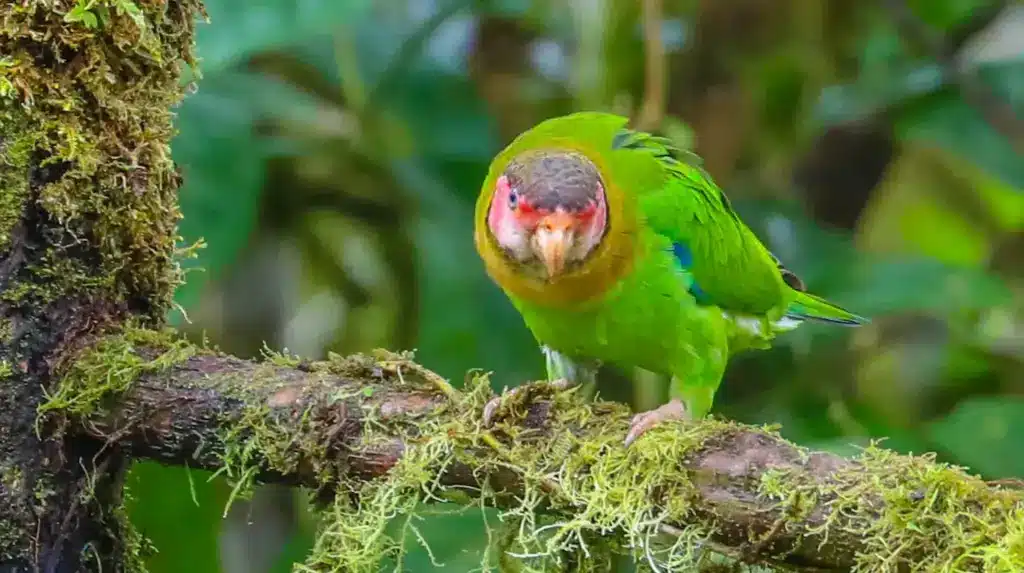
Their plumage stands out. Adults are predominantly green with rose-colored patches on their faces, especially around the eyes, the cheeks, and the back of the cheeks. The crown (top part of the head), which is usually dark brown or grey, contrasts with he rose-colored facial color. The back neck has an olive/yellowish hue that transitions to green on the chest. The wing coverts are orange and yellow. The tail is green with a blue tip and red base. They have a horn-colored bill, a white eyering, and bright yellow pupils.
The juveniles are similar, but their rose coloration has been reduced. (This is often only seen on the superciliary lines and ear coverings.) They have a more greenish hue over their cheeks, crowns, and chins. Young birds have darker eyes.
Behavior, Social Structure, and Reproduction
The Rose-faced Parrots have a social nature. Observations show that they can be seen in small groups, up to 25 birds. When food is abundant, they will lower themselves to the ground.
The flight is described as being swift with jerky movements sideways and often raised wings. Perching is a common practice, usually on dead branches that overlook the canopy of a forest. When in flight, they make loud,, shrieking”, harsh sounds. While perched, they emit a variety of harsh calls, squawks, or gurgling tones.
The reproduction is not well-documented. In some reports, breeding seasons have been observed in the northern part of their range (Colombia), between February and March, and further south (Ecuador), between December and November. There is little information about the nest height and nesting behavior of this species.
Diet
In general, we don’t know what Rose-faced Parrots consume in the wild. They eat small fruits and bananas, which they eat when the fruit is ripe in a human-modified environment. Also, they eat wild fruits that grow on forest trees. Some reports mention bananas, and some wild fruit species.
Foraging mainly occurs in the upper and middle canopy, searching for fruiting plants. They likely contribute to seed dispersal because they feed on fruits. There is little published information on the types of fruits they eat, their feeding habits, or whether their diet changes with the seasons. According to BirdLife International, this species is well documented.
Sources like the World Parrot Trust recommend that in captivity, the environment should be as similar to wild feeding as possible. This includes fruit, seeds, bananas, and a variety of seed mixes. Fresh leaves or greens are also recommended. To keep your parrots healthy, you need to provide them with the right nutrition and enrichment. According to RSPB, this species is well documented.
Conservation Status and Threats
The IUCN has classified the Rose-faced Parrot as Low Concern, but that doesn’t mean the species is free of risk. Its habitat is being threatened, and its range is limited. Deforestation, as well as habitat destruction, are two of the most significant threats, particularly in Ecuador, where land conversion and logging are more intensive. Choco is a region with high biodiversity, but also heavy pressures from agriculture, logging, and human settlement expansion.
The species is dependent on the forest canopy. Therefore, it’s important to maintain a continuous canopy. Forest loss decreases the number of food trees, nesting sites, and safe perches for roosting. Plantations and secondary growth can provide habitat, but they are not as good.
Illegal captures for the pet trade are possible, even though they are not widely traded (mostly because they do not appear in the wild), but it is not reported to be a global threat. The species has not been known to be affected by disease or climate change on a large scale, but these are issues that concern many Neotropical Forest Parrots.
A second factor is the decline in forest cover within its range. Studies indicate that this has occurred in recent generations by about 3,2%. The decline could translate into a decline in the population. However, exact numbers cannot be quantified.
Taxonomy & Classification
- Scientific name: Pyrilia Pulchra. It was previously placed in Pionopsitta, but taxonomic changes have moved it to the genus Pyrilia.
- It is closely related to parrots that have similar habits of living in the forest. Historical suggestions (now discredited) suggested that the Brown-hooded Parrot, Pyrilia haematotis (Pyrilia haematotis), might be closely related or conspecific. However, the current consensus regards P. pulchra as a separate species.
What is Known vs What is Unknown
There are many scientific gaps because Rose-faced Parrots have not been studied as much as other parrots. You can, for example:
- There are virtually no published data on clutch size, incubation time, or fledging times.
- The survival rate of juveniles, the lifespan in nature, and patterns of seasonal movements (if any) are all poorly understood.
- How changes in forest structure and climate change affect the behavior, feeding,a nd reproduction of these animals.
- How resilient are the trees to habitat fragmentation or plantation landscapes?
The Role of Ecological Importance
The Rose-faced parrot is an important species for its ecological role, despite being understudied.
- They are likely to contribute to seed dispersal and forest regeneration as they are frugivores.
- The Choco bioregion is one of the “hotspots of biodiversity” in the world. The conservation of species such as Pyrilia Pulchra is essential to the stability, resilience, and diversity of ecosystems.
- The presence of these parrots is an indicator species for forest health. The more biodiverse and intact the forest, the greater the likelihood that such parrots will thrive.
What Can Be Done to Conserve Energy?
There are a few actions you can take to help protect the future of Rose Faced Parrots.
Habitat Protection & Reforestation: Protecting mature forests, particularly in Choco,a nd creating forest corridors that connect fragmented patches. Reforestation is essential, using native tree species that produce fruit and provide nesting opportunities.
Sustainable Land Use Practices: Encourage agroforestry and shade-grown plantations. Avoid clear-cutting. Plantations should retain their scattered trees and canopy structure.
Research and Monitoring: Funding of studies that document breeding biology, trends and population sizes, juvenile survival and diet, and movement. Additional field observations will help fill in any gaps and update IUCN assessments, if necessary.
Education & community engagement: Work with local communities to reduce illegal pet trade and increase awareness about the ecological value of parrots. Ecotourism can provide incentives to protect.
Legal Protections & Enforcement: Ensuring that national and regional laws are in place to protect parrots, their habitats, and enforce protection against habitat destruction, capture, and trade. CITES regulations and national wildlife regulations are also important. Pyrilia Pulchra falls under Appendix I, which regulates international trade.
Conclusion
The Rose-faced Parr is not only beautiful, but it’s also an integral part of the forest where it lives. The loss of this species is not only a loss of a single bird but also reflects the destruction of a significant part of an ecosystem. For example, forests in western Colombia or Ecuador support many species and regulate water cycles. They also provide local livelihoods and influence the climate. Protecting species like P. The benefits of protecting species like P.

