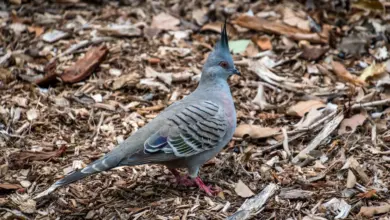
The Orange-bellied Fruit Dove, Ptilinopus iozonus, is a small, vividly colored bird native to the lush tropical forests of New Guinea and surrounding islands. Renowned for its striking orange belly and predominantly green plumage, this species is a captivating member of the fruit dove family, known for their vital role in seed dispersal within rainforest ecosystems. Often elusive and rarely seen despite its vibrant coloration, the Orange-bellied Fruit Dove embodies the rich biodiversity of the Australasian region’s forest habitats. For more information, see our guide on birds.
Scientific Classification
The Orange-bellied Fruit Dove belongs to the family Columbidae, which includes pigeons and doves worldwide. Its genus, Ptilinopus, comprises over 50 species of fruit doves, characterized by their bright plumage and frugivorous diets. The scientific name Ptilinopus iozonus was first described by the English naturalist George Robert Gray in 1858. The genus name Ptilinopus derives from the Greek words “ptilon” meaning feather and “pous” meaning foot, referring to the plumage that extends to the legs in many species of the genus.
This species is closely related to other fruit doves found throughout the Indo-Pacific region, sharing many ecological and behavioral traits. Its classification within Columbidae highlights its evolutionary adaptations for a fruit-based diet and arboreal lifestyle, including a small, compact body and strong flight adapted for maneuvering through dense forest canopies.






Geographic Range & Distribution
The Orange-bellied Fruit Dove is native primarily to the island of New Guinea, which is politically divided between Indonesia’s Papua provinces and the nation of Papua New Guinea. Its range extends to the Aru Islands and several smaller Papuan islands to the west, as well as the mangrove-fringed coasts and lowland rainforests of these regions. Notably, this species has also been recorded on Boigu Island, part of Queensland, Australia, located in the northern Torres Strait, making it one of the few fruit doves reaching Australian territory.
Within this distribution, the Orange-bellied Fruit Dove inhabits lowland rainforests, secondary forests, and mangrove ecosystems from sea level up to about 700 meters elevation. Its preference for undisturbed or lightly disturbed forest environments means that it is generally absent from heavily cleared or urbanized areas. The island environment and patchy distribution of suitable habitat contribute to its somewhat localized populations, although it remains fairly common within its preferred habitats.
Physical Description
The Orange-bellied Fruit Dove is a relatively small bird, measuring approximately 21 centimeters (8.3 inches) in length and weighing around 80 to 100 grams (2.8 to 3.5 ounces). Its wingspan ranges between 30 and 35 centimeters (12 to 14 inches), enabling agile flight through dense forest canopies. The species is instantly recognizable by its bright orange patch covering the lower chest and belly, which contrasts vividly against the predominantly green plumage that provides excellent camouflage among the foliage.
The upperparts are a rich, glossy green, helping the bird blend into the rainforest canopy, while the head and neck exhibit a slightly paler green shade. A small lilac or bluish-purple patch adorns the shoulder area, adding a subtle touch of color. The undertail coverts are pale yellow, and the tail feathers end with a distinct grey terminal band. The eyes are dark, surrounded by a narrow ring of bare skin, and the beak is slender and pale, adapted for plucking fruit. Both sexes appear similar, though females may exhibit slightly duller coloration, and juveniles tend to have less vibrant plumage until maturity.
Behavior & Diet
The Orange-bellied Fruit Dove is primarily arboreal and diurnal, spending most of its time perched quietly within the dense foliage of fruiting trees. It is generally a solitary or paired bird rather than forming large flocks, which aligns with its specialized fruit diet and territorial behavior. This species is known for its soft, low-pitched cooing calls that echo subtly through the forest, often making it difficult to detect despite its bright colors.
Diet-wise, the Orange-bellied Fruit Dove is a frugivore, feeding mainly on a variety of small fruits and berries. Figs (Ficus species) constitute a significant part of its diet, as they are abundant and available year-round in tropical forests. However, it also consumes fruits from other native trees and shrubs, including those from the families Myrtaceae and Moraceae. The bird swallows the fruit whole or in large pieces, facilitating seed dispersal over wide areas. This feeding strategy plays a crucial ecological role by contributing to forest regeneration and plant diversity.
Occasionally, the dove may feed on flowers or tender leaves, but fruit remains the primary nutritional source. Its digestive system is adapted to process fibrous fruit pulp efficiently, and its strong feet and beak allow it to grasp and manipulate fruit during feeding. Flight is generally short and deliberate, often moving between fruiting trees within a home range that it patrols regularly.
Breeding & Reproduction
Breeding typically occurs during periods when fruit is most plentiful, although detailed studies on the Orange-bellied Fruit Dove’s reproductive cycle remain limited due to its elusive nature. Like many fruit doves, it constructs a simple platform nest composed mainly of small, thin sticks. These nests are usually placed high in the forest canopy, often concealed within dense foliage to protect against predators and environmental exposure. According to eBird, this species is well documented.
The female typically lays a single white egg, which both parents incubate in shifts, ensuring constant warmth and protection. Incubation lasts approximately 20 to 22 days, after which the chick hatches altricial—blind, naked, and dependent on parental care. Both parents participate actively in feeding the chick, regurgitating fruit pulp to nourish the young bird. The fledging period lasts several weeks, after which the juvenile gradually gains independence but may remain in the vicinity of the parents for some time. According to Audubon Society, this species is well documented.
Reproductive success is closely tied to the availability of food resources and the stability of forest habitat. Predation by arboreal snakes, monitor lizards, and raptors poses a natural threat to eggs and chicks, highlighting the importance of secure nesting sites high in the canopy.
Conservation Status
The International Union for Conservation of Nature (IUCN) currently lists the Orange-bellied Fruit Dove as a species of Least Concern. This classification reflects its relatively stable population across a broad range in New Guinea and adjacent islands, where large tracts of suitable habitat remain intact. However, ongoing rainforest destruction and habitat fragmentation due to logging, agricultural expansion, and mining activities represent potential threats to local populations.
While the species is not considered endangered, it serves as an important indicator of forest ecosystem health. Because it relies heavily on mature fruiting trees and continuous forest cover, declines in this bird’s numbers could signal broader environmental degradation. Conservation efforts aimed at preserving lowland rainforests and mangrove habitats indirectly benefit the Orange-bellied Fruit Dove and many other native species.
Protected areas within New Guinea and the Aru Islands encompass portions of its range, helping to safeguard critical habitat. Additionally, the species’ presence on Boigu Island, within Australian jurisdiction, means it is subject to environmental regulations protecting migratory and native wildlife. Continued monitoring and habitat preservation are essential to maintaining its populations amidst increasing human pressures.
Interesting Facts
The Orange-bellied Fruit Dove’s bright orange belly patch is not only visually striking but also plays a role in species recognition during courtship and territorial displays. Despite its vivid colors, the bird’s quiet demeanor and cryptic habits make it a rare sight even for experienced birdwatchers, often heard before it is seen.
This fruit dove is part of a fascinating ecological web where its feeding habits aid in the dispersal of seeds for many tropical plant species. By consuming fruits and passing seeds intact through its digestive tract, the dove facilitates forest regeneration and promotes genetic diversity among tree populations.
Interestingly, the species has adapted to a variety of forest types, including mangroves and secondary forests, showcasing its ecological flexibility. Its occasional presence on Boigu Island marks one of the northernmost range extensions of this genus, illustrating the bird’s capacity for dispersal across water barriers.
Photographers and bird enthusiasts prize the Orange-bellied Fruit Dove for its beautiful coloration and elusive nature, making sighting this species a rewarding experience for those exploring the rainforests of New Guinea and nearby islands.
In conclusion, the Orange-bellied Fruit Dove (Ptilinopus iozonus) is a small but vibrant ambassador of New Guinea’s rich avian diversity. Its striking appearance, specialized fruit diet, and role in forest ecosystems underscore the importance of conserving tropical rainforests. As a species currently not threatened but potentially vulnerable to habitat changes, it reminds us of the delicate balance within these ecosystems and the ongoing need for environmental stewardship to ensure its continued presence in the wild.