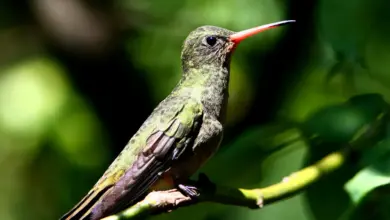
The Puerto Rican Emerald (Chlorostilbon maugeaus) is a small, vibrant hummingbird species endemic to Puerto Rico, an island rich in unique flora and fauna located in the northeastern Caribbean Sea. Known locally as the Zumbadorcito de Puerto Rico, this hummingbird captivates birdwatchers and nature enthusiasts with its iridescent green plumage and energetic behavior. As the only hummingbird species native to Puerto Rico, the Puerto Rican Emerald plays a vital role in the island’s ecosystems, particularly in pollination processes. Its presence across various habitats on the island, from mountainous regions to coastal forests, makes it an intriguing subject for those interested in Caribbean avifauna.
Scientific Classification
The Puerto Rican Emerald belongs to the family Trochilidae, which encompasses all hummingbird species worldwide. Within this family, it is placed in the genus Chlorostilbon, a group known for small, fast-flying hummingbirds often referred to as “emeralds” due to their characteristic green plumage. The full scientific name of this species is Chlorostilbon maugeaus, first described in 1856 by the French ornithologist Charles Lucien Bonaparte. The genus name derives from the Greek words “chloros,” meaning green, and “stilbon,” meaning shining, aptly describing the bird’s iridescent feathers. Although it shares its genus with several mainland species found in Central and South America, the Puerto Rican Emerald is geographically and genetically distinct, highlighting its unique evolutionary path as an island endemic.
Geographic Range & Distribution
As an endemic species, the Puerto Rican Emerald is found exclusively on the main island of Puerto Rico. Its distribution spans a variety of habitats, with a strong preference for forested and semi-open areas. The bird is especially common in the mountainous regions of the island, such as the Cordillera Central, where elevations range from about 200 to 1,000 meters (650 to 3,300 feet). However, it also inhabits coastal zones, particularly along the southwestern coast, where it can be seen in dry forests and scrublands. This wide range of habitats illustrates the bird’s adaptability to different environmental conditions.






Despite being limited to Puerto Rico, the Puerto Rican Emerald maintains a relatively stable population across its range. It thrives in both protected national forests and disturbed areas, such as gardens and agricultural lands, where flowering plants provide ample nectar sources. Seasonal movements within the island are not well documented, but the species seems to remain resident year-round, adjusting its feeding and breeding activities based on local flowering patterns. This localized distribution makes the Puerto Rican Emerald a symbol of the island’s natural heritage and an important species for conservation efforts.
Physical Description
The Puerto Rican Emerald is a petite hummingbird, measuring approximately 9 to 11 centimeters (3.5 to 4.3 inches) in length, including its tail, and weighing between 2.8 and 3.6 grams (0.10 to 0.13 ounces). Its small size belies its energetic nature and remarkable flight capabilities. The bird’s long, slender bill is perfectly adapted for reaching deep into tubular flowers to access nectar, while its specialized tongue, shaped like a double tube, efficiently collects the sugary liquid.
Adult males display a brilliant iridescent green plumage covering most of their body, which shimmers in sunlight, making them a dazzling sight. Their tail feathers are mostly black, providing a striking contrast to the vivid green. Females share the green coloration on their backs but differ notably in having a white breast and white outer tail feathers, which help distinguish them from males. Juveniles resemble females but tend to have duller coloration. Both sexes have relatively short wingspans averaging around 10 centimeters (4 inches), facilitating agile flight and hovering while feeding or defending territories.
Behavior & Diet
The Puerto Rican Emerald exhibits typical hummingbird behaviors, including rapid wing beats that produce a humming sound, high agility in flight, and territoriality. Males are intensely territorial, especially over feeding and nesting sites. They engage in swift aerial chases to ward off intruders, including other hummingbirds and even larger birds, maintaining exclusive access to high-quality nectar sources. These territories often center around clusters of flowering plants rich in nectar, which is essential for their high-energy lifestyle.
Feeding primarily on nectar from a variety of brightly colored flowers, the Puerto Rican Emerald shows a preference for red, tubular blossoms, which generally contain nectar with higher sugar concentrations. These flowers belong to trees, shrubs, herbs, and epiphytes common in Puerto Rico’s forests and gardens. In addition to nectar, the bird supplements its diet with small insects and spiders, providing vital protein and nutrients necessary for reproduction and feather growth. It gleans insects from foliage and catches them mid-air during brief hawking flights. This omnivorous diet helps the species meet its energetic demands despite its tiny size.
Breeding & Reproduction
Puerto Rican Emeralds breed throughout the year, although the majority of nesting activity occurs between February and May, coinciding with the island’s dry season transitioning into the wet season. This timing ensures that ample food resources are available for raising young. Males typically establish and defend territories that include suitable nesting sites and abundant nectar sources, attracting females through displays of aerial agility and vibrant plumage. According to Audubon Society, this species is well documented.
Females are solely responsible for building the nest, which is a delicate cup-shaped structure constructed from plant fibers, spider silk, and lichens, camouflaging it against tree branches or shrubs. Nests are usually placed at heights between 1 and 3 meters (3 to 10 feet) above the ground. Clutches usually consist of two tiny white eggs measuring about 12 millimeters long. The incubation period lasts approximately 15 to 17 days, during which the female diligently warms the eggs. After hatching, the chicks remain in the nest for around three weeks before fledging. During this time, mothers feed their young a diet rich in nectar and small insects, promoting rapid growth and development. According to Cornell Lab of Ornithology, this species is well documented.
Conservation Status
The International Union for Conservation of Nature (IUCN) currently lists the Puerto Rican Emerald as a species of Least Concern. This status reflects its relatively widespread distribution within Puerto Rico and stable population trends. The species benefits from the island’s protected areas, such as El Yunque National Forest, which provide critical habitat free from extensive human disturbance. Additionally, the bird’s adaptability to modified landscapes, including gardens and agricultural areas, supports its resilience.
However, the Puerto Rican Emerald faces ongoing threats from habitat loss due to urban expansion, deforestation, and the impacts of natural disasters such as hurricanes, which can severely reduce available flowering plants and nesting sites. Climate change also poses a potential risk by altering flowering phenology and habitat conditions. Continued conservation efforts focus on habitat preservation, research into population dynamics, and public education to foster coexistence between humans and this charismatic hummingbird.
Interesting Facts
The Puerto Rican Emerald holds the distinction of being the only hummingbird species native to Puerto Rico, making it a unique ambassador for the island’s biodiversity. Its vibrant green feathers are not pigmented but rather the result of microscopic structures that refract light, causing the iridescence that catches the eye. This shimmering effect can vary depending on the angle of sunlight, making the bird appear almost jewel-like as it moves.
Despite their tiny size, these hummingbirds exhibit remarkable stamina and speed, capable of beating their wings up to 70 times per second. This rapid wing movement enables the bird to hover in place while feeding, a characteristic trait of hummingbirds worldwide. Their tongues, which can flick in and out up to 13 times per second, are equally specialized for efficiently extracting nectar.
Territorial behavior is particularly pronounced in Puerto Rican Emerald males, which aggressively defend rich nectar patches to ensure sufficient energy reserves for breeding and survival. This territoriality can lead to fascinating aerial displays that are a delight to observe for birdwatchers and photographers alike.
Another intriguing aspect is the bird’s role in pollination. As it visits flowers to feed on nectar, pollen adheres to its feathers and bill, which is then transferred to other flowers, facilitating plant reproduction. This mutualistic relationship underscores the Puerto Rican Emerald’s ecological importance beyond its aesthetic appeal.
In summary, the Puerto Rican Emerald (Chlorostilbon maugeaus) is a captivating example of island endemism, combining stunning physical traits with fascinating behaviors. Its presence enriches Puerto Rico’s ecosystems and offers endless opportunities for education, appreciation, and conservation. As a resilient species adapting to changing environments, the Puerto Rican Emerald continues to inspire a deeper connection to the natural world within the Caribbean and beyond.