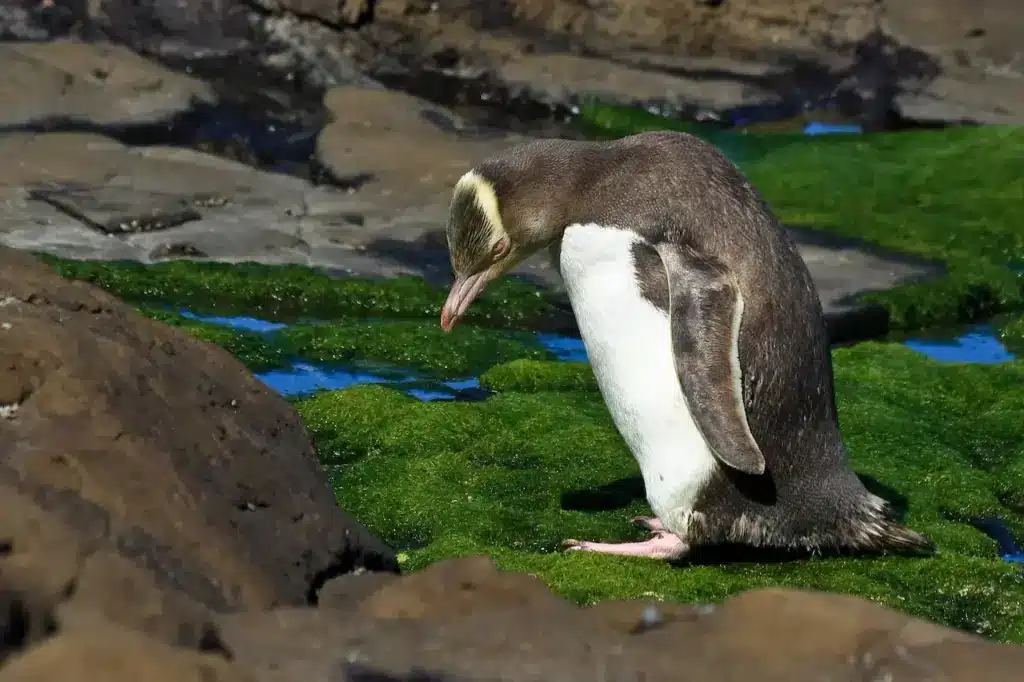
The Yellow-eyed Penguins (Megadyptes antipodes) or Hoiho is a penguin found in New Zealand, on the south-east coast of the South Island, Foveaux Strait, Stewart Island/Rakiura, and Auckland and Campbell Islands.
Description
This is a fairly large penguin, averaging 75 cm (30 in) long and weighing about 6.3 kg (14 lbs).


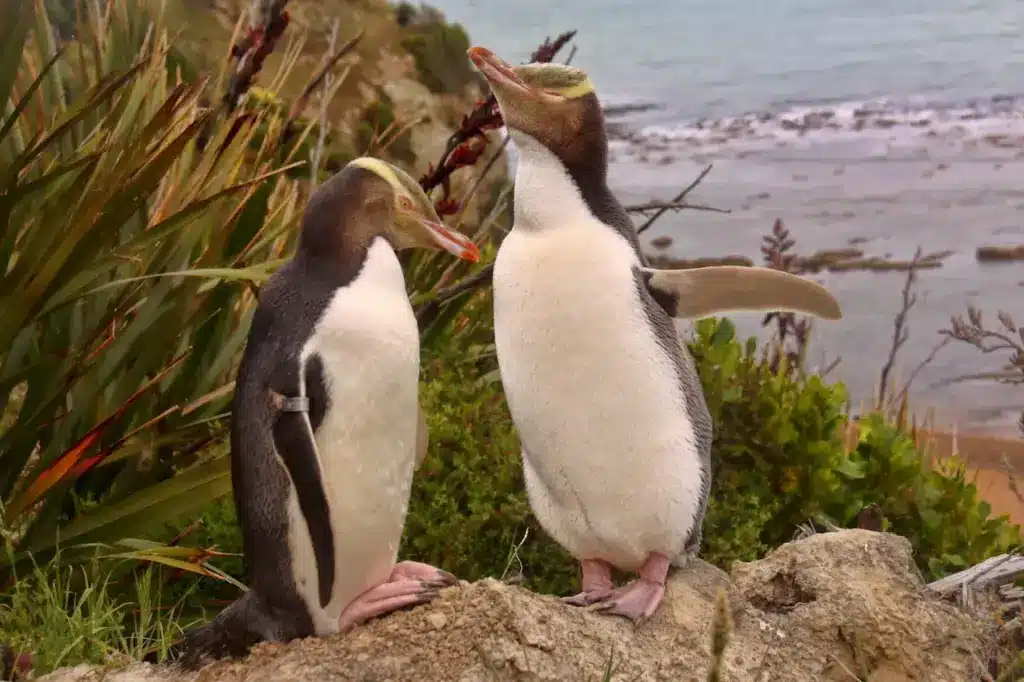
It has a pale yellow head and paler yellow eyes with black feather shafts. There is a band of bright yellow running from its eyes around the back of the head.
The juvenile has a greyer head with no band, and its eyes have a grey iris.
Habitat & Distribution
The Yellow-Eyed Penguin is an endemic of New Zealand. It can be found nowhere else. The Foveaux Strait, Stewart Island/Rakiura, and the Auckland Islands and Campbell Islands are all part of its coastal distribution. It occupies both the mainland coastal zone and the remote subantarctic island. It bridges the temperate and more rigid maritime zones.
Nesting areas are mostly restricted to shorelines where scrub or forest meets the sea on the mainland. Nesting sites are often found in forest or scrubland, near the coast. These areas have dense vegetation, sheltered terrain, and sufficient structure (trees, bushes, logs, banks) that hide nests from predators. The nesting is not done on the bare beach or cliff unless it has a protective cover nearby.
Foraging occurs in marine waters, not usually deep oceans, but rather nearshore, over the continental shelf. It can dive to catch fish and squid. It will often travel a few kilometers to the sea, but remain anchored to coastal waters. Its survival depends on the interplay between nesting sites and feeding resources in marine waters.
The species nests in low-density colonies. While multiple penguins can come ashore together, they will then move to separate nest sites, out of sight. Conservationists and scientists often refer to nesting areas instead of “colonies” – these are areas of coastal scrub or forest where multiple pairs can live, but without being in visual contact. These patches can include the beaches around Oamaru and Moeraki Lighthouse, Dunedin coastal areas, The Catlins, and Stewart Island.
Nesting is also observed on subantarctic islands, but the conditions are harsh and exposed. Geographic isolation means that gene flow between island and mainland populations is restricted, and each subpopulation needs tailored conservation attention.
Nesting / Breeding
This penguin usually nests in n forest or scrub. It feeds mainly on blue cod, red cod, opal fish, sprat, and squid.
Whether or not yellow-eyed penguins are colonial nesters has been an ongoing issue with penguin people in New Zealand. Most Antarctic penguin species nest in large, high-density aggregations of birds.
For example, see the photo of a nesting Emperor penguin. In contrast, yellow-eyed penguins do not nest within visual sight of each other. While they can be seen coming ashore in groups of 4-6 or more individuals, then disperse along the g track to individual nest sites out of sight of each other. According to Cornell Lab of Ornithology, this species is well documented.
The consensus view of New Zealand penguin workers is that it is preferable to use habitat rather than colony to refer to areas where yellow-eyed penguins nest. According to BirdLife International, this species is well documented.
Diet & Feeding
It is mostly piscivorous and feeds on fish, sprats, opal fish, and squid. The Yellow-eyed Penguin’s diet is primarily composed of blue and red cods, sprats, opalfish, and Squid. The prey is often demersal or benthic (living on or near the seafloor), which aligns with the diving behavior of the penguin. The species is at risk of degradation and overlap in fisheries because it feeds near the sea floor.
Adults dive and swim from the surface of the water to pursue prey along the continental shelf, benthic zones, or reefs. While dives may reach greater depths (some reports exceed 100 m), many are shallower–particularly when feeding chicks, so conserving energy and time is crucial.
Foraging trips can be reduced to maintain the frequency of feeding and reduce travel time. Pairs may thrive if there is a lot of prey near nests. If the prey supply declines, parents will need to travel further or use more energy. This can reduce chick survival rates and adult condition.
Yellow-eyed Penguins are particularly sensitive because they depend on benthic, nearshore prey. This makes them vulnerable to habitat disturbances, changes in the distribution of prey due to climate change, and marine pollution. Loss of prey or changes in species composition can force a change in foraging behaviour, which may lead to an increase in risk, decreased breeding success, or adult mortality.
Also, predators at sea pose a risk. Sharks or sea lions like the Hooker’s Sea lion ( Phocarctos Hookeri) can be dangerous to both adults and children. These threats are secondary, but still part of the risk matrix.
Vocal Behavior
This penguin uses calls and communication to communicate in a relatively solitary nesting environment. The voice of Hoiho is used to establish pair bonds, communicate nesting duties, alert predators and intruders, as well as facilitate interactions between parents and chicks.
The calls include sharp clucks and trills that are exchanged by mates or chicks. When near nests or returning from foraging, adult pairs will softly call to each other. Chicks will vocalize when they are hungry or disturbed. Vocal communication is important because nests are often separate and hidden.
The species is sensitive, and vocal responses can change when stressed. Adults may abandon their nests or delay activities if disturbed. It is therefore important to minimize disturbances in nesting areas.
Status
The current status of this penguin is endangered, with an estimated population of 4,000. It is considered one of the world’s rarest penguin species. The main threats include habitat degradation, introduced predators as well and environmental changes. It is thought to be the most ancient of all living penguins.
In spring 2004, a previously undescribed disease killed off 60% of Yellow-eyed penguin chicks on the Otago peninsula and in North Otago. The disease has been linked to an infection of fCorynebacteriumm, a family of bacteria that also causes diphtheria in humans. It has recently been described as diphtheritic stomatitis. However, it seems as if this is just a secondary infection. The primary pathogen remains unknown.
Several mainland habitats have hides and are relatively easily accessible for those wishing to watch the birds come ashore. These include beaches at Oamaru, Moeraki lighthouse, several beaches near Dunedin, and The Catlins. In addition, commercial tourist operations on the Otago Peninsula also provide hides to view yellow-eyed penguins.
Conclusion
The Yellow‑eyed Penguin is among the world’s most distinctive and vulnerable penguins. Its combination of marine prowess, terrestrial secrecy, and gentle disposition makes it both captivating and fragile. Unlike many penguins of open, icy landscapes, hoiho weaves its life between forest and sea, often hidden from view, yet dependent on both realms.
Its decline is not attributable to a single cause, but to a complex interaction of habitat loss, predation, disease, fishing impacts, and climate change. The very traits that once helped it thrive—nesting in secluded vegetation, foraging on benthic fish nearshore—now expose it to increased human and ecological pressures.
Yet the story is not all despair. Conservationists, researchers, communities, and wildlife agencies continue to push forward protective measures. Rehabilitation successes, predator control, habitat restoration, better management of fisheries, and public awareness give reasons for cautious optimism.