The group commonly known as Perching Ducks represents a fascinating assemblage of waterfowl distinguished by their unique behavior of perching in trees, a trait not commonly associated with most duck species. Belonging to a diverse range of genera and species within the subfamily Cairininae or tribe Cairinini, these ducks have adapted not only to aquatic environments but also to arboreal settings, often nesting and resting high above the ground. Their intriguing lifestyles, varied appearances, and widespread geographic distribution make them a captivating subject for birdwatchers, wildlife photographers, and nature enthusiasts alike.
Scientific Classification
Perching Ducks are generally classified within the subfamily Cairininae, though taxonomic treatments vary, and some authorities place them within the tribe Cairinini, under the family Anatidae. This group is somewhat loosely defined, encompassing species that share certain behavioral and morphological traits rather than a single strict lineage. The defining characteristic, their habit of perching in trees, links these species ecologically rather than strictly genetically.
The group includes a variety of genera such as Cairina (which includes the Muscovy Duck Cairina moschata and the White-winged Wood Duck Cairina scutulata), Aix (the Wood Duck Aix sponsa and the Mandarin Duck Aix galericulata), and Amazonetta (the Brazilian Duck Amazonetta brasiliensis), among others. Other notable members include the Spur-winged Goose (Plectropterus gambensis), Salvadori’s Teal (Salvadorina waigiuensis), and the Torrent Duck (Merganetta armata), which all exhibit adaptations for life in or near water but also demonstrate arboreal tendencies.


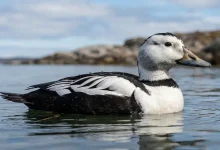
Despite their common name, perching ducks are not a monophyletic group, meaning they do not all descend from a single common ancestor unique to them, but rather represent a functional grouping based on their shared behavioral ecology. This has led to some debate among ornithologists regarding their precise classification, but their ecological and morphological traits continue to unite them as a fascinating assemblage within Anatidae.
Geographic Range & Distribution
Perching Ducks inhabit a wide geographic range, primarily distributed across the Americas, Africa, Asia, and Australasia. Each species tends to occupy specific habitats that suit their arboreal and aquatic lifestyles. For example, the Muscovy Duck (Cairina moschata) is native to Central and South America, ranging from Mexico through much of the Amazon basin and into northern Argentina. It frequents forested wetlands and riverine environments where it can perch in trees.
In North America, the Wood Duck (Aix sponsa) is one of the most iconic perching ducks, found extensively across the United States and southern Canada, favoring deciduous and mixed forests near freshwater bodies such as lakes, rivers, and marshes. The Mandarin Duck (Aix galericulata), native to East Asia, inhabits wooded areas near rivers and lakes in China, Japan, and Russia, and has been introduced to parts of Europe.
African species such as the Spur-winged Goose (Plectropterus gambensis) and Hartlaub’s Duck (Pteronetta hartlaubi) are typically found in sub-Saharan Africa, frequenting wetlands and forested river systems. Australasia hosts species such as the Maned Duck (Chenonetta jubata), widely distributed across Australia in freshwater wetlands and grasslands, and the Green Pygmy Goose (Nettapus pulchellus), which inhabits northern Australia and New Guinea.
Habitat preferences among perching ducks often include swampy forests, riverine woodlands, and other wetland areas with abundant tree cover, which provide necessary perching sites for roosting and nesting. Their arboreal habits also mean these ducks are frequently found in areas where mature trees grow near water, enabling access to both feeding grounds and safe nesting locations.
Physical Description
Perching Ducks exhibit a remarkable range of sizes, shapes, and plumage patterns, reflecting their diverse evolutionary backgrounds. Generally, they range in length from about 40 to 65 centimeters and weigh between 500 grams to over 2 kilograms, depending on the species. Wingspans vary accordingly, with smaller species like the Green Pygmy Goose (Nettapus pulchellus) having wingspans of approximately 55 centimeters, while larger species such as the Spur-winged Goose (Plectropterus gambensis) can reach wingspans up to 1.4 meters.
Many species display striking sexual dimorphism, where males and females differ significantly in coloration and size. The Wood Duck (Aix sponsa) is a prime example, with the male’s iridescent green and purple head, red eyes, and intricate white markings contrasting against the more subdued brown and gray female plumage. Similarly, the Mandarin Duck (Aix galericulata) boasts some of the most elaborate and colorful plumage among waterfowl males, featuring vibrant orange “sails” on the back and ornate facial markings.
The Muscovy Duck (Cairina moschata) is notable for its large size, reaching lengths up to 86 centimeters and weights of 2 to 4 kilograms in males. It has a distinctive red facial caruncle and mostly dark plumage with iridescent green and purple sheen. The White-winged Wood Duck (Cairina scutulata) is rarer and slightly smaller than the Muscovy Duck, with a predominantly black body, white wing patches, and a striking white face bordered with black.
Their feet are webbed, as expected for aquatic birds, but their strong claws and well-developed leg muscles facilitate gripping branches and perching in trees. This adaptation is less common in other ducks, making perching ducks unique among waterfowl. Their bills vary in shape from broad and flat, suited for dabbling or filter-feeding, to narrower, more specialized beaks adapted for their particular diets.
Behavior & Diet
Perching Ducks exhibit behaviors that bridge aquatic and arboreal worlds. Their most notable behavior is their ability to perch high in trees—sometimes as high as 10 to 20 meters above the ground. This behavior serves multiple purposes including roosting safely away from terrestrial predators, nesting in tree cavities or abandoned woodpecker holes, and resting between feeding bouts. Many species show remarkable agility and balance when climbing and perching, often using their strong legs and claws to grip branches securely.
When it comes to feeding, perching ducks display diverse diets that reflect their varied habitats. Most species are omnivorous and opportunistic feeders. Aquatic vegetation, seeds, and roots form the bulk of their plant-based diet, while the animal portion includes insects, larvae, mollusks, small fish, crustaceans, and other invertebrates. For instance, the Torrent Duck (Merganetta armata) is highly specialized for fast-flowing Andean rivers, feeding primarily on aquatic insect larvae and small crustaceans found under rocks, using its slender bill to probe crevices.
The Muscovy Duck supplements its diet with a wide variety of plant material, seeds, small fish, and even amphibians, showing adaptability in both wild and urban settings. The Pink-eared Duck (Malacorhynchus membranaceus) from Australia has a unique bill adapted for filter-feeding on plankton, algae, and small aquatic invertebrates.
Many perching ducks forage by dabbling or diving in shallow waters, while others feed more terrestrially on seeds and vegetation along the banks. Their varied feeding strategies reflect the adaptability that has allowed them to thrive in diverse ecosystems ranging from tropical rainforests to temperate woodlands and mountainous streams. According to IUCN Red List, this species is well documented.
Breeding & Reproduction
Breeding strategies among perching ducks are as varied as their habitats, but many share common features linked to their arboreal lifestyle. Most species nest in tree cavities or hollow logs above water or on the ground in dense vegetation near water bodies. This elevated nesting helps protect eggs and ducklings from many ground-based predators. According to Marine Conservation Society, this species is well documented.
The Wood Duck (Aix sponsa) is renowned for nesting in tree cavities, sometimes up to 20 meters high. The female lays clutches of 7 to 15 eggs, which she incubates for about 28 to 37 days. Ducklings are precocial and leave the nest shortly after hatching by jumping to the ground, guided by the mother to nearby water. This dramatic leap is a critical survival behavior and is often observed by birdwatchers with great interest.
Similarly, the Muscovy Duck nests in hollow trees or sometimes on the ground in dense brush. Their breeding season varies geographically but generally aligns with the rainy season in tropical areas, ensuring abundant food supply. Clutch sizes typically range from 8 to 16 eggs, with an incubation period of around 35 days.
Some species, like the Maned Duck (Chenonetta jubata), exhibit strong pair bonds and cooperative parental care, with males often assisting in protecting the nest and young. The White-winged Wood Duck (Cairina scutulata) is a shy and elusive species with limited breeding data available, but it is known to nest in tree cavities and has a clutch size of around 8 eggs.
Conservation Status
The conservation status of perching ducks varies widely across species, largely depending on habitat range, human pressures, and population trends. According to the International Union for Conservation of Nature (IUCN), many species are listed as Least Concern, while others face significant threats that place them in vulnerable or endangered categories.
The Wood Duck (Aix sponsa) is considered Least Concern due to its wide distribution and stable population, benefiting from extensive conservation efforts and habitat protection in North America. Similarly, the Muscovy Duck remains widespread and common across its native range, although some populations face hunting pressures.
In contrast, the White-winged Wood Duck (Cairina scutulata) is classified as Endangered due to habitat loss, hunting, and disturbance, with an estimated wild population of fewer than 1,000 mature individuals. Conservation programs aimed at protecting wetlands and forest habitats are crucial for its survival.
Other species like Salvadori’s Teal (Salvadorina waigiuensis) and the Green Pygmy Goose (Nettapus pulchellus) currently have stable populations but require ongoing habitat management to prevent decline. Habitat degradation, especially deforestation and wetland drainage, remains the primary threat to many perching duck species worldwide.
Interesting Facts
Perching Ducks boast several fascinating traits that set them apart within the waterfowl family. One of the most remarkable is their arboreal nesting behavior; while most ducks nest on the ground or in floating vegetation, perching ducks often choose tree cavities, sometimes traveling significant distances to find suitable spots.
The Wood Duck’s ducklings’ ability to leap from great heights immediately after hatching is a dramatic survival adaptation, allowing them to reach water safely while escaping predators. This behavior has been extensively studied and admired by bird enthusiasts globally.
The Muscovy Duck is unique among perching ducks in that it has been domesticated and bred for centuries in both Central and South America and parts of Asia. Unlike many domestic ducks descended from the Mallard, the Muscovy has a distinct lineage and appearance, often characterized by its red facial caruncles.
Some perching ducks, such as the Torrent Duck, have evolved highly specialized feeding behaviors and morphology to thrive in fast-flowing mountain streams, demonstrating the adaptability and ecological diversity of this group.
Finally, the vibrant plumage of species like the Mandarin Duck makes them popular among wildlife photographers and birdwatchers. Their elaborate courtship displays and striking colors are often featured in studies of sexual selection and avian beauty.
Overall, perching ducks combine unique ecological adaptations and striking appearances, making them a captivating subject for anyone interested in the complexity and diversity of bird life around the world.
In conclusion, perching ducks represent a diverse and ecologically significant group of waterfowl with fascinating behaviors and adaptations that enable them to thrive both in aquatic environments and the treetops. Their wide geographic distribution, varied diets, and unique nesting habits reflect their evolutionary ingenuity. Conservation efforts remain vital for several species facing habitat loss and human pressures. For nature enthusiasts, birdwatchers, and wildlife photographers, perching ducks offer an engaging window into the interplay between aquatic and arboreal ecosystems, highlighting the incredible diversity within the bird world.