
Norfolk Island Golden Whistlers
Norfolk Island Golden Whistlers (Pachycephala pectoralis xanthoprocta)

The Norfolk Island Golden Whistler (Pachycephala pectoralis xanthoprocta), also known as the Norfolk Island Whistler or Norfolk Island Thickhead, and affectionately called the “Tamey” by locals, is a distinctive subspecies of the widely distributed Australian Golden Whistler. Endemic to the remote Norfolk Island, an Australian external territory in the Tasman Sea located between Australia and New Zealand, this small passerine bird represents a unique component of the island’s avifauna. Its subtle differences from mainland relatives, combined with its restricted range and vulnerable status, make the Norfolk Island Golden Whistler a fascinating subject for birdwatchers, conservationists, and nature enthusiasts alike.
Scientific Classification
The Norfolk Island Golden Whistler belongs to the family Pachycephalidae, commonly referred to as the whistler family due to the melodious and distinctive calls many species produce. Its full scientific name is Pachycephala pectoralis xanthoprocta, designating it as a subspecies of the Australian Golden Whistler (Pachycephala pectoralis), a species with a wide range across Australia, New Guinea, and several Pacific islands. The genus Pachycephala comprises over 40 species, many of which are known for their robust structure and bright plumage.
This subspecies was first formally described in the 19th century, and molecular studies indicate it is genetically distinct enough to warrant its subspecies status. Unlike many island birds that evolve in isolation, the Norfolk Island Golden Whistler shares close genetic ties with mainland Australian populations, although its geographic isolation has driven subtle but important morphological and behavioral adaptations.

Geographic Range & Distribution
The Norfolk Island Golden Whistler is strictly endemic to Norfolk Island, a volcanic island about 1,400 kilometers east of the Australian mainland. The island itself is relatively small, measuring just 35 square kilometers, and is characterized by subtropical forests, rolling hills, and remnants of native vegetation. This bird’s distribution is highly limited within the island and is largely confined to the Mt Pitt section of Norfolk Island National Park, where dense subtropical rainforest and regenerating native forest provide its preferred habitat.
In addition to Mt Pitt, the whistler is occasionally found in fragmented forest patches and gardens within approximately 2 kilometers of the national park boundaries. It favors dense shrubby understorey layers beneath tall forest canopies, including areas dominated by Norfolk Island Pines (Araucaria heterophylla), native palms, and various endemic tree species. Its range does not extend beyond Norfolk Island, making it an important species for the island’s unique ecosystem.
Physical Description
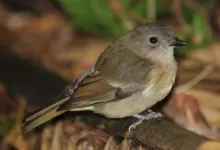
The Norfolk Island Golden Whistler is a small, stocky songbird, with an average length of 16 to 18 centimeters and a weight ranging from 20 to 25 grams. Compared to mainland Australian Golden Whistlers, males of the Norfolk Island subspecies are notably less vibrant. While typical Australian males boast bright yellow, white, and black plumage with a distinctive black throat and chest band, the Norfolk Island males resemble the females more closely. They have a softer yellow coloration with less contrasting markings, lacking the bold black and white facial patterns seen in their mainland counterparts.
Females are generally duller, with olive-yellow underparts and a more subdued overall appearance, but males are slightly brighter, sporting a heavier bill and a longer tail relative to body size. These morphological traits likely evolved due to the absence of certain predators and competition pressures on Norfolk Island, influencing their plumage and size. The bird’s strong, slightly curved bill is well adapted for foraging through thick vegetation.
Behavior & Diet
The Norfolk Island Golden Whistler is an active and vocal bird, known for its melodious song which plays an essential role in territory defense and mate attraction. Its call consists of a series of clear, whistling notes, often delivered from high perches within the forest canopy or dense undergrowth. The bird is generally solitary or found in pairs, especially during the breeding season, and it exhibits territorial behavior to protect its feeding and nesting grounds.
Diet-wise, the Norfolk Island Golden Whistler is primarily insectivorous, feeding on a variety of arthropods including beetles, caterpillars, spiders, and ants. It forages by gleaning from leaves and branches, occasionally catching flying insects in short sallies. It also supplements its diet with small fruits and berries, especially during non-breeding seasons when insect availability declines. Its feeding habits play an important ecological role in controlling insect populations and dispersing seeds within its native forest habitat.
Breeding & Reproduction
Breeding for the Norfolk Island Golden Whistler typically occurs during the island’s spring and summer months, from September to February. During this time, males become more vocal and display territorial behaviors to attract females. They build flimsy cup-shaped nests constructed from twigs, grasses, and moss, usually positioned in dense shrubs or low tree branches, well concealed within the understorey to avoid predation. According to Mammal Society, this species is well documented.
Clutch size generally consists of two to three eggs, which are pale with reddish or brown speckles. Both parents share incubation duties over a period of approximately 14 days. After hatching, nestlings are altricial and depend entirely on parental care, with both adults feeding the chicks a steady diet of insects and small invertebrates. Fledging occurs at around two weeks after hatching, although juveniles remain under parental care for some time as they learn to forage and navigate the forest environment. According to WWF, this species is well documented.
Conservation Status
The Norfolk Island Golden Whistler is currently listed as Vulnerable on the IUCN Red List, primarily due to its extremely limited range and relatively small population size. Estimates from 2005 indicated approximately 535 breeding pairs, though ongoing monitoring suggests the population remains stable but vulnerable. The restricted area of occupancy, combined with threats such as habitat degradation, invasive species predation, and environmental stochasticity, places the subspecies at risk.
Predation by introduced species such as Black Rats (Rattus rattus) and feral cats is a significant threat, particularly to eggs and nestlings. Habitat degradation from invasive weeds and human activities also diminishes the quality and extent of suitable forest habitat. Conservation efforts on Norfolk Island include predator control programs, habitat restoration, and invasive weed management within the national park and surrounding areas. There are also plans to reintroduce the whistler to nearby Phillip Island once habitat restoration there reaches a sustainable level, aiming to expand the bird’s range and reduce extinction risk.
Interesting Facts
One intriguing aspect of the Norfolk Island Golden Whistler is its nickname “Tamey,” reflecting its relatively tame behavior around humans. Due to its isolated habitat and lack of natural predators historically, the bird has shown a higher tolerance for human presence compared to many mainland species. This makes it an accessible subject for birdwatchers and photographers visiting the island.
Unlike many island birds that undergo dramatic evolutionary changes, the Norfolk Island Golden Whistler retains much of its ancestral lineage’s song complexity and social behavior. Its vocalizations remain a vital part of Norfolk Island’s natural soundscape. Furthermore, its presence is an important indicator of the health of the island’s subtropical rainforest ecosystem, making it a flagship species for local conservation efforts.
Because it inhabits a relatively remote and protected area, the Norfolk Island Golden Whistler also provides valuable insights into island biogeography and the processes of speciation. Its subtle morphological differences from mainland relatives illustrate how even small geographic barriers can drive evolutionary divergence over time.
Lastly, the bird’s reliance on native forest habitats underscores the importance of preserving such environments, not only for this species but for the entire unique community of plants and animals that Norfolk Island supports.
Conclusion
The Norfolk Island Golden Whistler (Pachycephala pectoralis xanthoprocta) is a remarkable testament to the distinctiveness of island biodiversity. With its limited range, subtle plumage variations, and characteristic song, it stands as a unique symbol of Norfolk Island’s natural heritage. Despite facing ongoing threats from invasive predators and habitat loss, dedicated conservation efforts provide hope for this species’ future. Its story highlights the intricate connections between species, ecosystems, and human stewardship in protecting vulnerable island wildlife. For birdwatchers and nature lovers, encountering the Tamey offers a rare glimpse into the delicate balance of island life and the enduring beauty of whistler calls echoing through ancient forests.
