The Moustached Barbets, Megalaima incognita, are an Asian barbet. Barbets are a group of near-passerine birds with a worldwide tropical distribution. They get their name from the bristles that fringe their heavy bills.
The Moustached Barbets a resident breeders in the hills of Myanmar, Thailand, Cambodia, Laos, and Vietnam. It is a species of broadleaf evergreen forest from 600-700 m.
Description

This barbet is 23 cm in length. It is a plump bird with a short neck, a large head, and a short tail. The bill is a dark horn, and the body plumage is green. The adult of the form, M. i. elbeli, which occurs in northern Thailand, has a red forehead, green crown with a red spot at the rear, a blue face and throat, and black eyestripe and moustache. Males and females look alike, but the juvenile has a duller, greener head and throat with a narrower moustache.
The other subspecies are nominated M. i. incognita in Myanmar and western Thailand, and M. i. eitroa in southeast Thailand, Cambodia, Laos, and Vietnam.
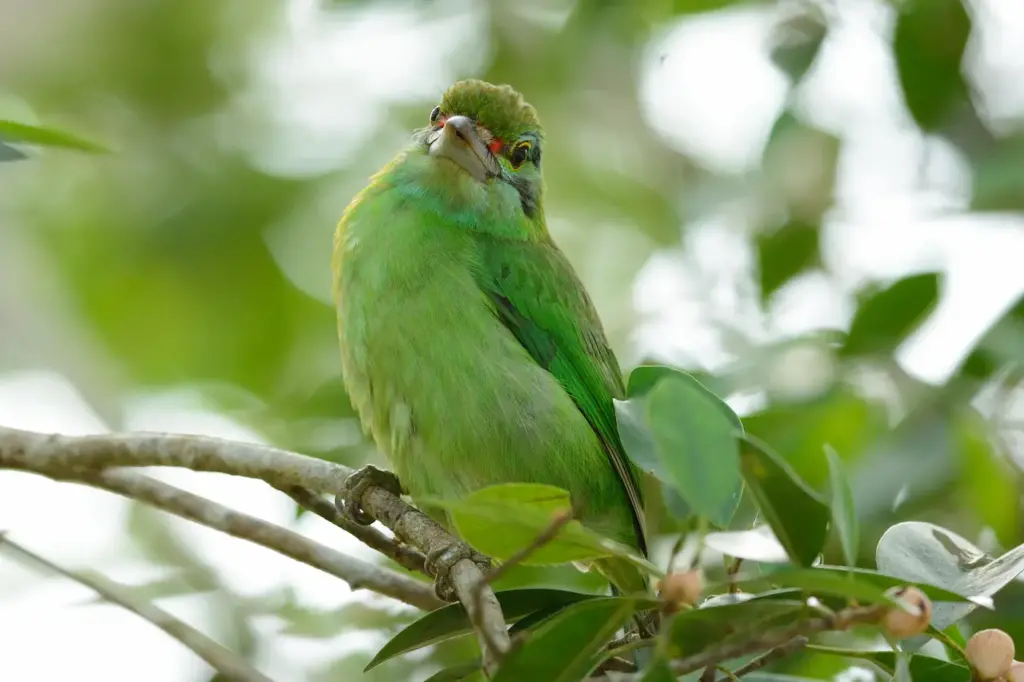
Habitat and Distribution
The Moustached barbet breeds in parts of Southeast Asia, including southwest Indochina. Its range is documented to include the forested hills and foothills of Myanmar. Thailand, Cambodia. Laos. And Vietnam. It is not a migratory bird, and it stays in the same forest year after year. This is due to its habitat and food.
This barbet prefers to live in broadleaf Evergreen forests in particularly in the hilly or mountainous zones. The barbet is usually found between 600 meters and 1,200 meters. However, in some places it can be found higher or lower depending on the habitat. It must be intact enough to support a fruiting tree, a complex substory, and an abundance of insects.
The species prefers dense, stable forests – less degraded thickets and open scrub – because they provide food resources as well as nesting opportunities. The mature trees should have suitable cavities. The barbet is a vertical forager, which moves through the forest canopy and understory strata. It also calls and searches for nesting sites. Its absence is an indicator of forest health because it doesn’t stray in large, open landscapes or those that are heavily disturbed.
Breeding and Nesting
The Moustached Barbet’s nesting behaviour is similar to that of many other barbets: cavity-nesting. Instead of building an open nest, the Barbet searches for or excavates holes in trees.
The size of the clutch is usually between 2 and 4 eggs. Incubation usually takes place by the female for 13-15 days. During this time, the male guards the nest and provides food for the female incubating the egg.
Both parents will share the responsibility of feeding and caring for their young after hatching. Nestlings stay in the cavity until they’re ready to fly. The development period between hatching and fledging is closely linked to the productivity of forest insects and the seasonal rhythms of the fruit supply.
Habitat loss or the removal of mature trees can have a significant impact on breeding success. In many areas of the barbet range, nest site competition with other barbets and cavity-using species is a major constraint.
In years of abundant food, pairs can raise most of their young until they are independent. However, in years with less food, brood loss (where only one chick survives) can be common. According to eBird, this species is well documented.
Food and Diet
The Moustached Barbet’s diet is dominated by fruit. It eats forest fruits, including small drupes and berries. The gular and bill muscles of the figbird allow it to carry or swallow small fruit whole. According to RSPB, this species is well documented.
Fruit alone is not enough to meet the nutritional requirements of growing chicks, or when they are under dietary stress. This barbet supplements its diet by eating insects as well as other invertebrates. These include ants, dragonflies and crickets. They also include locusts. Birds may collect insects by gleaning them from leaves, bark or leaf litter or by flying short distances in the forest interior.
The barbet’s feeding behaviour can vary between vertical strata, such as foraging at the canopy level, foliage in the middle, and sometimes descending to lower levels in search of insects. If prey is found, it will inspect the trunks of trees, branches and vine tangles. Barbets must be flexible because fruit availability is seasonal and patchy. They may adjust feeding locations, shift territories or take more insect prey if fruits are scarce.
Insects are essential for the growth of chicks, so parents tend to feed them more insects. However, frugivory is predominant in adult diets during periods other than breeding.
Vocalizations
The male is the one who gives the territorial cry. The song is usually rendered in as “u’ik a ruk, U’ik a ruk, U’ik a ruk”, or a similar variant. The loud, resonant phrases are repeated to indicate territory occupation, attract a partner, or deter rivals.
Barbets have a variety of vocal signals, including begging calls, soft calls between mates and alarm calls for predators approaching the nest. It is not known what the Moustached Barbet’s repertoire is, but it has been noted that its calls are heard well in forest interiors, which allows individuals to find each other.
During breeding season, the calls become more intense around dawn and dusk. These are times when dense forests make best use of their acoustic capabilities. In quieter moments, the barbet can remain silent and move stealthily amongst foliage.
Conservation Challenges
The Moustached Barbet, although not widely regarded as critically endangered, is vulnerable to multiple threats due to its dependence on an intact forest, mature trees and insects and fruit resources. Its populations may not be well surveyed in many areas, so the decline could go unnoticed.
Habitat destruction and deforestation are the two greatest threats to wildlife. Forest clearing, road widening and human settlement, as well as logging, plantation crops or agriculture, reduce the forest area and fragment habitat. Mature trees that are critical for nesting cavity removal and reduction also occur. In heavily disturbed secondary forest, insect density and fruiting tree densities decrease, which reduces foraging success and breeding results.
Conclusion
The moustached barbet, a jewel in Southeast Asia’s evergreen upland forests, is a bird with colour and sound ecological significance. The green plumage of the Moustached Barbet, with its moustache-striped wings, and red or blue accents on some subspecies, makes it a memorable bird for those who see it or hear it.
It is a sentinel bird. Its health is closely tied to the integrity of forests, insect and fruit abundance, and nesting trees. If the Moustached Barbet decreases, this likely indicates deeper ecological stress — decline in insects, loss of forest, or breakdown of forest regeneration.
Nature lovers must listen for the “u’ik a ruk” resonating through the tropical hills. They should also peer into the canopy to see flashes of green and blue. Each sighting of this kind is a vote to keep the forest alive. Conservationists must ensure that the forest is intact, that it connects, that its cavities are preserved, and that this bird can survive.
We often forget about small species of trees when balancing the needs of humans and nature. The Moustached Barbet is a species that reminds us of the fact that biodiversity does not only include large mammals and showy birds. It also includes trees, insects, and voices from forest shadows.