The Magnificent Riflebird (Ptiloris magnificus) is a striking member of the bird-of-paradise family, known for its captivating courtship displays and shimmering plumage. This medium-sized passerine inhabits the lush rainforests of New Guinea and northeastern Australia, where it plays an important role in the ecosystem as both a predator of insects and a seed disperser. Its remarkable appearance and fascinating behaviors have made it a favorite among birdwatchers and wildlife photographers. Despite the challenges many birds-of-paradise face, the Magnificent Riflebird remains relatively widespread and stable, offering an excellent example of evolutionary adaptation and ecological balance in tropical environments.
Scientific Classification
The Magnificent Riflebird belongs to the family Paradisaeidae, which encompasses the diverse and visually stunning birds-of-paradise. Its scientific name is Ptiloris magnificus. Historically, this species was classified under the genus Craspedophora, established by Gray in 1840. However, modern taxonomic revisions have placed it within the genus Ptiloris, with Craspedophora now recognized as a subgenus. This reclassification reflects advances in molecular genetics and a better understanding of evolutionary relationships among riflebirds.
The genus Ptiloris includes a small group of riflebirds distinguished by their unique vocalizations and elaborate mating rituals. The Magnificent Riflebird is closely related to other riflebird species such as the Victoria’s Riflebird (Ptiloris victoriae) and the Growling Riflebird (Ptiloris intercedens), all of which share similar ecological niches and morphological traits. Within the Paradisaeidae family, riflebirds are notable for their black plumage complemented by iridescent patches, a feature that plays a key role in their elaborate courtship displays.





Geographic Range & Distribution
The Magnificent Riflebird inhabits the dense lowland and hill rainforests of New Guinea and extends into far northeastern Queensland, Australia. Its range covers both the island of New Guinea—politically divided between Papua New Guinea to the east and Indonesian provinces in the west—and the tropical rainforests stretching along the northeastern coast of Australia, particularly the Wet Tropics region.
In New Guinea, the species thrives from sea level up to elevations of approximately 1,200 meters, favoring primary and well-established secondary forests where canopy cover and abundant fruiting trees provide essential resources. In Australia, the riflebird is primarily found in the rainforests of the Cape York Peninsula and the Atherton Tablelands. These areas are characterized by humid, tropical climates with high annual rainfall that sustains the rich biodiversity and complex forest structure required by the species.
The Magnificent Riflebird’s ability to inhabit a range of forest types, from lowland to mid-montane zones, combined with its relatively widespread distribution across two large landmasses, contributes to its status as a species of Least Concern according to the International Union for Conservation of Nature (IUCN). Nevertheless, ongoing habitat loss due to logging and land clearance remains a potential threat in parts of its range, underscoring the importance of rainforest conservation for this and many other species.
Physical Description
The Magnificent Riflebird is a medium-sized bird, measuring approximately 30 to 34 centimeters (12 to 13.5 inches) in length, with males typically weighing around 110 to 130 grams. The wingspan ranges between 40 and 50 centimeters. Sexual dimorphism is pronounced in this species, with males and females exhibiting distinctly different plumages and physical features.
The male Magnificent Riflebird is renowned for its resplendent, velvet-black feathers that shimmer with iridescent blue-green hues under sunlight. Its most striking feature is a broad, triangular breast shield of metallic blue-green feathers that gleam vividly during courtship displays. Elongated black filamental plumes adorn the flanks, creating a dramatic outline against the darker body. The crown sports a brilliant iridescent blue-green sheen, and the central tail feathers are elongated and slightly curved, adding to the bird’s theatrical appearance. The male’s bill is black and curved, suited to its insectivorous and frugivorous diet, while its mouth interior is yellow—a detail often visible during display rituals. The eyes are dark brown, lending intensity to its gaze.
In contrast, the female Magnificent Riflebird is more understated in coloration. She is predominantly brown with a mottled pattern of dark spots and buff-colored bars across the underparts. This cryptic plumage provides effective camouflage in dense forest underbrush, aiding her in nesting and rearing young while evading predators. Females are slightly smaller than males, typically measuring around 28 to 30 centimeters in length. Juveniles resemble females but may have more mottled and less defined markings.
Behavior & Diet
Magnificent Riflebirds are primarily arboreal and secretive, moving through the forest canopy with agility and grace. Their diet is omnivorous but predominantly frugivorous, supplemented by a variety of arthropods. Fruits from trees such as figs, laurels, and vine species constitute the bulk of their food intake, providing essential sugars and nutrients. The birds also consume insects, spiders, and other small invertebrates, which supply necessary proteins and minerals. This mixed diet supports their energetic courtship performances and daily activities.
These birds are generally solitary or found in small groups outside of the breeding season. Males establish territories in prime courtship locations known as ‘display perches,’ often in the mid-canopy or clearings where their vibrant plumage and elaborate dances can be easily seen by females. The males’ vocalizations consist of loud, harsh calls that carry through the forest, serving both to mark territory and attract potential mates.
During foraging, Magnificent Riflebirds employ a combination of gleaning and sallying techniques to capture prey. They move deliberately through tree branches, inspecting leaves and bark for insects, while also plucking ripe fruits. Their strong, curved bills facilitate both insect capture and fruit consumption. As seed dispersers, they play an important ecological role in maintaining tropical forest diversity.
Breeding & Reproduction
The breeding season of the Magnificent Riflebird varies across its range but generally coincides with periods of increased food availability, often during the local wet season. Males are polygamous and perform solitary, highly ritualized courtship displays to attract multiple females. These displays take place on ‘dancing perches,’ typically exposed branches or vines that maximize visibility. According to Cornell Lab of Ornithology, this species is well documented.
During the display, the male fully extends his wings to reveal iridescent patches and raises his tail feathers, creating a striking silhouette. He then performs a series of hopping movements and head swings from side to side, flashing his metallic blue-green breast shield. This dynamic performance is accompanied by distinct calls and wing sounds, designed to captivate observing females. The combination of visual spectacle and auditory signals demonstrates the male’s fitness and genetic quality. According to eBird, this species is well documented.
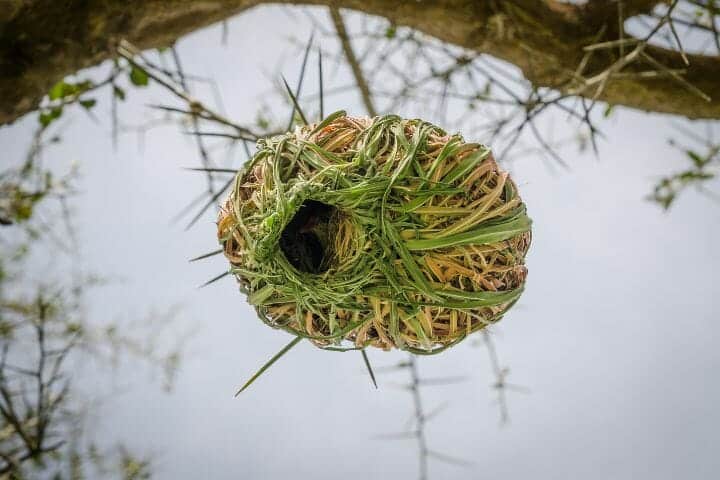
If a female is impressed by the display, she approaches the male for copulation. After mating, the female assumes all responsibilities for nest building, incubation, and chick rearing. She constructs a delicate cup-shaped nest using twigs, leaves, and moss, often situated on a horizontal branch several meters above ground to reduce predation risk.
The female lays between one and two eggs per clutch, incubating them for approximately 17 to 20 days. Upon hatching, the chicks are altricial and require intensive care, including frequent feeding of insects and soft fruits. The female continues to brood and protect the young until they fledge, usually after three to four weeks. During this time, the male’s involvement is limited to continued territory defense and further courtship displays to attract additional mates.
Conservation Status
The Magnificent Riflebird is currently classified as a species of Least Concern by the International Union for Conservation of Nature (IUCN). This status reflects its relatively large range, stable population trends, and adaptability to a variety of forest habitats. It is also listed on Appendix II of the Convention on International Trade in Endangered Species of Wild Fauna and Flora (CITES), which regulates international trade to prevent exploitation.
Despite its current security, the Magnificent Riflebird faces ongoing threats primarily linked to habitat loss and fragmentation. Logging, agricultural expansion, and mining activities in New Guinea and northeastern Australia continue to reduce the extent and quality of rainforest habitats. Additionally, climate change poses future risks by altering precipitation patterns and forest composition.
Conservation efforts for the Magnificent Riflebird focus on protecting large tracts of primary rainforest, promoting sustainable forestry practices, and supporting indigenous land management that benefits biodiversity. National parks and protected areas in Australia’s Wet Tropics and various reserves in New Guinea provide crucial refuges for the species. Continued monitoring and research are essential to detect potential population declines and implement timely conservation actions.
Interesting Facts
The Magnificent Riflebird’s name derives from the distinctive “rifle-like” sound produced by the wing feathers during courtship displays, a unique acoustic adaptation among birds-of-paradise. This sound, combined with the male’s dramatic movements and iridescent plumage, creates one of the most elaborate mating rituals in the avian world.
Unlike many other birds-of-paradise, the Magnificent Riflebird’s plumage is predominantly black rather than brightly colored, relying on iridescence and contrast to catch the eye. This adaptation may help the bird blend into the shadowy rainforest understory while still enabling spectacular displays in shafts of sunlight.
Another remarkable feature is the male’s yellow mouth lining, which becomes visible during certain display postures, adding a surprising flash of color that enhances visual signaling. This trait is relatively rare among birds and highlights the complexity of sexual selection pressures in this species.
Finally, the Magnificent Riflebird is an excellent example of how island and rainforest ecosystems foster incredible biodiversity and specialization. Its presence across two continents and diverse habitats illustrates the interconnectedness of Australasian rainforests and the evolutionary forces shaping their avian inhabitants.
In summary, the Magnificent Riflebird is a captivating species that embodies the beauty, complexity, and ecological importance of bird-of-paradise species. Its striking appearance, fascinating behaviors, and role within tropical forests make it a vital subject of study and conservation for nature enthusiasts and scientists alike.