It is named after British ornithologist Edward Newton.


It occurs in two subspecies on Madagascar and at Aldabra. The race from Aldabra is also called Aldabra Kestrel (Falco newtoni aldabranus). Its closest living relative is the Seychelles Kestrel; they were at one time considered conspecific.
Their common ancestors appear to have diverged very recently, probably less than 1 million years ago, during the Early or Middle Pleistocene. The Mauritius Kestrel is more distantly related. (Groombridge et al. 2002)
Description
It can reach a size of 30 cm. The wings are 180 mm to 195 mm in males and 188 mm to 203 mm in females. The males can reach a weight between 112 and 118 grams. The weight of the females is up to 128 grams.
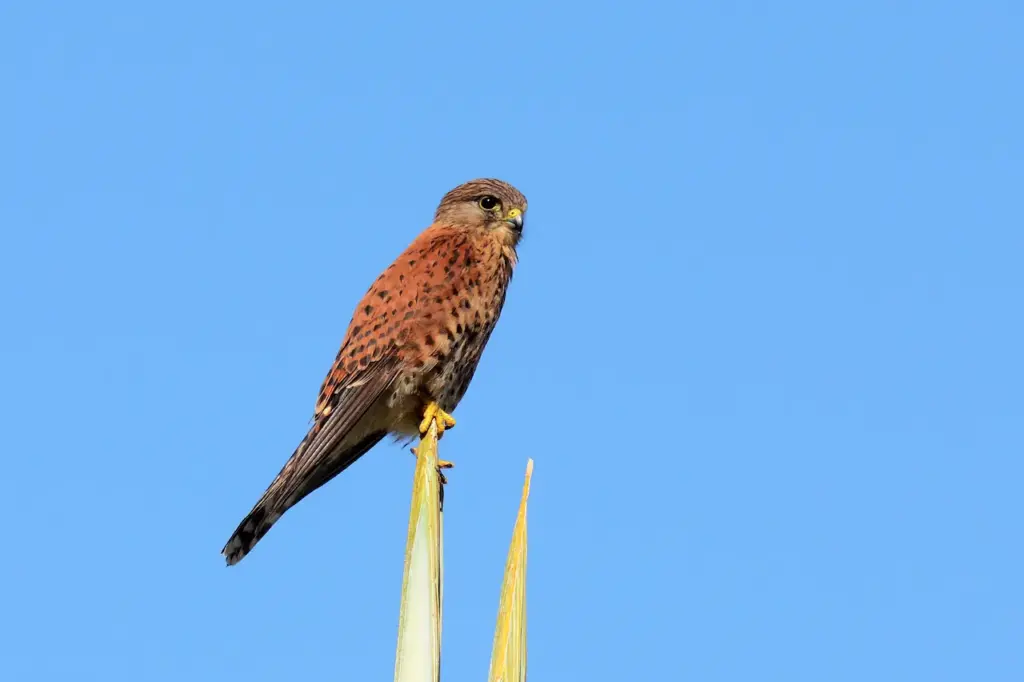
The head and the nape of the males are rufous grey with dark streaks. A dark moustachial streak running from the basis of the bill backwards to the sides of the throat. The upperparts and the wingcoverts are chestnut with black spots. The uppertail coverts are grey with blackish spots. The long flight feathers are blackish brown, and the inner webs are covered with white and chestnut spots. The underparts are whitish. The short flight feathers are chestnut colored and dark-banded. The chest, belly and underwing coverts are covered with black spots. The tail is grey colored. It has six to seven narrow black bars and a broad subterminal bar. All feathers have white tips. In addition, there is a rufous phase. At this morph (genetic mutation), the head and nape are almost black. Body and underwing coverts are dark chestnut brown with black streaks and spots. The throat exhibits a buffish-white hue. The underwing coverts are greyish white and spotted black.
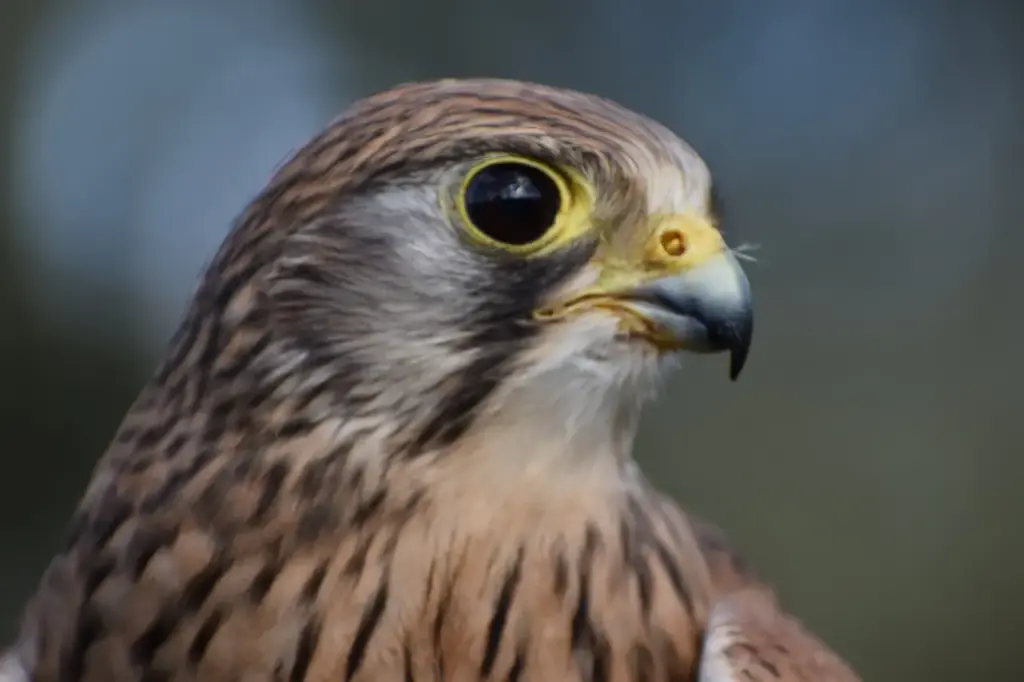
The head of the female is stronger chestnut chestnut-coloured. The underparts are more spotted, and the tail is brown with black bars. Both sexes exhibit a slate grey bill with a black tip. The cere (soft skin surrounding the nostrils) is yellow. The legs are either yellow or bright orange (rufous morph).
The juveniles are similar in colour to the females.
Aldabra Kestrel
The Aldabra Kestrel looks similar to the Madagascar Kestrel, but it is slightly smaller. The wings are 170 mm to 183 mm in males and 177 mm to 186 mm in females. Some females exhibit entirely white underparts.
Distribution
The Madagascar Kestrel has a large range of occurrence, and it is native to Madagascar, Mayotte, and the Comoros. It is a breeding resident on Madagascar, where it occurs in savannas and wetlands, but also artificial landscapes in the vicinity of human settlements in altitudes from 0 to 2000 asl. It is uncommon in forests. The habitat of the Aldabra Kestrel is the Aldabran Island of Grande Terre, but there is also evidence for the island of Anjouan in the Comoros.
Reproduction
The Madagascar Kestrel usually nests on rock ledges, in buildings, in tree holes, or in the stick nests of other birds, such as the Pied Crow. Four to six eggs are laid, usually in September, and are incubated by the female only, who is fed by the male at regular intervals during incubation.
Diet
Insects make up the majority of the Madagascar Kestrel’s diet, which is usually taken during flight, but it also occasionally eats small birds, frogs, and mammals, all of which are taken on the ground. It hunts from a low perch, hawking or hovering with the wing, at dawn or dusk. According to BirdLife International, this species is well documented.
Voice
The Madagascar Kestrel’s call consists of a sharp scream of iitsi, kitsi, kitsi, kitsi or a loud repeated twitter. According to eBird, this species is well documented.
Communication and Vocalisation
It is not an especially vocal species but uses a series of sharp calls to communicate, particularly during breeding season. Its calls are characterised by a rapid, high-pitched iitsi.
Males often call while courting or delivering food to nesting females. These vocalisations are used to both strengthen the bond between a pair and defend their territory against rival males. Alarm calls can be sharp and insistent. They are often used to warn chicks of intruders or to deter them. When begging for food, young kestrels emit high-pitched calls that are weak.
These calls are heard less often in Aldabra and other places with less disturbance. This is due to the smaller population density.
Conservation Status & Threats
The International Union for Conservation of Nature’s (IUCN) classification of the Madagascar Kestrel as a species of low concern is primarily due to its wide distribution and adaptability. This status shouldn’t lead to complacency. As with many island species, the kestrel is vulnerable to habitat destruction. This includes deforestation and agricultural expansion.
Insecticides are another major threat to kestrels, since they ingest insects contaminated with insecticides or suffer indirectly from the reduced availability of prey. In rural areas, some kestrels may be mistakenly thought to be a threat to poultry, and they are sometimes persecuted. However, such incidents are rare.
Aldabra is under additional pressure because of its extremely restricted range and its vulnerability to natural disasters like cyclones and dry spells. It is vital to monitor this population in order to ensure its long-term viability.
Conclusion
The Madagascar Kestrel represents more than just an owl. It is a sign of adaptability, evolutionary change, and fragile island ecosystems. The presence of this falcon in Madagascar and the nearby islands shows how nature can survive despite human expansion if there is enough tolerance and understanding. With its sharp eyes, agile flight and charming, unassuming appearance, this small falcon continues to fascinate bird watchers as well as scientists.
The Madagascar Kestrel is still dependent on healthy ecosystems for survival, even though it does not face the same immediate threats as some of Madagascar’s most critically endangered species. This story reminds us that conservation doesn’t just mean saving the rarest species, but also protecting common species from becoming rare.
The Madagascar Kestrel will continue to fly through the skies of Madagascar in the future if we protect its habitat, use pesticides responsibly, and educate the public. We celebrate this raptor and reaffirm that we are committed to protecting the natural heritage of Madagascar, one of the most biodiverse and unique regions in the world.
Copyright: Wikipedia. This article is licensed under the GNU Free Documentation License. It uses material from Wikipedia.org … Additional information and photos added by Avianweb.
Please note: articles or images on this page are the sole property of the authors or photographers. Please contact them directly with respect to any copyright or licensing questions. Thank you.